

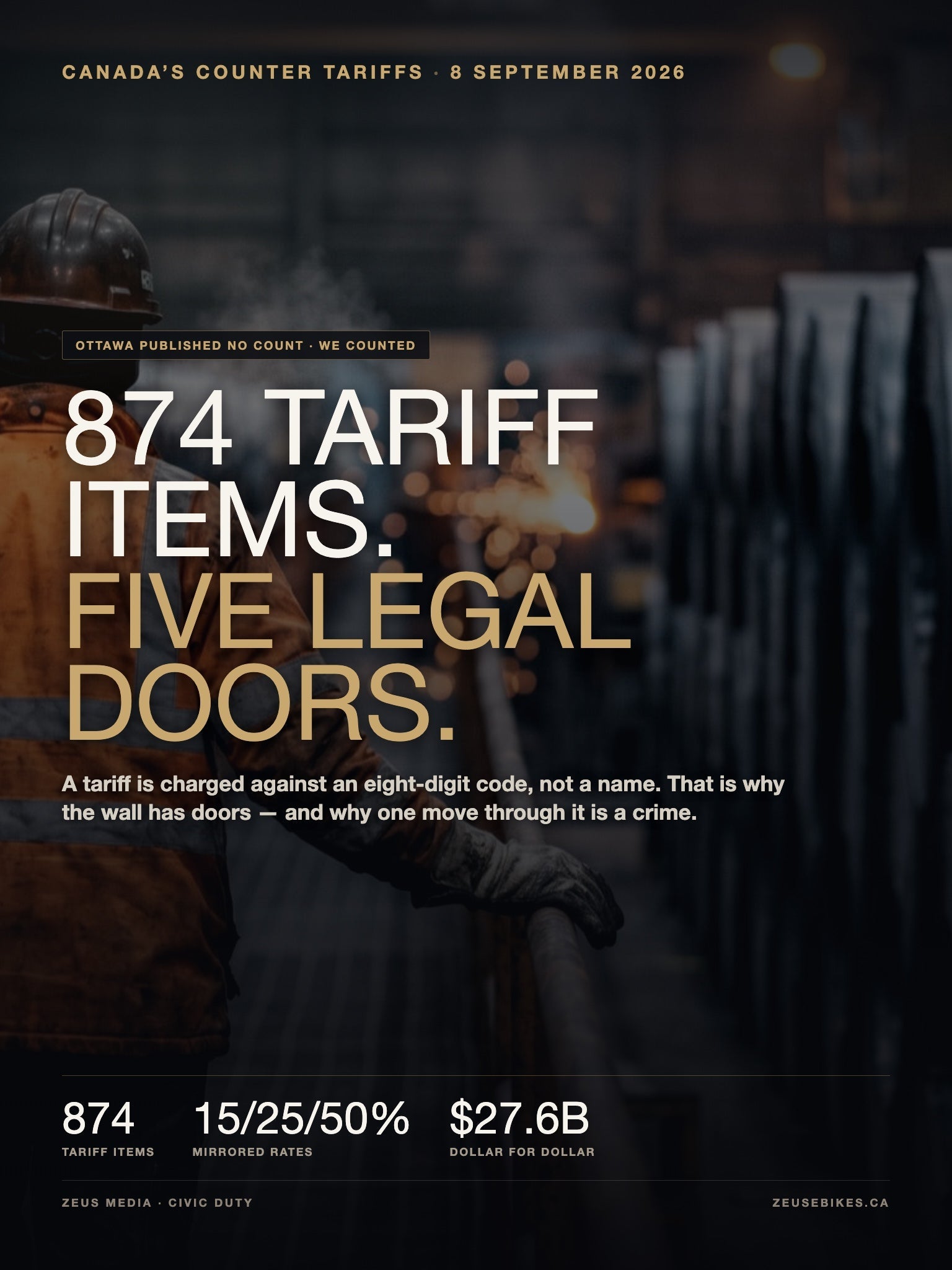
Canada’s Counter Tariffs, 2026: All 874 Items, Every Legal Door — and the One Move That’s a Crime

Every container crossing this dock carries a classification code before it carries a price. A tariff is charged against that code — not against a name, a brand, or a country’s reputation.
Can a Canadian business get around the counter-tariffs? Partly, and legally — but not by renaming anything. Tariffs are charged against a good’s classification under the Harmonized System, not its label, so the legal routes through the wall are the ones written into the instruments themselves: rules of origin, remission, duty drawback, the goods-in-transit exclusion, and advance rulings. Redesigning a product so it genuinely falls in a cheaper class is lawful — the U.S. Supreme Court said so in 1882. Disguising what a product actually is, is customs fraud. Ford paid US$365 million in 2024 to settle US government allegations that it crossed that line — allegations Ford denies, and which no court ever decided. Two dates decide whether any of this helps you. The schedule bites at 12:01 a.m. on 8 September 2026. And the one door that delivers certainty — a written ruling from the Canada Border Services Agency (CBSA) — must be applied for 120 days before the goods arrive. That is too late to be guaranteed an answer for a shipment landing on 8 September. It is not too late for anything you import from January onward, which is the point most people miss. Start with how the tariffs actually affect Canada, then the leverage Canada still holds.
How this piece was built. We read the instruments rather than the coverage. Canada’s counter-tariff schedule was parsed directly from the Department of Finance’s published table with a named, re-runnable script (count_counter_tariff_lines.py), cross-checked against the French-language backgrounder, and verified to contain no duplicate tariff items. The 1882 rule was read in the official U.S. Reports PDF, with majority and dissent separated by position so the quotes are attributed to the right judges. Every door below is quoted from the CBSA memorandum, customs notice or Finance Canada page that creates it, each re-checked live. Where a government document does not say something — a count, a deadline — we say that too, because writing that a document says something it never said is the commonest error in trade coverage. And one measurement we ran for this piece failed its own robustness test; we killed it, and we explain why near the end.
What’s in this guide
- What actually happened: three dates
- Why a tariff wall has doors at all
- The 1882 U.S. rule behind tariff engineering
- The $365-million line
- The doors, one by one
- What has no door
- Speed is the binding constraint
- The instrument is public; the noise is easier
- What to do before 8 September
- Frequently asked questions
What Actually Happened: Three Dates, Not One
Three dates are doing the work of one in much of the coverage: the day the U.S. measure took effect, the day Canada answered, and the day Canada’s answer bites. On 22 August, a 50% American tariff took effect on what Finance Canada puts at $27.6 billion of Canadian goods under Section 338 — the figure U.S. wire copy renders as about US$20 billion, a difference consistent with the exchange rate rather than a dispute about scope. On 25 August, Finance Minister François-Philippe Champagne announced Canada’s answer. And that answer does not bite until 12:01 a.m. on 8 September 2026 — which means you have days, not months.
The instrument itself is public, and it is more specific than the coverage suggested. In the Department of Finance’s own words, Canada will impose “15, 25, and 50 per cent tariffs on products drawn from those targeted by U.S. Section 338 and Section 232 tariffs, with individual product rates based on the matching U.S. rate for the same goods” — a mirror, matched “dollar for dollar” against the same $27.6 billion. That is why a single 50% American action produces a Canadian schedule with three rates: it answers two U.S. programmes at once, matching each good to the American rate on that good. Section 232 lets a U.S. president tariff imports on national-security grounds; it is the tool Washington has used since 2018. Section 338 is stranger: a 1930 provision aimed at countries that “discriminate” against American commerce, effectively unused for ninety years until this round. The schedule is aimed at “steel, dairy, appliances, agricultural equipment, pulp and paper, and electronics” (Department of Finance Canada, 25 August 2026). verified
We counted the table ourselves rather than repeat a figure, and the unit matters more than the number. The backgrounder says what it is counting: products listed “at the tariff item level.” A tariff item is an 8-digit code: the finest cut Canada’s customs schedule makes, fine enough that one item can be a single kind of frozen fish fillet. Count every row that carries one and you get 874, all unique, none unparsed: 21 at 15%, 449 at 25%, 404 at 50%. The French-language backgrounder parses to the same 874. verified
Before anyone cites a number, ours included: The Government of Canada publishes no count at all — not in the news release, the backgrounder, or the consolidated programs page. It quantifies the measure by dollar value and rate only. We checked all three pages, in both official languages. The string “700” does appear once in the backgrounder, inside a product description: “34.8 kW (118,700 BTU per hour).” verified
We swept the coverage — 25 outlets attempted, 20 retrieved with verbatim text, two partial, three blocked to us — and not one of the twenty explained how it counted. Four went further and attributed the number to the government itself. Reuters, in copy carried by the Spokesman-Review, wrote that the tariffs cover “around 700 products… a government statement said”; Al Jazeera, “more than 700 products, the government said in a statement”; Global News, “more than 700 American goods… the federal government said”; Newsweek, “about 700 products, according to a government statement.” reported
We could not find that statement. That is not the same as saying it does not exist. Governments brief reporters in lock-ups (closed rooms where journalists read an embargoed document before it is public) and on background calls, and a figure given verbally there would never appear on a web page. The honest description is that a number four outlets sourced to the Government of Canada does not appear in anything the Government of Canada published, and that no outlet said where it came from. analysis
On the most likely reading, all four did nothing improper: a figure given in a lock-up is a government statement, and attributing it as one is normal practice. What is missing is not integrity on their part but a published number on the government’s. The arithmetic offers one candidate for where it came from. Every country in the Harmonized System shares the first six digits; Canada adds two of its own to cut finer. Chop Canada’s last two off and you are back at the international code. Do that and the 874 Canadian items collapse into 715 — close enough to “more than 700” to be the likely origin. No outlet mentioned subheadings, or the number 715, so that remains our inference rather than a finding. analysis
One more distinction, if you are working from the consolidated list rather than the backgrounder. Both numbers are right; they count different things. from 8 September the total in force is 893 tariff items — the 874 new ones plus 19 motor-vehicle items (HS 8703/8704) carried forward from the April 2025 auto countermeasures, which the release confirms “remain in place.” 874 is the new tranche; 893 is the standing total. verified
Parsed from the Department of Finance’s published schedule, 26 August 2026, with count_counter_tariff_lines.py. Rows that failed to parse: zero.
Two things in that table we did not find reported in the coverage we reviewed. The first is the shape: the single largest chapter is not steel and not dairy — it is fish and seafood, at 254 tariff items — more than either steel chapter on its own, though the two iron-and-steel chapters together (134 + 140) come to 274. The second is a door. Buried in the backgrounder is an exclusion for goods already in transit on 8 September, written into the measure by the people who wrote the measure. verified
The top five chapters account for 629 of the 874 items; the remaining 245 are spread across more than forty chapters. The two iron-and-steel chapters are shown as the government’s own table lists them — separately. Together they total 274.
Takeaway: The schedule is public, it is 874 tariff items long, it mirrors the American rate good-by-good, and it starts at 12:01 a.m. on 8 September. Every number in this section came from counting the government’s own table.
Why a Tariff Wall Has Doors at All
Most coverage skips this, and it is the key to the entire subject: a tariff is not charged against a product’s name. It is charged against a classification — a code in the Harmonized System, the international list that sorts every traded good by what it physically is: its material, its form, its function, sometimes its size or its stitching.
Which answers the question everyone asks first, usually as a joke. If the Americans tariff lumber, can Canada just relabel it lumberoni and walk it through? No. A customs officer does not read the invoice for a name; they classify the goods in front of them. Two-by-fours are Chapter 44 wood whatever the paperwork calls them, and declaring otherwise is not clever — it is a false statement at entry, which is the move in this field that carries the heaviest penalties.
But the same fact opens a door. If duty follows what a good is, then changing what a good actually is — genuinely, physically, at the point of manufacture — changes the duty. This is not a trick. It has a name, tariff engineering, it is used openly, and litigated in the open — the Ford case below is the best-documented example, and it is older than the income tax.
The distinction this whole piece turns on. Building your product so it genuinely falls into a cheaper classification is lawful. Making a product look like something it is not, in order to be taxed as that thing, is fraud. One is design. The other is disguise. Everything below applies that one line.
The 1882 U.S. Rule Behind Modern Tariff Engineering

A banded bundle of two-by-fours going onto the hook. Whatever the invoice calls it, this is Chapter 44 wood — classification follows the object, which is exactly why redesigning the object is lawful and relabelling it never was.
The rule was set in a case about sugar, and the sentence that governs is 144 years old. American importers were bringing in sugar graded for duty by colour against something called the Dutch standard, and the government accused them of deliberately manufacturing it dark so it would fall into a cheaper grade. In Merritt v. Welsh, 104 U.S. 694 (1882), Justice Bradley, writing for the majority, took the accusation head-on:
“Great stress is laid on the charge that sugars are manufactured in dark colors on purpose to evade our duties. Suppose this is true; has not a manufacturer a right to make his goods as he pleases? If they are less marketable, it is his loss; if they are not less marketable, who has a right to complain?”
One caution before going further, because it matters for a Canadian importer: Merritt is American law and it does not bind the Canada Border Services Agency. Canadian classification is set by section 10(1) of the Customs Tariff, which provides that classification “shall… be determined in accordance with the General Rules for the Interpretation of the Harmonized System and the Canadian Rules set out in the schedule.” Those rules classify a good by what it is when it is presented at the border. The result is the same principle arrived at independently — the duty follows the object — which is why a genuinely redesigned product can classify differently in Canada too. verified
That is the founding statement of tariff engineering, and it is the legal answer to the instinct everybody has. You may build your goods to fit the cheaper class. The tax follows the object, and you are allowed to choose what object you make. If a legislature dislikes the result, the Court added, the remedy is for Congress to change the law — not for the customs department to reinterpret it at the border. verified
The same majority also drew the limit. If colouring is “artificially imposed” after the sugar is manufactured, the Court said, “the sugars would then have a different color from that which belonged to them when manufactured. This might be held to be a fraud on the revenue.” Then, notably: “But it is unnecessary to decide this question in this case.” The Court drew the line and expressly declined to rule on the far side of it. verified
The far side is where the modern arguments happen — and where the cost of being accused of standing on it gets set. analysis
Takeaway: Make your goods as you please — that is a right. Alter their appearance after manufacture to change how they are taxed, and you are in the territory the 1882 Court called a possible fraud on the revenue and modern law calls a penalty.
The $365-Million Line
Between 2009 and 2013, Ford shipped Transit Connect vans from Turkey to the United States with rear seats bolted in. The seats came out on arrival. Cargo vans face a 25% U.S. duty — the so-called chicken tax, a 1964 retaliation against European duties on American poultry that has outlived the dispute by sixty years. Passenger vehicles face 2.5%. According to the Justice Department, Ford imported the vans fitted with rear seats, declared them as passenger vehicles, and the seats came out on arrival. Ford denies that the conduct occurred.
On 11 March 2024, Ford agreed to pay the United States US$365 million to resolve allegations that it “violated the Tariff Act of 1930 by misclassifying and understating the value of hundreds of thousands of its Transit Connect vehicles” — the executed settlement covers “approximately 162,833” vehicles in total, a set wider than the sham-seat vans alone. The Justice Department’s account is blunt. Ford presented the vans with “sham rear seats and other temporary features to make the vans appear to be passenger vehicles.” The seats “were never intended to be, and never were, used to carry passengers.” Once each van cleared customs it “was immediately stripped of its rear seats and returned to its original identity as a two-seat cargo van.” reported
Stop and picture the lot. A van clears customs as a passenger vehicle. Somebody with a socket wrench takes out the rear seats. Then the next one. On the government’s account those seats existed for the length of one border crossing and were never sat in by anyone in their manufactured lives. The settlement covers approximately “162,833” vehicles.
And the other half: the fraud allegations were never adjudicated. The Department’s own release closes, “The claims resolved by this settlement are allegations only. There has been no determination of liability.” The settlement agreement records that Ford denies the conduct occurred or violated the statute, and states that the agreement “is not an admission of liability by Ford or the United States.” What the case demonstrates is not that Ford committed fraud — no court found that — but what the American government treats as the line, and what testing it costs. verified
And the record is fuller than the settlement alone suggests,. The classification question was litigated. In 2017 the U.S. Court of International Trade ruled for Ford, holding: “Ford has not ‘disguised’ anything,” and that “the purposeful manufacture or preparation of an article to avoid higher tariffs is not disguise or artifice; rather, that is legitimate tariff engineering” — reasoning the court built on Merritt v. Welsh itself. The Federal Circuit reversed in 2019 on the classification, holding the vans were cargo vehicles dutiable at 25%, and the Supreme Court declined review in 2020. But on the disguise question the Federal Circuit expressly declined to rule: “we need not address the Government’s alternative theory.” No court has ever found that Ford disguised anything. One court found that it did not. verified
Ford’s own public position, on the record: “Ford strongly disagrees with many of the characterizations in the DOJ’s statement and admits no liability in this matter… But in the interest of moving on from this complex, decade-old dispute, we have agreed to settle the matter once and for all.” verified
The arithmetic is public, and it does not read the way the headline number suggests. The settlement agreement splits the $365 million: $183,476,539.62 as restitution for lost duties, the remainder as penalties — roughly one to one, which is below even the two-times-duties ceiling § 1592 sets for simple negligence. U.S. Customs had originally assessed $1.3 billion, a figure Ford disclosed in its own annual report. What the file shows is not a punitive multiple but a heavily negotiated compromise. verified
That design is written into the statute the settlement agreement invokes. Under 19 U.S.C. § 1592, entering goods by means of a materially false statement or omission carries civil penalties on a ladder: fraud is punishable by a penalty “in an amount not to exceed the domestic value of the merchandise” — the whole value of the shipment, not the duty on it; gross negligence up to four times the duties lost; negligence up to twice. You do not have to mean it: a negligent misclassification is penalisable without any fraudulent intent. But the statute draws a line at honest slips. Section 1592(a)(2) provides that “clerical errors or mistakes of fact are not violations… unless they are part of a pattern of negligent conduct,” and that a system repeating an initial clerical error does not by itself make a pattern. A typo is not the exposure. A habit is. verified
And civil penalties are only the first layer. Misdescribing goods at the border is also a federal crime in the United States — and not only when it is deliberate. Section 542’s first branch reaches a false declaration made “without reasonable cause to believe the truth of such statement.” Under 18 U.S.C. § 542, bringing goods in by “any fraudulent or false invoice, declaration, affidavit, letter, paper, or… any false statement” is a crime. The section adds, pointedly, that it applies “whether or not the United States shall or may be deprived of any lawful duties” — you can be charged even if the government lost nothing. The penalty: a fine, or up to two years, or both, for each offence. Section 541 reaches false classification on the same terms, and § 545 reaches smuggling at up to twenty years.
Lumberoni is two years.
That is what lumberoni actually costs, and it is not a door. verified
And none of that is the law a Canadian importer answers to. Canada’s machinery is separate and independent. Under section 153 of the Customs Act, false or deceptive statements — including in an advance-ruling application — are an offence, and deceptive country-of-origin marking is a further offence under section 159.1(b). Section 160 sets the punishment at up to $50,000 and six months on summary conviction, or $500,000 and five years on indictment. Running alongside that is the Administrative Monetary Penalty System, where failing to correct a declaration of origin, classification or value climbs with repetition — and reaches $400,000 per occurrence only at the third and subsequent level, not on a first error. CBSA states plainly that the two tracks are not alternatives: an AMPS penalty “does not preclude the CBSA from prosecuting non-compliant TCPs at the criminal level” (Memorandum D22-1-1). verified
There is also an obligation most importers do not know they carry, and a way back for anyone who has already tripped over it. Under section 32.2(2) of the Customs Act, the subsection headed “Corrections to other declarations”, anyone with reason to believe a declaration of origin, tariff classification or value for duty is incorrect must correct it “within ninety days,” and pay what results. CBSA dates the clock from when you have specific information that the declaration is wrong, and s.32.2(4) ends the obligation four years after the goods were accounted for. And CBSA’s Voluntary Disclosure programme (Memorandum D11-6-4) waives penalties and reduces interest for importers who come forward first, with one caveat stated in the memorandum itself: acceptance of a disclosure “does not preclude criminal prosecution when warranted.” The door for the reader who already got it wrong is the one this kind of article usually forgets. verified
This is journalism. It is not advice. Nothing here is legal or customs advice, and classification is genuinely difficult — it is why licensed customs brokers exist. The safe path when a classification is uncertain is a written ruling from the customs authority before the goods move rather than a guess in your favour. That door is described below. These rules change week to week — verify against the current instrument before acting.
The Doors, One by One

Remission, drawback and in-transit relief all resolve to a stack of invoices and an 8-digit tariff item number. Nobody files them for you.
Five doors. The same governments that built the wall built every one of them, and none is a secret. What they need is paperwork filed correctly and early — which is exactly why the businesses that need them most never file it.
1. Origin — a legal test about where a good was made
Canada’s counter-tariffs do not apply to everything arriving from an American warehouse. They apply to goods “eligible to be marked as a good of the U.S. in accordance with the Determination of Country of Origin for the Purpose of Marking Goods (CUSMA Countries) Regulations” — a legal test about where a product was produced and how substantially it was transformed — never the address on the bill of lading. Two identical-looking pallets on the same truck can carry different duty because one was made in Ohio and the other only passed through it. In our view, getting origin right is the highest-value paperwork in a trade war, and the most often assumed rather than documented. verified
2. Remission — the government’s own escape valve
First, a vocabulary note that will save you an hour. In the legal instruments, Canada’s counter-tariffs are called surtaxes. Same thing, different word — and it is the word the relief programmes are indexed under. Search “counter-tariff remission” and you will find nothing; search “surtax remission” and you will find the order.
Remission is relief from a surtax already imposed, granted by order for defined categories of goods and users. Canada has run one continuously through this trade war: the United States Surtax Remission Order (2025). Its purpose, in its own words, is to relieve surtax on goods “used in Canadian manufacturing, processing and food and beverage packaging,” and on goods supporting health care, public safety and national security.
Read the categories, because they are broader than most businesses assume. Relief covers goods you import to make, process or package something else. Read processing widely: the Customs Tariff says it “includes the adjustment, assembly, or modification of the goods.” If you assemble it, you may qualify. Separate relief covers health care — hospitals, clinics, diagnostic labs, long-term care, and health authorities at every level of government. So does relief for public-safety and national-security bodies, and for scheduled lists of specific codes. verified
Finance Canada takes remission requests on a standing basis. There are only two grounds, and both are narrow. First: you cannot get the input in Canada, or reasonably from any non-American supplier. Second: some other exceptional circumstance that “could have severe adverse impacts on the Canadian economy.” The department sets the bar in its own words — “exceptional and compelling,” and strong enough to outweigh the reason the tariffs exist at all.
Three things about the machinery that businesses routinely misunderstand. It is not a counter transaction: under section 115 of the Customs Tariff, the Minister of Finance recommends remission and it takes effect only by Order in Council. “Only companies registered in Canada are eligible to make requests.” And requests go to a single address — remissions-remises@fin.gc.ca, with “U.S. Remission” in the subject line — supported by the 8-digit tariff items the goods fall under. We found no published filing deadline on that process page; do not assume one exists, and do not assume there is time. verified
The timing point that matters right now. That order relieves surtaxes under the 2025 orders. For the measures starting 8 September 2026, Finance’s backgrounder says only that “additional details on the administration of these tariffs will be available on the Canada Border Services Agency website: Customs Notices.” the most recent notice on that page is 26-21, dated 25 August 2026, and it concerns an unrelated tariff-item description change — CBSA has published no notice for the September measures. Anyone whose inputs are about to be taxed should be watching that page rather than the news. verified
3. Drawback — getting duty back on goods that leave again
If you import goods into Canada, pay duty, and then export them — as-is, or after using them to manufacture something that is exported — you can claim the duty back through the Duty Drawback Program (CBSA Memorandum D7-4-2, PDF). It is not limited to ordinary customs duty: CBSA’s notice on the 2025 US surtax states that “Canada’s Duties Relief and Duty Drawback Programs will be available for surtax paid or payable, subject to the provisions of the Canada–United States–Mexico Agreement (CUSMA)”: the CUSMA analysis in Memorandum D7-4-3 governs how much actually comes back. The refund covers “the customs duties, anti-dumping and countervailing duties, or excise taxes, other than the Goods and Services Tax/Harmonized Sales Tax (GST/HST)” — so GST/HST is not recoverable this way.
Three practical facts the memorandum settles. The claim goes on Form K32, the drawback claim form, filed through CARM — the CBSA’s online portal for importers. It can be filed by “the importer, exporter, processor, owner, or producer” — not only the party that paid. And there is a hard window: “A claim for drawback must be filed within four years of the release date of the imported goods” (five years for spirits used in exported distilled spirits). Four years is long enough that duty paid in this trade war is still claimable well after it ends — which is exactly why it gets forgotten. verified
4. Goods in transit — the door that closes on a specific night

For the trucks already rolling on the night of 8 September, the rule is different — but only if the driver’s paperwork can prove where they were.
The narrowest door and the one with a deadline attached. Canada’s countermeasures “do not apply to U.S. goods that are in transit to Canada on the day on which they come into force” — that is, on 8 September 2026.
What that means operationally has not yet been published for this order, but CBSA’s formulation for the 2025 US surtax order, since repealed but stillCBSA’s most recent worked example, sets out the test and, more importantly, the burden. Customs Notice 25-10 defines “in transit to Canada” as “goods bound for but not yet arrived in Canada, and under the control of a carrier.” The notice is blunt about who must prove it: “Importers must have proof in their possession that such goods were in transit to Canada.” The proof is paper — a bill of lading, a report of entry, cargo-control documents. And “such proof may be requested at any time by a CBSA officer.” Keep the file. pre-positioning a shipment before the date is lawful commercial planning. Claiming transit status for goods that were not in transit is a false statement at entry, caught by the same provisions as any other misdescription. Read that as the likely shape of the September rule rather than the rule itself, because the notice for this order has not been issued. It is also a one-time exclusion rather than an ongoing exemption. verified
5. Advance rulings — the answer in writing, before the goods move
The door with the clearest answer and the longest lead time — the only one that puts certainty in writing before the goods move. One limit: paragraph 43.1(1) reaches tariff classification and origin for free-trade-agreement preference, but whether a good is U.S.-origin for surtax purposes is neither. That question goes through a National Customs Ruling under Memorandum D11-11-1. Under paragraph 43.1(1)(c) of the Customs Act, an importer can ask CBSA for a binding advance ruling on tariff classification — a written determination of how a specific good will be classified, issued before it crosses. Memorandum D11-11-3 sets out when and how to apply, when CBSA may decline, and how to seek review. If your classification is arguable, a ruling is the difference between an answer you can defend and a fine you cannot.
But read the timing before you count on it for September. The Tariff Classification Advance Rulings Regulations say an application must be filed “not less than 120 days before the proposed date of importation of the goods.” CBSA works to the same 120 days as its service standard. File later and the agency “cannot guarantee that the advance ruling will be issued before the date of the importation.” Measured against an announcement on 25 August and an in-force date of 8 September, the last day to file and still be inside CBSA’s 120-day service standard for an 8 September importation was 11 May 2026 — 106 days before Canada announced the measure at all. You can still apply later; CBSA simply “cannot guarantee that the advance ruling will be issued before the date of the importation.” And because the clock runs from the date you import, later shipments have their own, still-open window. It is the right door. It just does not open in time for this round — which is an argument for applying now for the goods you will import next year rather than guessing at this one. verified
The advance-ruling window for an 8 September importation closed on 11 May — 106 days before Canada announced the measure. The rest of the schedule ran in a fortnight.
Takeaway: Origin, remission, drawback, in-transit, advance rulings. Five doors, all published by the governments that built the wall, all requiring documents rather than arguments — and the one with a hard deadline closes at 12:01 a.m. on 8 September.
What Has No Door

Rolled coil, stacked to the roof. No design change makes steel stop being steel — which is why, for the Section 232 commodity walls, the five doors in this article mostly do not apply.
The routes run out, and they run out exactly where the damage is worst. The American Section 232 walls on steel, aluminum and copper apply to goods classified by what they physically are, in their rawest form. No design change makes steel stop being steel. No origin engineering is available either, since a Canadian mill selling Canadian steel has nowhere else for it to have come from. And softwood lumber sits behind a duty fight Canada and the United States have been litigating for forty years. For these, the honest answer is that the routes described above mostly do not apply.
Which leaves two strategies, and neither is clever. One: sell somewhere else. That is a multi-year industrial project, not a form. Two: use the support programmes. There are four — the large-enterprise loan facility, working-capital lines from Export Development Canada and the Business Development Bank of Canada, the Regional Tariff Response Initiative through the regional development agencies, and EI Work-Sharing for employers cutting hours instead of staff. All four are named in the 25 August announcement. None of them arrives on its own. Each is a separate form, and somebody in your company has to fill it in. Announcing money is not the same as paying it: Ottawa announced $25 billion and has approved $825 million. The money is not stuck in Washington. It is stuck in the departments that write the forms and staff the desks that read them.
Takeaway: If your product is raw steel, aluminum, copper or softwood, none of the five doors is built for you. Your two routes are new markets and the support programs — and only one of those can start this month.
Speed Is the Binding Constraint

The distance between money announced and money approved is measured in queues, forms and file numbers.
Ottawa announced roughly $25 billion. About $12.2 billion was actually booked. The $10-billion large-enterprise loan facility has approved $825 million — 8% of that facility, and about one dollar in thirty of what Ottawa announced across all programmes. We traced where each of those three numbers comes from in our guide to how the tariffs affect Canada. The 25 August announcement added a further $7.5 billion on top of that. But the gap between announced and approved is not a legal problem, a constitutional problem or a negotiating problem. Approvals are moving far more slowly than the headline commitments. Why is a separate question — application volumes, eligibility rules and staged funding could each contribute, and we have not established which dominates. verified
Three measures of one response, on three different bases. Only the smallest is money that has reached a decision — roughly 3% of the headline. Bars are proportional.
Which reframes the entire question this article started with. Canada cannot out-manoeuvre a wall built on raw commodities. What it can do — what any country in this position can do — is out-administer the Americans: certify more of its trade as origin-compliant, claw back at the border what it is owed, get the announced money out the door, and make the doors that exist usable by the businesses standing in front of them. It is unglamorous, it generates no headlines, and it is where the money is.
Takeaway: One of the most underappreciated near-term constraints on Canada’s tariff resilience is neither leverage nor law. It is the speed at which paperwork moves — at the border, and in Ottawa. For the commodity sectors in the section above, demand, alternative markets and the sheer physics of redirecting volume bind at least as hard.
The Instrument Is Public. The Noise Is Easier.
None of the above is secret. It is published, in English, on government websites. So why does a country in a trade war spend its attention on personalities?
Because the machine does not perform and the personalities do. On the same day Canada published an 874-item schedule, the President of the United States posted that he was giving “serious consideration” to renaming Lake Ontario “Lake America.” He attached an altered map: the real label crossed out, “Lake America” over it “in a larger, gold-colored font,” an American flag beside it (ABC News; Global News, both 25 August 2026). One of those two events moves $27.6 billion. The other requires a phone. Which is, when you think about it, the same manoeuvre this whole article is about: rename the thing and hope the tax follows the name. It does not work on lumber. It does not work on lakes either.
We tried to measure the imbalance and got it wrong. Using the GDELT news database, we compared global coverage volume for "Lake America" against "counter-tariffs" and found the lake ahead by roughly 1.4 to 1 — then stress-tested it, which we should have done first. That number is wrong and we are withdrawing it. Against "retaliatory tariffs" the gap narrowed to almost nothing; against the broader canada tariffs, tariff coverage ran ahead of the lake by nearly three to one. The finding was an artifact of which words we picked. So we are not making the claim. The most we can honestly say is that a social-media post about a lake name drew serious international coverage on the same day as a $27.6-billion trade measure, which is remarkable enough without a statistic attached to it. analysis
A publication that only applies its standards to other people does not have standards. Our own check cuts against the easy version of this: measured broadly, tariff coverage outran the lake by about three to one. What we can still say is narrower: the instrument is public and boring; the noise is free and constant; and a reader who follows only the noise will never learn that their government wrote a door into paragraph four.
Keep reading the machine. How the tariffs actually affect Canada — every industry, every person, and who can reach the support. Then: the trade-war playbook, on the leverage Canada still holds, and why Canada dropped its retaliatory tariffs the last time.
What To Do Before 8 September
Seven actions before Tuesday 8 September, in the order they are worth doing. Six of them need one person, your tariff items and an email client.
- Pull your 8-digit tariff items and check them against the schedule. Not your product names — your tariff items. The Finance Canada table is searchable, and it is the only list that governs.
- Confirm origin documentation for every U.S.-marked SKU. The measure applies by origin under the CUSMA marking regulations, not by shipping address. If you assumed rather than documented, that is the assumption that will cost you.
- If your inputs are hit, write to remission this week. remissions-remises@fin.gc.ca, subject line “U.S. Remission,” with your 8-digit items and the evidence you cannot source domestically or from a non-U.S. supplier. No deadline is published — which is a reason to file early, not late.
- If you re-export, open a drawback file. Form K32 through CARM. You have four years from the release date, so duty you pay this autumn is still recoverable in 2030 — but only if somebody starts the file.
- For anything crossing the night of 7–8 September, warn your carrier and broker now. Keep the bill of lading, the cargo-control document and the report of entry, somewhere you can produce them months from now — an officer can ask at any time. Pre-positioning a shipment before the date is lawful commercial planning; claiming transit status for goods that were not in transit is a false statement at entry, caught by the same provisions as any other misdescription.
- File an advance-ruling application for next year. The 120-day clock runs from the date of importation, so it cannot cover a shipment arriving in September — but it can cover everything you bring in from January onward, and it is the only instrument that answers in writing before the goods move. One scope note: an advance ruling covers tariff classification, not whether a good is U.S.-origin for surtax purposes — that question goes to a National Customs Ruling under Memorandum D11-11-1.
- If step 1 shows a past declaration was wrong, correct it. Section 32.2(2) of the Customs Act gives you ninety days from having reason to believe a declaration of origin, classification or value is incorrect. CBSA’s voluntary-disclosure programme (Memorandum D11-6-4) waives penalties on a disclosure made before the agency comes looking — though it does not preclude prosecution where that is warranted.
None of this is legal or customs advice. Verify every item against the current instrument — the CBSA notice governing these measures had not been published when this piece went up — and take advice from a licensed customs broker or trade counsel before filing.
Takeaway: Six of these seven you can start today at a desk. The other one — the shipments crossing on the night of the 7th — needs a phone call to your carrier. That is the whole distance between a wall and a door, and it is a distance you cover this week or not at all.
Frequently Asked Questions
Is there a way to get around tariffs legally?
Yes, five — and none involves renaming anything. Duty is charged against a good’s code and origin, not its label. So the lawful routes are the ones written into the rules themselves. Qualify under the rules of origin. Claim remission where the government has granted it. Recover duty through drawback when goods are re-exported. Use the in-transit exclusion the day a measure starts. Or get a binding advance ruling from CBSA before the goods move. What is not lawful is misdescribing what a product is at the border. It is a false statement at entry, and it carries penalties far larger than the duty avoided.
Who pays tariffs — the importer or the exporter?
The importer of record pays. When the United States tariffs Canadian steel, the cheque is written by the American company bringing it in rather than the Canadian mill; when Canada’s counter-tariffs take effect on 8 September, the cheque is written by the Canadian importer bringing in American goods. The cost is then fought over through prices, contracts and margins, which is why tariffs show up in domestic prices on both sides of a trade war. The exporter feels it through lost orders and squeezed prices rather than a customs bill.
What is tariff engineering?
Designing or making a product so that it genuinely falls under a lower-duty code. It is lawful, and the U.S. Supreme Court blessed it in 1882: “has not a manufacturer a right to make his goods as he pleases?” The limit is equally old. The product must actually be the thing you declare. Change the goods and you have engineered; change only the label and you have lied.
What is on Canada’s tariff list right now?
Canada’s counter-tariff schedule takes effect at 12:01 a.m. on 8 September 2026 and covers 874 tariff items of U.S.-origin goods at 15%, 25% or 50%, with each product’s rate mirroring the U.S. rate on the same good. By tariff-item count the largest chapters are fish and seafood (254), articles of iron and steel (140), iron and steel (134), dairy (51) and machinery (50). The authoritative list is the Department of Finance’s published table — read it against the Schedule to Canada’s Customs Tariff, because the rate attaches to the tariff item rather than the plain-language description.
How does a good qualify as U.S.-origin under these measures?
Not by where it shipped from. The measures apply to goods “eligible to be marked as a good of the U.S.” under the CUSMA marking regulations. Origin asks where the thing was made and how much was done to it there — which is why two identical pallets on one truck can carry different duty.
Does the tariff apply to goods already on the way?
No. Canada’s countermeasures “do not apply to U.S. goods that are in transit to Canada on the day on which they come into force.” Finance Canada has confirmed the exclusion itself. Exactly how it will be administered is not published yet — CBSA has issued no notice for these measures. On the wording it used for the 2025 U.S. surtax, expect the test to be carrier control, and expect to prove it with shipping records on demand. Verify against the September notice once CBSA publishes it.
What happens if you get a tariff classification wrong?
Under U.S. law, penalties do not depend on intending fraud. 19 U.S.C. § 1592 sets a ladder. Negligence: up to twice the duty you avoided. Gross negligence: four times. Fraud: the entire domestic value of the merchandise — the whole shipment, not the duty on it. Ford’s 2024 settlement of US$365 million — resolving allegations it denies, with no determination of liability, on duties the agreement puts at $183.5 million — is the practical illustration of the exposure. When classification is genuinely uncertain, the answer is a written advance ruling before the goods move rather than a favourable guess.
You do not have to mean it — but an isolated clerical error is expressly not a violation. Source: 19 U.S.C. § 1592(c).
Can a Canadian business get the tariff money back?
Sometimes, through two different routes. Duty drawback refunds duties — and, per CBSA’s notice on the 2025 U.S. surtax, surtax itself — on imported goods that are later exported, filed on Form K32, the drawback claim form, through CARM, the CBSA’s online importer portal within four years of the goods’ release date; GST/HST is not recoverable this way. Remission is different: it is relief from the tariff itself, granted by Order in Council on the Minister of Finance’s recommendation under section 115 of the Customs Tariff, and only in “exceptional and compelling” circumstances. Only companies registered in Canada may request it, and requests go to remissions-remises@fin.gc.ca.
How long does a CBSA advance ruling take?
Plan on 120 days. The Tariff Classification Advance Ruling Regulations require an application “not less than 120 days before the proposed date of importation,” and CBSA uses 120 days as its service standard; apply later and the agency says it cannot guarantee a ruling before the goods arrive. Read the clock carefully, because it is the most misunderstood rule here: the 120 days runs from the date you import, not from the date a tariff starts. For goods arriving on 8 September, the 120-day guaranteed-service window closed on 11 May 2026 — you can still file, but CBSA will not promise an answer before the goods land. For goods you will import in, say, March 2027, you can file today and be covered. The door is shut for this shipment, not for your business.
Can Canada avoid the tariffs by selling somewhere else?
Eventually, and only partly. For the walls with no doors — steel, aluminum, copper, softwood — no paperwork route makes steel stop being steel, so selling into other markets is the honest long-run answer. But that is a multi-year industrial project involving ports, contracts and customers, not a filing. In the weeks before 8 September the real levers are origin, remission, drawback and timing.
Sources
- Department of Finance Canada, 25 August 2026 — backgrounder and full table: List of products from the United States subject to counter-tariffs effective September 8, 2026. Source of the rate structure, the $27.6-billion figure, the CUSMA marking-regulations origin test, the in-transit exclusion, and the 874-item table parsed for this article.
- Merritt v. Welsh, 104 U.S. 694 (1882) — read in the official United States Reports volume 104 (Library of Congress PDF). Bradley J. for the majority; Matthews J., with Harlan J., dissenting. Quotes in this piece are majority text unless stated.
- 19 U.S.C. § 1592 (Cornell Legal Information Institute) — U.S. customs penalties for entry by fraud, gross negligence or negligence, and the penalty ceilings quoted.
- Coverage sweep of the “700 products” figure, conducted 26 August 2026 and saved as a dated table listing every outlet, its verbatim count sentence, whether it attributed the figure to the government, and its retrieval status: 25 outlets attempted, 20 retrieved with verbatim text, 2 partial (one paywalled, one wire-syndicated), 3 blocked to retrieval (Bloomberg, Politico, National Post — we make no claim about what they published). Attribution quotes above are from Al Jazeera, Global News, Newsweek, and Reuters as syndicated by the Spokesman-Review.
- CBSA Customs Notice 25-19: United States Surtax Remission Order (2025), Ottawa 17 April 2025, updated 3 July 2026 — remission purpose, eligible categories, and the manufacturing/processing/agricultural/packaging relief quoted.
- CBSA Customs Notices index — checked 26 August 2026; most recent notice listed was 26-21 (25 August 2026), with no notice yet published for the 8 September counter-tariffs.
- CBSA Memorandum D7-4-2: Duty Drawback Program — drawback scope, the manufacture-for-export definition, and the GST/HST exclusion.
- CBSA Memorandum D11-11-3: Advance Rulings for Tariff Classification, 21 October 2024 — the advance-ruling program under paragraph 43.1(1)(c) of the Customs Act.
- Department of Finance Canada news release, 25 August 2026 — Canada announces targeted countermeasures and substantive support for workers and businesses in response to U.S. tariffs. Source of the announcement date, the dollar-for-dollar framing, the $7.5-billion support package, and the confirmation that existing auto counter-tariffs remain in place. Contains no product count.
- Customs Tariff, S.C. 1997, c. 36 — s.10(1): classification of imported goods is determined by the General Rules for the Interpretation of the Harmonized System and the Canadian Rules. This, not U.S. case law, is what governs a Canadian import.
- Customs Act, R.S.C. 1985, c. 1 (2nd Supp.) — s.32.2(2) and (4) (the ninety-day duty to correct and its four-year limit); s.153(a) and (a.1) (false or deceptive statements, including in an advance-ruling application); s.159.1(b) (deceptive origin marking); s.160(1) (fifty thousand dollars and six months on summary conviction, five hundred thousand and five years on indictment); s.43.1(1) (advance rulings). Read directly.
- CBSA Memorandum D22-1-1 (Administrative Monetary Penalty System) and Memorandum D11-6-4 (Voluntary Disclosure) — the AMPS penalty ladder and the statement that neither an AMPS penalty nor an accepted disclosure precludes criminal prosecution.
- Ford Motor Co. v. United States, 254 F. Supp. 3d 1297 (Court of International Trade, 2017) — “Ford has not ‘disguised’ anything”; legitimate tariff engineering, reasoning from Merritt v. Welsh. Reversed on classification at Ford Motor Co. v. United States, 926 F.3d 741 (Federal Circuit, 2019), which expressly declined to reach the disguise-or-artifice theory; certiorari denied 2020.
- 18 U.S.C. § 542 (entry by false statement) with §§ 541 and 545 — the criminal counterparts to the civil penalties in § 1592.
- CBSA Customs Notice 25-10 — the in-transit test as CBSA framed it for the United States Surtax Order (2025-1), an order repealed effective 1 September 2025, and confirmation that drawback and duties relief reach surtax. Cited as the equivalent prior order; no notice has yet been issued for the 8 September measures.
- Finance Canada — Process for requesting remission of tariffs that apply on certain goods from the U.S. — the two grounds, the “exceptional and compelling” bar, the section 115 Customs Tariff / Governor in Council mechanism, and the Canada-registration requirement. No filing deadline is stated on the page.
- U.S. Department of Justice, press release 24-275, 11 March 2024, and the executed settlement agreement in the Ford Transit Connect matter — source of the “sham rear seats” allegations, the 2.5% and 25% rates, the ~162,833 vehicles, the “allegations only… no determination of liability” language, and Ford’s denial. justice.gov serves an automated-access challenge to scripted retrieval; the release was read in a browser session and the settlement agreement retrieved separately. Ford Motor Company is invited to respond to anything in this piece.
- Coverage-volume measurements referenced in “Why almost nobody covers this” were run against the GDELT DOC 2.0 API on 26 August 2026 and are not relied on for any quantitative claim in this article — see that section for why the result was withdrawn. The underlying data is retained.
- Federal support figures ($25 billion announced / $12.2 billion booked / $825 million approved) are carried from our own audit in How Do Tariffs Affect Canada?, sourced there to Budget 2025 Chapter 2 and the federal loan facility.
Corrections and replies: milad@zeusebikes.ca. If you find an error in this piece, we will fix it and say that we did.


Share:
Danielle Smith, Trump, and the Trade War: What the Record Shows
Buy Canadian: What Actually Works — We Parsed 1.3 Million US Customs Records