
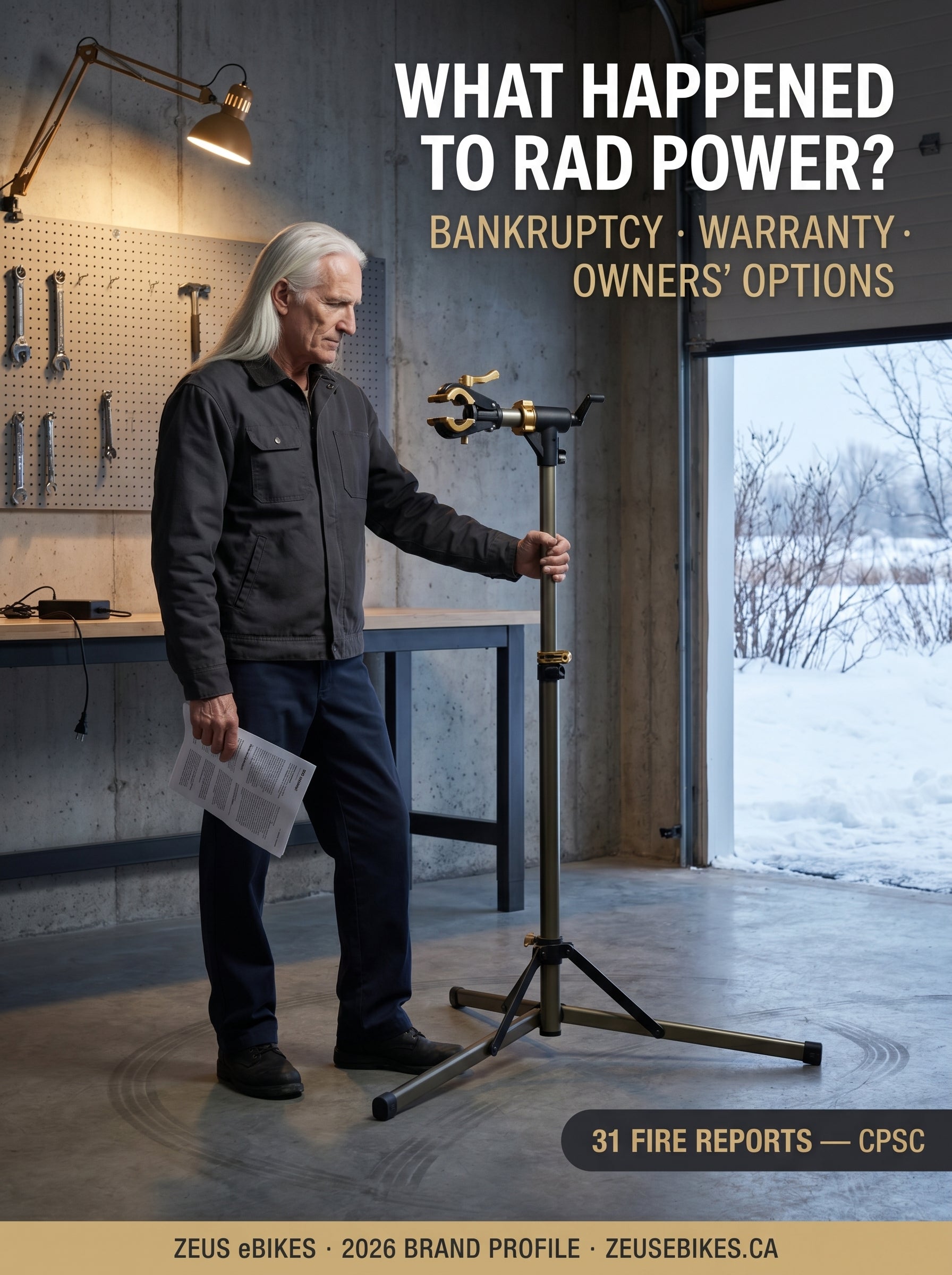
Rad Power Bikes Canada (2026): What Happened, Who Owns It Now, and What Canadian Owners Can Do

We verified every claim in this Rad Power profile against named primary sources before publishing. 📸 Cover by Playcut.ai
Rad Power Bikes was once the most visible eBike brand in Canada — the one that turned the country onto electric bikes, that opened a Vancouver store, that displaced tens of thousands of riders from car trips. Between November 2025 and March 2026, the company filed bankruptcy, was sold for $13.2M, closed its only Canadian retail location, and drew a U.S. government battery fire warning tied to 31 fire reports. This profile covers the verified facts of what happened — sourced to primary documents — and what Canadian owners and buyers actually need to know in 2026.
This page is part of an independent directory of eBike brands sold in Canada. Zeus does not carry Rad Power Bikes. This profile is written as a public-interest record of a major market event, following the same sourced, neutral standard as every other brand in the directory. If you are looking for alternatives to Rad Power Bikes, read our separate guide: best Canadian eBike alternatives to Rad Power.
Every claim here was cross-checked against at least one primary source, and where sources conflicted we deferred to the original document over secondary reporting. The CPSC battery fire warning was read directly on cpsc.gov (the Rad action is a warning, not a recall, because Rad refused the voluntary recall). The Chapter 11 filing details were taken from the bankruptcy docket and contemporaneous trade reporting (GeekWire, TechCrunch, BikeRumor). The warranty, return policy and seller entity were read live on radpowerbikes.ca's own warranty and Terms of Purchase pages. The Health Canada status was confirmed by a direct search of the federal recalls database on June 13, 2026. We deliberately excluded community and forum claims that could not be traced to a named source. Rad Power Bikes, Rad Life Mobility, Life Electric Vehicles Holdings Inc., and any other company or person named in this profile have a standing right of reply: milad@zeusebikes.ca.
Rad Power Bikes is a Seattle-founded, Delaware-incorporated eBike brand whose bikes are contract-manufactured overseas (primarily China and Thailand). Once Canada's most visible eBike brand, it filed Chapter 11 bankruptcy on December 15, 2025, with about $72.8M in liabilities against $32.1M in assets — including an $8.36M U.S. Customs tariff claim listed as disputed. Its assets were acquired out of bankruptcy by Life Electric Vehicles Holdings Inc. (OTC: LFEV), with the deal closing March 5, 2026 for $13.2M cash; Life EV operates the brand through subsidiary Rad Life Mobility. The Vancouver store — its only Canadian walk-in location — permanently closed in January 2026. On safety, a U.S. CPSC battery fire warning issued November 24, 2025 — not a formal recall, because Rad refused one — cites 31 fire reports (including 12 of property damage, ~$734,500 USD), affecting RadWagon 4, RadCity HS 4, RadRover HS 5, RadCity ST 3, RadRover ST 1, RadRunner 2, RadRunner 1, RadRunner Plus and RadExpand 5 (battery models RP-1304, RAD-S1304Y and HL-RP-S1304); the official instruction is to immediately remove and dispose of the affected battery per local hazardous-waste rules. No Health Canada recall has been found as of June 13, 2026. On warranty, Rad stated it cannot support warranty requests for products purchased before December 15, 2025, and the new owner has not published a finalized pre-acquisition policy — so for pre-bankruptcy Canadian owners, warranty support is effectively voided. You can still buy new Rad bikes at radpowerbikes.ca, but there is no Canadian store or confirmed Canadian legal entity behind the purchase. For alternatives, read our Rad Power alternatives guide.
What This Profile Covers
- Who owned Rad Power Bikes and where it came from
- The CPSC battery fire warning: what it covers
- The Chapter 11 bankruptcy and Life EV acquisition
- What it means for Canadian owners
- Warranty status: what you can and can't claim
- Verified timeline of key events
- Frequently asked questions
- The bottom line for Canadian buyers
Who Owned Rad Power Bikes and Where Did It Come From?
Rad Power Bikes was founded by Mike Radenbaugh (with co-founder Ty Collins) and built into the most visible direct-to-consumer eBike brand in North America before its 2025 bankruptcy; in 2026 it is owned by Life Electric Vehicles Holdings Inc. It matters to Canadian riders precisely because it was once genuinely impressive. Radenbaugh built his first eBike as a high-school project — Rad's own about page dates that first build to 2005, though 2007 is the year most widely reported as the company's founding, and neither is registry-confirmed. The brand relaunched as a direct-to-consumer company in 2015, the same year its RadRover Indiegogo campaign raised $320,365 — roughly eight times its goal. This was a real startup by a genuine founder, not a dropship brand with no history. By 2021 it had raised about $330M from named institutional investors — Fidelity, Morgan Stanley, T. Rowe Price, Vulcan and Durable — at a reported peak valuation of $1.65B.
Rad's Canadian footprint centred on a single retail and service store at 275 W 5th Ave in Vancouver, which opened in October 2020 and was the only Canadian walk-in location. It permanently closed in January 2026 during the bankruptcy — a closure we return to below.
Rad's bikes were contract-manufactured overseas across multiple countries — primarily China and Thailand, with sources also citing Vietnam, Cambodia and Taiwan. One confirmed OEM/ODM supplier is Jinhua Jobo Technology Co., Ltd., whose own marketing materials reference building for Rad; it is one supplier among several, not the sole factory. That overseas reliance is connected to the $8.36M U.S. Customs tariff claim that surfaced in the bankruptcy — a figure the filing lists as disputed rather than settled. Under Life EV, the brand has announced plans to assemble in a Fort Lauderdale, Florida facility, but that assembly is announced, not verified as operational as of June 2026. Rad's bikes use 750W nominal hub motors across the lineup — a point that matters for Canadian riders, addressed in the section below.
Rad's North American bikes ship with 750W nominal hub motors. Canada's federal Power-Assisted Bicycle (PAB) framework caps a power-assisted bicycle at 500W nominal with assistance ending at 32 km/h. A 750W bike exceeds that nominal limit, so its PAB classification — and where it can legally be ridden — depends on the bike being set to PAB parameters. Confirm the power setting on any specific model before relying on PAB classification, and see our full breakdown of electric bike laws in Canada.
Rad Power Bikes had a real founding story, real institutional backing, and a real Canadian presence. In our assessment, the slide from a reported $1.65B valuation to a $13.2M bankruptcy sale in under five years reflects a combination of factors visible in the public record — the post-COVID eBike demand slump, a disputed $8.36M customs tariff claim that became the largest unsecured claim in the filing, and a CPSC battery fire warning the company stated it could not afford to remedy. The brand still exists under new ownership — but the company that Canadian riders trusted is not the same company that exists today.
The CPSC Battery Fire Warning: What It Covers and What It Doesn't
On November 24, 2025, the U.S. Consumer Product Safety Commission issued a warning — technically not a recall — against Rad Power Bikes for batteries associated with 31 fire reports, including 12 of property damage totalling approximately $734,500 USD. The distinction between a warning and a recall matters: a recall requires a remedy (repair, replacement, refund). According to the CPSC, the agency issued a warning instead because Rad refused to agree to an acceptable recall, with the CPSC stating the company cited an inability to fund a remedy. In our assessment, a company declining a recall is a rare and serious step — it means the CPSC issued the strongest action available to it without manufacturer cooperation.
The warning names three specific battery model numbers: RP-1304, RAD-S1304Y and HL-RP-S1304. The affected bike models that used these batteries:
- RadWagon 4
- RadCity HS 4 (High Step)
- RadRover High Step 5
- RadCity Step Thru 3
- RadRover Step Thru 1
- RadRunner 2
- RadRunner 1
- RadRunner Plus
- RadExpand 5
The RadTrike is not named in the warning. Rad's newer Safe Shield batteries (UL 2271 certified) are a different, later design and are not the packs at issue — but UL certification on the newer batteries does not extend backward to the older packs the warning covers.
If your Rad Power Bike uses battery model RP-1304, RAD-S1304Y or HL-RP-S1304, the CPSC's official instruction is to immediately remove the battery and dispose of it according to your local hazardous-waste procedures — not merely to stop charging it. Check the battery compartment label for the model number before assuming you are or are not affected. If you cannot confirm your battery model number, treat the directive as applicable until you can.
One further fact that Canadian owners deserve to know: a direct search of the Health Canada recalls database (recalls-rappels.canada.ca) returned no parallel Rad Power Bikes battery recall or alert matching the CPSC action as of June 13, 2026. The absence of a Canadian regulatory action does not mean Canadian owners are not affected — the same batteries crossed the border in the same bikes. Canadian owners of affected models are advised to treat the CPSC directive as applicable regardless.
The CPSC warning covers three specific battery model numbers — check your battery label before assuming you are or are not affected. If your pack matches, the official directive is to remove and dispose of it, not just stop charging. No Health Canada recall has been found as of June 13, 2026, but that regulatory gap does not protect Canadian owners from the underlying fire risk. Treat the directive as applicable until Rad Life Mobility provides a clear Canadian remedy path.
The Bankruptcy and the Life EV Acquisition
Rad Power Bikes Inc. filed Chapter 11 bankruptcy in the U.S. Bankruptcy Court for the Eastern District of Washington on December 15, 2025. The filing disclosed about $32.1M in assets against $72.8M in liabilities — a balance sheet whose single largest unsecured claim was an $8.36M U.S. Customs tariff debt, listed as disputed. The customs claim ties directly back to Rad's overseas manufacturing, and the figure remains contested in the filing rather than a settled, paid amount.
At a bankruptcy auction in January 2026, the winning bidder for Rad's assets was Life Electric Vehicles Holdings Inc. (OTC: LFEV); the backup bidder was Xander Bicycle Corporation (Retrospec) at $13M. The deal closed on March 5, 2026 for $13.2M in cash (about $14.9M including assumed liabilities). Life EV is headquartered in Broward County (Deerfield Beach), Florida, and is — per the company's own corporate profile — incorporated in Nevada; it was formerly known as Second Street Capital Inc. before being renamed in 2022 (one structured filing aggregator instead lists the company as Florida-incorporated, reflecting the predecessor entity). Rad's own acquisition announcement names Rob Provost — founder of the former Prodeco Technologies — as CEO; a public filing source (stockanalysis.com) instead lists Kyle E. Meyer as Chairman/CEO of the LFEV holding company, a discrepancy at the holding-company level worth noting. Life EV also holds an interest in Serial 1 Cycle Company, the eBike brand that spun out of Harley-Davidson, and operates Rad through subsidiary Rad Life Mobility.
Key context for Canadian buyers: Life EV trades on the OTC market — not on the NYSE or Toronto Stock Exchange — and is a micro-cap company with limited public financial disclosure compared to exchange-listed peers. Its model is the consolidation of distressed eBike brands. Whether it has the resources and operational capability to rebuild Rad's Canadian service infrastructure is an open question as of June 2026.
The Rad Power Bikes brand still exists under new ownership — but the company is not the same entity that Canadian riders built relationships with. Life EV / Rad Life Mobility is an OTC micro-cap built on distressed-brand acquisitions. The reported $1.65B company of 2021 became a $13.2M asset sale in 2026. Judge the current company by what it does going forward, not by the legacy brand equity the old company built.
What the Bankruptcy Means for Canadian Owners Right Now
Three things changed for Canadian Rad owners in the December 2025–March 2026 window that matter in practical terms:
1. The Vancouver store is gone. The only Canadian walk-in retail and service location — 275 W 5th Ave, Vancouver BC — permanently closed in January 2026 during the bankruptcy. Canadian Rad owners now have no domestic walk-in service option. Rad's historic Canadian service was delivered largely through the Velofix mobile network, its longstanding North American assembly and service partner, which continues to operate; Rad's own materials credited that partnership with tens of thousands of Rad bikes assembled and serviced across the continent.
2. There is no confirmed Canadian legal entity. The seller named in radpowerbikes.ca's own Terms of Purchase is Rad Power Bikes Inc., a Delaware corporation — a US entity. Trade data shows a Delta, BC distribution/office address, but that is a logistics address, not a registered Canadian legal entity, and the customer-support line on the site is a US toll-free number, not a Canadian phone line. For a Canadian buyer, that means warranty and consumer-protection recourse runs against a US company, which is materially harder to pursue from Canada — one reason our legit eBike store checklist treats a confirmed Canadian legal entity as a baseline trust signal.
3. Post-purchase support is now uncertain. With no Canadian store, no confirmed Canadian entity, and an owner that has not finalized its Canadian warranty stance, the practical support picture for many Canadian owners is unsettled as of June 2026. Owners who need physical service rather than a formal warranty claim may still be best served by an independent Canadian eBike shop comfortable with hub-motor bikes.
Looking for your next eBike after Rad?
We mapped every displaced Rad model to a Canadian-stocked alternative — spec-for-spec, use-case-for-use-case. Zeus ships free across Canada with Canadian warranty support and a real phone line behind every purchase.
Find Your Rad Alternative → Browse Zeus eBikesWarranty Status: What Canadian Owners Can Actually Claim
Rad's published Canadian warranty (radpowerbikes.ca/pages/warranty) is a tiered 2-year limited warranty, not the 1-year term sometimes cited for older models. Its current (2024) version covers, for 2 years, the frame, forks, stem, handlebar, headset, seat post, brakes, lights, bottom bracket, rims, wheel hub and reflectors, together with the core electronics — motor, controller, throttle, wiring harness and LCD display. A separate 1-year warranty applies to the pedals, freewheel, crankset, cassette, derailleur, shifter and saddle. The battery carries a 2-year warranty OR up to 300 recharge cycles (~6,000 miles / ~9,600 km), whichever comes first. Wear items — brake pads, chains, tyres, tubes, paint/decals, bearings and spokes — are excluded, as are water damage, misuse and improper charging. Notably, the current version is transferable, extending coverage to a subsequent owner rather than being limited to the original purchaser.
On its return policy, radpowerbikes.ca's Terms of Purchase set out a 30-day return window: new bikes carry no restocking fee but a $149 return-shipping charge; used bikes returned with under 20 miles on the odometer are subject to a 30% restocking fee; accessories carry a 30% restocking fee plus $10 shipping; and helmets, child seats and spare parts are non-returnable. These are the written terms; whether they are honoured smoothly under the post-bankruptcy owner is a separate, practical question.
The critical caveat sits on top of all of this: as of December 15, 2025 (the bankruptcy filing date), Rad stated it cannot support warranty requests for products purchased before that date. Post-acquisition (Life EV / Rad Life Mobility, from March 5, 2026), no finalized public policy has been published specifying which pre-bankruptcy Canadian warranties the new owner will honour. Reporting around the bankruptcy described customers being directed toward the US bankruptcy-court claims process — cumbersome and expensive for Canadian buyers filing cross-border. Third-party Trustpilot customer ratings reflect the strain: the U.S. site radpowerbikes.com sits in the "Bad" band (around 1.5 out of 5) at the time of writing, while the Canadian site radpowerbikes.ca rates somewhat higher in the "Average" band (around 2.8 out of 5).
For pre-bankruptcy purchase warranties, Canadian owners have three practical paths — none of them simple:
- Contact Rad Life Mobility directly (radpowerbikes.ca) and request the new owner's policy on pre-acquisition Canadian warranty claims. This is the first step and may resolve some cases.
- File a claim through the U.S. bankruptcy court process — tedious and expensive for Canadian buyers, but a documented escalation path for pre-bankruptcy purchases.
- Seek local independent repair — for bikes that need service rather than formal warranty replacement, a local eBike shop comfortable with hub-motor eBikes may be able to address the issue directly, even without Rad-specific parts.
If you bought your Rad before December 15, 2025 and need warranty support: contact Rad Life Mobility first at radpowerbikes.ca to ask about their policy on pre-acquisition claims. If that fails, the US bankruptcy court claim process is the documented fallback — though cross-border claims are complex. For repairs rather than replacements, a Canadian eBike shop with hub-motor experience may be your most practical near-term option.
Rad's published warranty is a tiered 2-year (transferable) policy, and its return policy runs 30 days — but the decisive fact is that Rad itself stated it cannot support warranty requests for products purchased before December 15, 2025, and the new owner has not finalized a pre-acquisition policy. With no Canadian store and no confirmed Canadian legal entity, that leaves pre-bankruptcy owners in a genuinely hard position. Contact the new company directly in writing as a first step, and document everything.
Verified Timeline of Key Events
| Date | Event | Source |
|---|---|---|
| Jan 3, 2025 | A house fire in Andalusia, Alabama killed Keith Stephens and injured the plaintiff. A wrongful-death suit (Shannon Stephens v. New Summit Collective Inc. (f/k/a Rad Power Bikes Inc.), Summit Collective Inc., and The Cycle Joint Inc.) filed April 28, 2026 alleges a Rad e-bike battery ignited during charging and caused the fire. The allegations are unproven; the suit is filed/active with no judgment as of June 13, 2026. | BicycleRetailer; BikeRumor |
| Nov 24, 2025 | CPSC issues battery fire warning (not a recall) — 31 fire reports incl. 12 property-damage, ~$734,500 USD; battery models RP-1304, RAD-S1304Y, HL-RP-S1304. Rad refused an acceptable recall. | cpsc.gov |
| Dec 15, 2025 | Rad Power Bikes Inc. files Chapter 11. ~$72.8M liabilities vs $32.1M assets, including an $8.36M U.S. Customs tariff claim listed as disputed. | U.S. Bankruptcy Court, E.D. Washington; BikeRumor |
| Jan 9, 2026 | Vancouver store (275 W 5th Ave) permanently closed during bankruptcy. Zero Canadian walk-in service remaining. | GeekWire |
| Jan 18, 2026 | Fire at a Rad retail store on Pacific Coast Highway, Huntington Beach, CA (reported Jan 20); Rad described it as contained. | Electrek; GeekWire |
| Mar 5, 2026 | Life EV completes its asset acquisition for $13.2M cash (~$14.9M incl. liabilities); backup bidder Xander/Retrospec at $13M. Brand operated via subsidiary Rad Life Mobility. | TechCrunch; GeekWire |
| Jun 13, 2026 | Health Canada recalls database returns no parallel Rad Power Bikes battery recall or alert matching the November 2025 CPSC action. | recalls-rappels.canada.ca |
Rad Power Bikes' Canadian walk-in presence ended when the Vancouver store closed in January 2026, and pre-bankruptcy warranty support is, by Rad's own statement, no longer available. The brand still sells bikes in Canada under Life EV ownership — and the current lineup (Safe Shield batteries, post-acquisition models) is distinct from the older packs that drew the CPSC fire warning. If you are an existing pre-bankruptcy Canadian Rad owner: identify your battery model number and, if it is RP-1304, RAD-S1304Y or HL-RP-S1304, follow the CPSC directive to remove and dispose of the battery; then contact Rad Life Mobility in writing and document the response. If you are a prospective buyer evaluating the current Rad Life Mobility lineup: evaluate it as the new company it is — not the brand it was — confirm any bike's power setting against Canada's 500W PAB limit, and verify that it uses Safe Shield or newer batteries. For most Canadian buyers who were Rad customers, the practical path forward is a different brand with Canadian warranty support and a domestic service network. Our Rad alternatives guide maps every Rad model to a Canadian-stocked equivalent.
Ready to move on from Rad?
Our alternatives guide maps the RadRover, RadRunner, RadWagon, RadCity, and RadExpand to Canadian-stocked bikes with real Canadian warranty support. Free shipping. A phone line that answers. No cross-border warranty questions.
Find Your Alternative → Legit eBike Store ChecklistFrequently Asked Questions
Are Rad Power Bikes any good?
Historically, Rad Power Bikes built a strong reputation: a real founder (Mike Radenbaugh), about $330M in named institutional backing, and a reported peak valuation of $1.65B in 2021, with popular models like the RadRover and RadRunner. That reputation is now offset by serious recent events — the November 2025 CPSC battery fire warning (31 fire reports), the December 2025 Chapter 11 bankruptcy, and pre-bankruptcy warranties Rad has stated it cannot support. Third-party Trustpilot customer ratings sit low: the U.S. site radpowerbikes.com is in the "Bad" band (around 1.5 out of 5 at the time of writing), while the Canadian site radpowerbikes.ca rates somewhat higher in the "Average" band (around 2.8 out of 5). For Canadian buyers specifically, the loss of the Vancouver store and the absence of a confirmed Canadian legal entity are the most material drawbacks.
Where are Rad Power Bikes made?
Rad Power Bikes is headquartered in Seattle, Washington and incorporated in Delaware, but its bikes are contract-manufactured overseas — primarily China and Thailand, with sources also citing Vietnam, Cambodia and Taiwan. One confirmed OEM/ODM supplier is Jinhua Jobo Technology Co., Ltd. That overseas reliance is connected to the $8.36M U.S. Customs tariff claim — listed as disputed — that became the largest unsecured claim in the bankruptcy. Under Life EV, the brand has announced plans to assemble in Fort Lauderdale, Florida, but that assembly is announced, not verified as operational as of June 2026.
Where can I buy Rad Power Bikes in Canada?
As of 2026, Rad Power Bikes is sold in Canada online only, through radpowerbikes.ca, under new owner Life Electric Vehicles Holdings Inc. (operating as Rad Life Mobility Inc.). There is no longer any Canadian walk-in store — the Vancouver location at 275 W 5th Ave permanently closed in January 2026. The seller named in the site's Terms of Purchase is Rad Power Bikes Inc., a Delaware corporation, so a Canadian purchase is effectively a cross-border transaction with no confirmed Canadian legal entity behind it.
Is Rad Power Bikes still in business in Canada?
Rad Power Bikes still sells bikes in Canada through radpowerbikes.ca under its new owner, Life Electric Vehicles Holdings Inc. (LFEV), operating as Rad Life Mobility Inc. However, the only Canadian retail location — the Vancouver store — permanently closed in January 2026 following the December 2025 bankruptcy. Canadian customers now deal with the post-acquisition entity with no walk-in service option in Canada.
Is my Rad Power Bikes warranty still valid in Canada?
For bikes purchased before December 15, 2025 (the bankruptcy filing date), Rad stated it cannot support pre-bankruptcy warranty requests. Rad Life Mobility (the new owner as of March 5, 2026) has not published a clear public policy for pre-acquisition Canadian warranties. Contact Rad Life Mobility directly as a first step. If unresolved, the U.S. bankruptcy court claim process is the documented fallback — cumbersome but available for Canadian buyers.
Which Rad Power Bikes models are affected by the CPSC fire warning?
The CPSC warning (November 24, 2025) covers battery models RP-1304, RAD-S1304Y and HL-RP-S1304, used in: RadWagon 4, RadCity HS 4, RadRover High Step 5, RadCity Step Thru 3, RadRover Step Thru 1, RadRunner 2, RadRunner 1, RadRunner Plus, and RadExpand 5. The RadTrike is not named in the warning, and Rad's newer Safe Shield batteries are a later design that is not the packs at issue. Check the battery label on your specific bike to confirm your battery model number.
Did Health Canada issue a warning about Rad Power Bikes?
No parallel Canadian action has been found. A direct search of the Health Canada recalls database (recalls-rappels.canada.ca) returned no Rad Power Bikes battery recall or alert matching the November 2025 CPSC action as of June 13, 2026, despite the wide distribution of affected Rad bikes across Canada. Canadian owners of affected models should treat the CPSC directive as applicable regardless of the absence of a Canadian parallel action.
Who owns Rad Power Bikes now?
Life Electric Vehicles Holdings Inc. (OTC: LFEV) — a Florida-headquartered micro-cap company (incorporated in Nevada per the company's own corporate profile) formerly known as Second Street Capital Inc. The acquisition closed March 5, 2026 at $13.2M. The operating entity is now Rad Life Mobility Inc. Life EV also owns Serial 1 Cycle Company (formerly Harley-Davidson's eBike brand).
What should I do if I own a Rad Power Bikes battery fire warning model?
Step 1: Identify your battery model number from the label on the battery. Step 2: If it is RP-1304, RAD-S1304Y or HL-RP-S1304, follow the CPSC directive to immediately remove the battery and dispose of it according to your local hazardous-waste procedures — not merely stop charging it. Step 3: Contact Rad Life Mobility (radpowerbikes.ca) in writing to ask about the current remedy status under the new owner. Step 4: Document every communication. If a pre-bankruptcy warranty claim goes unresolved, the U.S. bankruptcy-court claims process is a documented escalation path, though it is cumbersome for Canadian owners.
The Bottom Line for Canadian Buyers
If you own an affected Rad model: identify your battery model number now — RP-1304, RAD-S1304Y and HL-RP-S1304 are the ones named in the CPSC warning. The official CPSC directive is to immediately remove the battery and dispose of it per local hazardous-waste rules, not merely to stop charging it. Then contact Rad Life Mobility in writing. No Health Canada recall has been found as of June 13, 2026, but that absence is not a safety clearance. If you are a prospective buyer: Rad Life Mobility continues to sell into Canada, and the current post-acquisition lineup with Safe Shield batteries is a different product from the older packs that drew the fire warning — evaluate it as the new company it is, and confirm any model's power setting against Canada's 500W PAB limit. For most displaced Canadian Rad customers, the practical path is a different brand with established Canadian warranty infrastructure and a domestic service network — read our complete Rad alternatives guide, compare options in our roundup of the best electric bikes in Canada, or use our legit eBike store checklist to vet any brand before buying. If budget is the constraint, our guide on how to finance an eBike in Canada covers the monthly-payment math.
Related Zeus Guides
Rad Alternatives
Laws & Safety
Cost & Financing
This Rad Power Bikes profile is part of the Canadian eBike Brands & Shops directory — verified brand profiles and city-by-city shop listings, launching soon.
This profile was researched and written by the Zeus eBikes Canada editorial team as part of an independent directory of eBike brands sold in Canada. Zeus does not sell Rad Power Bikes and has no commercial relationship with Rad Life Mobility Inc. or Life Electric Vehicles Holdings Inc. Last verified: June 14, 2026.
Sources: U.S. CPSC, "CPSC Warns Consumers to Immediately Stop Using Batteries for E-Bikes from Rad Power Bikes Due to Fire Hazard" (November 24, 2025, cpsc.gov); In re: Rad Power Bikes Inc., Chapter 11 petition (U.S. Bankruptcy Court, Eastern District of Washington, December 15, 2025) and contemporaneous reporting (GeekWire, TechCrunch, BikeRumor, BicycleRetailer); radpowerbikes.ca warranty and Terms of Purchase pages; Health Canada recalls database (recalls-rappels.canada.ca, searched June 13, 2026); Shannon Stephens v. New Summit Collective Inc. (f/k/a Rad Power Bikes Inc.), Summit Collective Inc., and The Cycle Joint Inc. — wrongful-death complaint (U.S. District Court, Middle District of Alabama, filed April 28, 2026, allegations unproven) per BicycleRetailer and BikeRumor; Huntington Beach store fire (January 18, 2026, reported January 20) per Electrek and GeekWire; Trustpilot customer-rating bands for radpowerbikes.com and radpowerbikes.ca (trustpilot.com, accessed June 2026); Vancouver store closure (GeekWire); Velofix service-partner history (velofix.com, press.radpowerbikes.com); OTC market data for LFEV (otcmarkets.com, stockanalysis.com).
📸 All photography by Playcut.ai — personalised AI actor technology

Share:
Emmo eBikes Canada (2026): Review, Warranty & Verdict
Biktrix eBikes Canada (2026): Verified Brand Profile