

Canada’s Social Media Bill Never Says “Algorithm.” I Checked All 92 Pages.

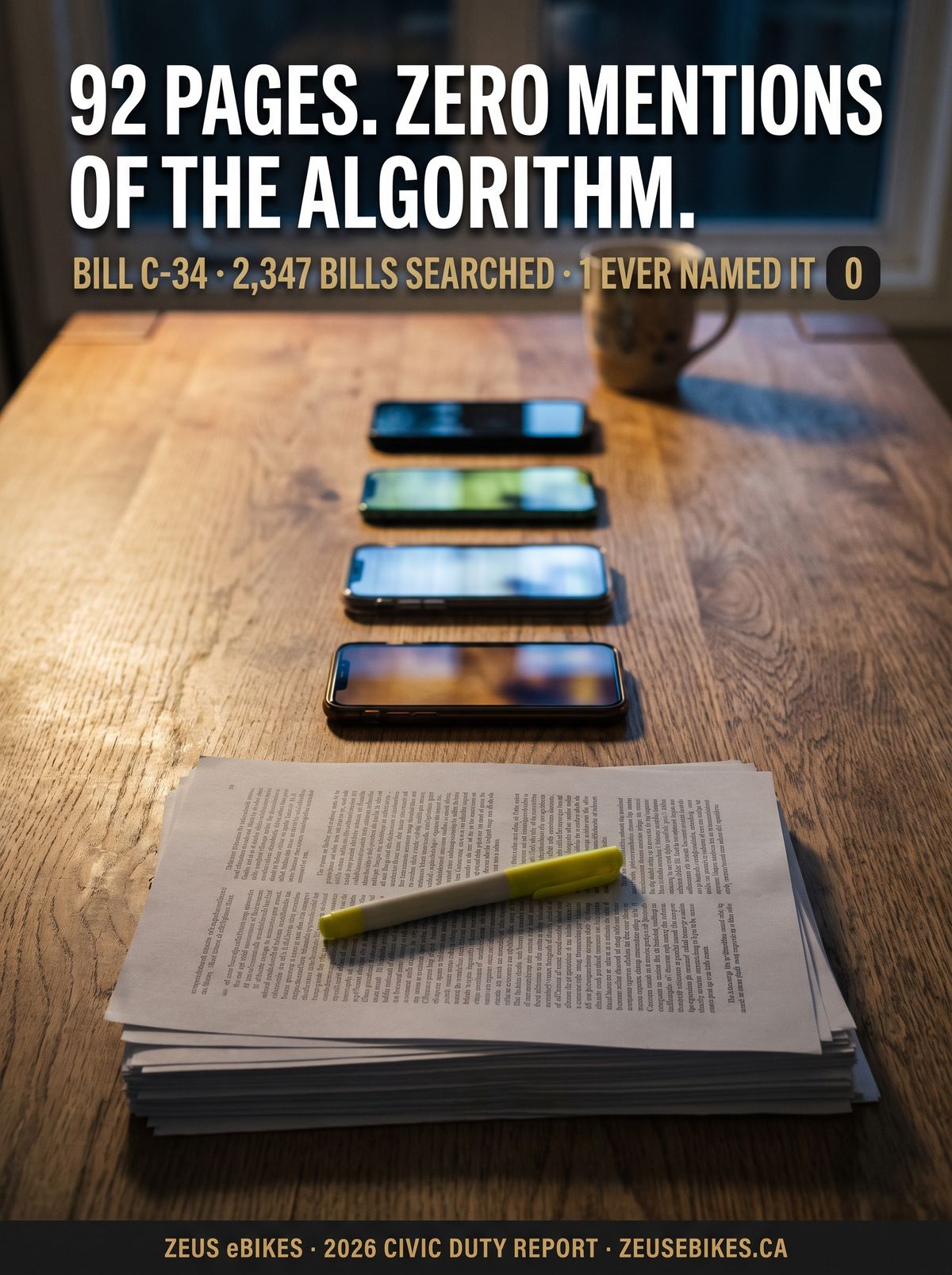
The bill on the left, the feeds on the right. Ninety-two pages of it, and the word that describes what the phones were doing appears nowhere in the text.
Canada has a social media bill in Parliament right now. It runs to 92 pages. It uses the word algorithm zero times — along with recommender, ranking, feed, personalise and amplification. I downloaded the bill from Parliament’s own server and searched it myself, and before believing any absence I checked that the search could find things that are certainly in there. That finding is the spine of this article, and anyone with a PDF reader can reproduce it in five minutes.
Here is what sent me looking. On a Sunday in August 2026 I signed into four Facebook accounts I keep for testing, one after another, in about twenty minutes. The first was a wall of content designed to make Canadians hate Muslims. The second was hostility to the Prime Minister mixed with posts arguing Canada should become the fifty-first state. The third was hatred aimed at Jewish Canadians. The fourth was church burnings.
I want to be precise about what that afternoon is and is not, because it is the weakest evidence in this article and it is mine. It is a dated observation on accounts I control. It is not an experiment: no control account, no logging, no randomisation, nothing preserved for anyone else to examine. It is the reason I started, not a reason for you to conclude anything. Everything load-bearing below is somebody’s published measurement or a document you can open yourself.
So this article does two things in order. It establishes what Canadian law actually says about the machine that decides which Canadian sees what — which is, on the evidence, nothing. Then it goes to the measured data on what Canadians are in fact being shown, because four feeds cannot carry that weight and I am not going to pretend otherwise.
What this piece is. Not a claim that the country is falling apart — the data below says it is not. It is an accounting of which Canadian law reaches the machine that decides what each of us is shown, built from three datasets I made myself because nobody had published them.
How this was researched. Three original datasets, all reproducible, all saved.
One. I downloaded the first-reading text of Bill C-34 from Parliament’s own server (92 pages, 53,691 words, English and French in parallel) and searched it myself rather than trusting a summary. Before believing any absence, I validated the search against terms that must be present: harmful content returned 54 hits, chatbot 50, Digital Safety Commission 37. Only then did I run the terms in question.
Two. I pulled every bill from LEGISinfo’s public JSON for seven parliamentary sessions — 2,347 bills between 2011 and today — and filtered the titles against thirty platform and online-harms terms, then re-verified each shortlisted bill against its own parliamentary record. The script stops with an error if a request fails, so a network problem can never be silently recorded as “no bills found.”
Three. I rebuilt Canada’s police-reported hate crime series from two Statistics Canada tables, with a check that the provinces and the Canadian Forces Military Police add up to the national total in every year. That check caught a revision and a double-counting trap, both disclosed below.
Where a claim rests on somebody else’s measurement, it is named and linked. Where I could not determine something, the piece says so instead of rounding it into a conclusion. Research files, scripts and the full source list are available on request: milad@zeusebikes.ca.
Two disclosures this piece owes you
Our conflict of interest. Zeus eBikes runs a Facebook page and posts every article we publish to it, including this one. We depend on Meta for a share of our own distribution while criticising Meta in these paragraphs, and you should weigh the argument knowing that. We have never paid for advertising on any platform named here, and this page carries no products, no affiliate links and nothing for sale.
Right of reply. We did not put these findings to Meta, TikTok or the Department of Canadian Identity and Culture before publishing, because every claim rests on a document those parties published themselves or on a third party’s measurement, not on private information. That is a real limitation and it is stated rather than hidden. Any of them, or anyone else named here, can have a correction or a response published here: milad@zeusebikes.ca.
Quick answer. Canada’s proposed social media law is Bill C-34, the Safe Social Media Act, introduced 10 June 2026. As of 31 August 2026 it is at second reading and is not law. It creates a Digital Safety Commission, defines seven categories of harmful content, requires 24-hour takedown of child sexual abuse material and non-consensual intimate images, blocks under-16s from designated services, regulates AI chatbots, and carries penalties up to 5% of global revenue. What it does not do is regulate recommender systems. The words algorithm, recommender, ranking, feed, personalise and amplification appear in its 92 pages a combined zero times — and zero times in Bill C-63 before it. Across 2,347 federal bills since 2011, exactly one — the Online Algorithm Transparency Act, 2022 — ever named the problem, and it was never debated.
- Four accounts, four enemies, one question about the law
- What Canada’s social media law actually says
- The word it never uses
- Is Canada even allowed to? The Charter question
- Fifteen years of trying: every bill Canada aimed at the platforms
- What passed instead: a law about doors
- The measured version of my four feeds
- The numbers the feed will not show you
- About those church burnings
- Why nobody can audit Facebook — including me
- Who is actually pushing, and what we can honestly say
- From feed to street: what the protest record shows
- What other countries did, and whether it worked
- What Canada could still do while C-34 is open
- Questions readers ask
- What this piece cannot tell you
- The bottom line
- Sources
Four Accounts, Four Enemies, One Question About the Law
On 10 June 2026 the federal government introduced its latest attempt to govern social media platforms, Bill C-34, and on a Sunday in August I opened four Facebook accounts and was handed four different populations to be afraid of. If that bill passes unamended, a Canadian who reads it looking for the provision that addresses what I saw will not find one, because there isn’t one. This piece is the legal accounting: what the law says, what died before it, what the measured evidence shows, and which of it a Canadian can still change while the bill is open.
A word about the tone from here. It would be easy to write the version of this article where Canada is on fire and everything is getting worse, because that version performs well. It also happens to be false, and the data below says so plainly: police-reported hate crime in Canada fell in 2025. I am going to keep both facts in the same room. The distribution machine is real and largely ungoverned. The country outside the feed is calmer than the feed insists. Those statements do not cancel; they are the whole problem.
I should also say what this piece deliberately does not re-litigate. The psychology of engagement ranking — Facebook’s internal experiment that walked a fictional user into conspiracy groups in two days, the years when an angry reaction was worth five likes in the ranking formula, the peer-reviewed work on out-group hostility as the strongest predictor of sharing — is documented at length in our earlier piece asking whether Canada is actually a racist country. That article covers the machinery. This one covers the statute book. Read that one for how the feed works; read this one for who in Ottawa is responsible for it.
Hold on to this: the question is not “is there hate online.” Of course there is. The question is who assigned it, to whom, and which Canadian institution has the legal authority to look.
What Canada’s Social Media Law Actually Says
Bill C-34, the Safe Social Media Act, was introduced on 10 June 2026 by Marc Miller, Minister of Canadian Identity and Culture. It enacts two new statutes: the Digital Safety Act, which sets the duties, and the Digital Safety Commission of Canada Act, which builds the regulator. As of 31 August 2026 it sits at second reading in the House of Commons, which means it has not been through committee, has not been amended, and is not law (LEGISinfo, Bill C-34).
It is a serious bill, and it deserves to be described accurately before it is criticised. Here is what is actually in it, read from the bill rather than from the press release.
| Provision | What it does |
|---|---|
| Seven harm categories | Intimate content shared without consent; content sexually victimising children; content inducing a child to harm themselves; content bullying a child; content fomenting hatred; content inciting violence; terrorism and violent extremism content. |
| 24-hour takedown (ss. 43–44) | Child sexual abuse material and non-consensual intimate images must be made inaccessible within 24 hours of identification, whether the operator finds it or a user flags it. |
| No general monitoring (s. 12) | Operators are not required to proactively search their services for harmful content. |
| Under-16 accounts (s. 27) | Designated services must “implement adequate age-verification or age-estimation measures designed to prevent a person under the age of 16 from being able to have an account.” Which services are designated is left to the Governor in Council. |
| AI chatbots (ss. 49–58) | Crisis-intervention duties when a user expresses suicidal intent; a prohibition on a chatbot posing as a human being, claiming professional credentials it does not have, or using manipulative attachment techniques. |
| Synthetic content (s. 38) | Labelling of synthetic content, as prescribed by regulation. |
| Researcher access (ss. 60–64) | The Commission may accredit researchers and order an operator to give them access to specified data. Quietly the most consequential clause in the bill — see below. |
| Penalties | Administrative penalties up to $10 million or 3% of gross global revenue, whichever is greater; on indictment, up to $20 million or 5%; on summary conviction, up to $15 million or 4%. Individual liability capped at $50,000, with no imprisonment (DLA Piper, June 2026). |
Three per cent of global revenue is not a symbolic number. Applied to a company the size of Meta it is a figure with real weight, and the researcher-accreditation power in sections 60 to 64 would let an independent party demand to see inside a platform rather than ask nicely. Anyone dismissing C-34 as theatre has not read it.
One correction to a claim I nearly made here. That accreditation power is not an invention of C-34. Bill C-63 proposed substantially the same machinery in 2024 — its sections 73 and 74 let the Commission accredit researchers and order operators to give them access to electronic data. What C-34 could do is make it the first such regime Canada actually enacts, because C-63 never became law. The design is a revival, not a debut, and the continuity between the two bills is itself worth knowing.
Fair to the bill: C-34 is real legislation with real penalties and a real regulator. The criticism that follows is not that it does nothing. It is that it aims at the wrong layer.
The Word It Never Uses
Here is the finding I went looking for and did not expect to be so clean. Bill C-34 governs what may appear on a platform and who may hold an account. It says nothing whatsoever about how a platform decides which of the permitted things to show which Canadian. I searched the complete first-reading text for every term that would carry such a duty. The result was zero across the board.
| Term | Occurrences | Why it was searched |
|---|---|---|
| harmful content | 54 | Control — confirms the search works |
| chatbot | 50 | Control — confirms the search works |
| Digital Safety Commission | 37 | Control — confirms the search works |
| algorithm | 0 | The system that ranks a feed |
| recommender | 0 | The EU’s term of art for the same thing |
| ranking / ranked | 0 | What ordering content is called |
| feed | 0 | What users call it |
| personalise / personalize | 0 | Tailoring content to an individual |
| amplification | 0 | Boosting reach beyond organic |
| curation | 0 | Editorial selection by machine |
The controls matter as much as the zeros. A search that returns nothing is worthless until you have proven it returns something, because a broken search and an empty statute look identical from the outside. That is the whole reason the first three rows are in the table.
One provision sits in the neighbourhood, and it is worth quoting in full because it shows precisely where the line was drawn. Section 39 requires an operator to label harmful content where it has reasonable grounds to believe the content:
“(a) is the subject of multiple instances of automated communication on the service by a computer program, other than a computer program that is implemented by the operator to facilitate the proper functioning of the service; and (b) is more prominent on the service than it would have been had it not been the subject of those multiple instances of automated communication by a computer program.”
Read what that provision reaches. It is a labelling duty triggered by outside computer programs pushing content up, and clause (a) carves out software the operator runs to make the service work. Whether a recommender counts as software that makes the service work is a question the bill never answers, because the bill never raises it. Either way the effect is the same: section 39 imposes a duty about other people’s automation and imposes no transparency, audit or user-control duty on the platform’s own ranking system.
Two independent legal summaries reach the same conclusion from their own reading — DLA Piper’s overview and Gowling WLG’s. So does the Policy Options critique, from a different direction, arguing the bill leans too heavily on platforms assessing their own risk.
There is one hook a future government could hang something on, and it is worth knowing about precisely because it is the thing to argue for at committee. Section 21 reads, in its entirety: “An operator must integrate into every regulated service that it operates the design features respecting the protection of children set out in the regulations.” That is the only place in 92 pages where Parliament reaches the design of a service rather than its contents. Note the two limits. It applies only to the protection of children, so nothing in it touches what an adult is shown. And the features themselves are not in the statute at all — they are whatever a future cabinet writes into regulations, which may be a great deal or may be nothing, and which Parliament will not vote on.
Before blaming this government in particular, I checked the last one. Bill C-63, the Online Harms Act of 2024, also uses the word algorithm zero times, along with recommender, ranking, amplification and personalisation. I ran the same validated search against its full text. So this is not a provision that C-34 quietly dropped. It is a fifteen-year Canadian blind spot that has survived two governments, two justice ministers and two completely different drafting teams.
Why does this layer matter more than the content layer? Because almost nothing in my four feeds was individually illegal. Very little of it would meet the Criminal Code standard for wilful promotion of hatred, and much of it would survive C-34’s seven categories without difficulty. The harm was not in any single post. The harm was in the selection — a hundred lawful posts about one group, delivered to one person, for months. A law that reviews posts one at a time cannot see a pattern that exists only in the sequence.
The gap in one line: C-34 regulates the content and the account. Canada has no general statutory duty requiring a social media platform to explain, audit, or offer adult users any control over how its recommender ranks what they see — and that ranking is where the harm I saw actually lives. Adjacent regimes touch the edges: privacy law governs the personal data that feeds ranking, and the Online Streaming Act imposes discoverability duties on video services. Neither reaches a social feed.
Is Canada Even Allowed To? The Charter Question
Before demanding a law, it is worth asking whether Parliament could pass one. The short answer is that it almost certainly could, and the shape of the answer is the best argument for the specific amendment this article ends up recommending. Regulating what a platform shows engages section 2(b) of the Charter, and that is a feature of the design problem rather than a wall.
Section 2(b) protects “any activity or communication that conveys or attempts to convey meaning” (Department of Justice, Charterpedia). That definition is wide enough to catch a ranking decision, and companies are not outside it: in Irwin Toy Ltd. v. Quebec (Attorney General) the Supreme Court held that Quebec’s ban on advertising to children infringed section 2(b) — and then upheld it anyway under section 1, as a reasonable limit demonstrably justified in a free and democratic society.
So the question in Canada is never whether a feed is expression. It is whether a given limit on it survives section 1. And that is precisely why the design of the ask matters. A duty to disclose the main parameters of a ranking system, and to offer users a feed not built on profiling, is a far lighter burden on expression than a duty to show or suppress particular content. It adds information and choice rather than removing speech. That is the model the European Union chose, and it is the version most likely to survive a Canadian constitutional challenge.
The honest limit on this section. I am not a lawyer and none of this is a legal opinion. No Canadian court has ruled on whether a recommender-transparency duty would survive section 1, and the reason is the whole point of this article: Parliament has never passed one for anybody to challenge. I also did not resolve the division-of-powers question — which head of federal power such a law would rest on — and a serious legislative brief would have to.
Fifteen Years of Trying: Every Bill Canada Aimed at the Platforms
C-34 is not Canada’s first attempt, and understanding why it looks the way it does means looking at what happened to the others. So I pulled every bill introduced in the House and Senate across seven parliamentary sessions — 2,347 bills between 2011 and today — from Parliament’s own LEGISinfo database, filtered the titles against thirty platform and online-harms terms, and then checked each shortlisted bill against its individual parliamentary record. Fifty-nine matched. These are the ones that matter.
| Bill | Year | What it was | What happened |
|---|---|---|---|
| C-30 | 2012 | Protecting Children from Internet Predators Act | Died at second reading |
| C-11 | 2020 | Digital Charter Implementation Act, 2020 (privacy) | Died at second reading |
| C-36 | 2021 | Hate propaganda, hate crimes and hate speech | Died at dissolution, 10 weeks after introduction |
| C-11 | 2022 | Online Streaming Act | Royal assent |
| C-18 | 2022 | Online News Act | Royal assent |
| C-27 | 2022 | Digital Charter Implementation Act, 2022, including Canada’s first AI statute | Died in committee |
| C-292 | 2022 | Online Algorithm Transparency Act — private member’s bill, Peter Julian | Never reached the order of precedence. Never debated. |
| C-63 | 2024 | Online Harms Act | Died on prorogation, 11 months after introduction |
| C-70 | 2024 | Countering Foreign Interference Act | Royal assent |
| C-9 | 2025–26 | Combatting Hate Act | Royal assent 18 June 2026 |
| C-34 | 2026 | Safe Social Media Act | At second reading. Not law. |
Read the right-hand column as a single sentence. Canada has passed laws about who pays for news, what streams, who must register as a foreign agent, how critical systems are secured, and what counts as a hate crime. In fifteen years and 2,347 bills it has never passed a law governing how a recommender system ranks content for a Canadian.
And then there is C-292. In the entire modern record, exactly one bill named the problem in its own title: the Online Algorithm Transparency Act, introduced by Peter Julian on 17 June 2022. Its LEGISinfo status has never changed from “Outside the Order of Precedence.” For a private member’s bill that is not a defeat — it means the bill never came up in the lottery that decides which backbench bills get House time. Nobody voted it down. Nobody argued against it. It simply never got a turn, and the Parliament it was introduced into has since ended.
Read what it would have done, from its own summary: to ensure that providers “do not use algorithms that use personal information in a manner that results in the adverse differential treatment of any individual or group of individuals based on one or more prohibited grounds of discrimination.” Its preamble is stranger still to read in 2026, because it describes my Sunday afternoon four years before I had it — noting that providers are “increasingly using algorithms that use personal information to moderate the content made available to certain individuals,” that such practices “have even led to disinformation campaigns,” and that they “have disproportionately affected members of marginalized communities who have historically been the target of discriminatory online activity.”
That was written in June 2022. It sat on the notice paper for three years and was never called.
The ledger, stated plainly. Canada’s failure here is not a failure of will. It is a failure of survival. C-30 died, C-11 died, C-36 died after ten weeks, C-27 died in committee, C-63 died on prorogation. Four of those five were government bills with a government’s resources behind them. Online harms legislation in Canada has a fifteen-year record of being introduced late in a Parliament’s life and running out of calendar. C-34 was introduced in June 2026, in the second year of this Parliament. That timing is the single best thing it has going for it.
What Passed Instead: A Law About Doors
Something did pass this year, and it deserves more attention than it received. The Combatting Hate Act, Bill C-9, sponsored by Justice Minister Sean Fraser, received royal assent on 18 June 2026 and came into force on 18 July 2026. It amends the Criminal Code on hate propaganda and hate crime, and it creates new offences for obstructing or intimidating people trying to reach places where communities gather — places of worship, schools, community centres — along with an offence for the public display of symbols of listed terrorist entities.
If you are a Canadian who has been afraid to walk into your synagogue or your mosque, that law is about you, and it is now in force. It is a good law and it was overdue.
It is also, precisely, a law about the door of the building. It reaches the person standing outside the mosque. It has nothing to say about the system that spent six months explaining to that person why they should be standing there. Canada in 2026 has legislated the last three metres of the problem and left the first ten thousand kilometres alone.
The honest summary of Ottawa’s 2026: a real hate-crime law in force since July, and a social media bill at second reading that never mentions ranking. The government is not absent. It is aimed at the wrong end of the pipe.
The Measured Version of My Four Feeds
My four accounts are testimony. Here is the measurement, and it is better than anything I could have produced. The Institute for Strategic Dialogue, funded by Public Safety Canada’s Community Resilience Fund, has been running a multi-year study of Canadian domestic extremist accounts. Its briefing covering 1 June to 30 November 2025, published in April 2026, is the most complete public accounting that exists of what Canadian extremist networks actually post.
ISD has identified 749 Canadian domestic extremist accounts and channels across eight platforms. From the 442 that were active in that window it collected 1,064,966 posts. Of those, 30,702 — 2.9% — were classified as hate speech. And then it did the thing that makes my Sunday afternoon legible: it broke the hate down by who it was aimed at.
| Target | Posts | Share | Change vs. previous quarter |
|---|---|---|---|
| Migrants | 10,598 | 34.5% | +61.2% |
| Jewish people | 5,134 | 16.7% | +103.6% |
| Muslims | 4,987 | 16.2% | +90.4% |
| LGBTQ people | 4,873 | 15.9% | +28.1% |
| Asian Canadians | 4,377 | 14.3% | +37.1% |
| Black Canadians | 1,743 | 5.7% | +87.1% |
| Indigenous communities | 1,359 | 4.4% | +152.9% |
| Arab Canadians | 176 | 0.6% | +93.3% |
Two things must be said about that table before anyone quotes it. First, the columns sum to 33,247 against a total of 30,702, which means about 2,545 posts — 8.3% — are counted against more than one group. It is not a clean partition, and a post attacking Muslim migrants lands in two rows. Second, ISD says plainly that part of the quarter-over-quarter rise comes from adding new accounts to the dataset in September rather than from new behaviour. The cleaner signal is the share: hateful posts rose from 2.4% to 3.2% of everything those accounts published.
The two hatreds that run at the same volume
Targets of the 30,702 posts classified as hate speech among 1,064,966 posts by Canadian domestic extremist accounts, 1 June – 30 November 2025. The two gold bars are the finding: antisemitic and anti-Muslim content, from overlapping accounts, in the same six months, half a percentage point apart. Group names are shortened from the source’s categories to fit a phone screen.
Source: Institute for Strategic Dialogue, Online Domestic Extremism in Canada: Data Briefing, June to November 2025 (April 2026), funded by the Public Safety Canada Community Resilience Fund. Counts sum to 33,247 against a 30,702 total because about 8.3% of posts target more than one group — the shares are not a clean partition.
Now look at rows two and three. Hatred of Jewish Canadians: 5,134 posts. Hatred of Muslim Canadians: 4,987 posts. Sixteen point seven per cent against sixteen point two. In the same network. In the same six months.
This is the single most useful thing in the data and the hardest to hear if you are inside one of those feeds, because inside the feed the other group looks like the threat. From outside, in a dataset covering a million posts, the two hatreds are near-identical in volume and they come from overlapping accounts. Whatever the feed told you about who your enemy is, the people producing it were also busy telling somebody else that you are theirs.
The engagement figures tell you what the machine rewards. Ethnonationalist accounts drew 62.0 million engagements, anti-Muslim accounts 37.6 million, white supremacist accounts 10.3 million. Ten male-supremacist accounts, ten of them, generated more than four million engagements, the highest rate per post of any category in the study. Reach is not evenly distributed across the people posting. A very small number of accounts carry an enormous share of it.
ISD’s earlier work on anti-South Asian hate, published April 2025, found posts using anti-South Asian slurs on X had risen more than 1,350% from 2023 to 2024, and that 2,300 such posts drew 1.2 million engagements in a seven-week window. Roughly 70% of the Canadian extremist accounts they track used those slurs at least once.
And yes, the anti-Carney material in my second account is in the dataset too. ISD logs a spike on 23–25 June 2025 around the NATO summit in The Hague, built on clips criticising the Prime Minister’s press conference answers, one of which called him “arrogant.” That is politics, and politics is supposed to be adversarial. It is in the extremist dataset because of the accounts carrying it, not because criticising a prime minister is extremism. Worth being careful about.
What the measurement adds to the anecdote: my four feeds were not four coincidences. They map onto the four largest target categories in a million-post Canadian dataset. The targets are a portfolio, and different people get different products.
The Numbers the Feed Will Not Show You
If you learned about Canada only from the four accounts I opened, you would conclude the country is coming apart. Statistics Canada published the 2025 hate crime figures on 22 July 2026, and they say something different: police-reported hate crime in Canada fell 3% in 2025, to 4,708 incidents from 4,841 the year before. Religion-motivated incidents fell 18%. Sexual-orientation incidents fell 19%. Race and ethnicity was essentially flat.
I rebuilt the series myself rather than quoting the headline, and two things turned up that are worth reporting.
The 2024 number moved. When Statistics Canada first published the 2024 data in The Daily on 30 March 2026, the national figure was 4,882. The table re-released on 22 July 2026 carries 4,841 — a routine downward revision of 41 incidents. Both numbers are “official”; the later one supersedes. Anyone still citing 4,882, ourselves included in an earlier article, is citing the March figure. I checked that the revised table reconciles internally — the provinces plus the Canadian Forces Military Police sum exactly to the national total in every year — before trusting it.
One breakdown is a trap, and I fell into it before an outside reader pulled me out. Statistics Canada added detailed ethnicity codes in 2023. In 2025 the newer code “India, Pakistan or South Asian” records 278 incidents while the older “South Asian” row records 204 — impossible if one sat beneath the other. I concluded the two ran in parallel and could not be added, dropped the detailed codes, and published the 204 as the South Asian total. That was wrong. The anomaly was real; my conclusion from it was not.
The test I should have run, and did not, is whether the parent category “Race or ethnicity” equals the sum of its child rows. It does — to the incident, in every year from 2018 — but only when all three South Asian codes are counted. They are siblings, not parent and child: when the detailed codes arrived, the old label became a residual bucket. The South Asian group total is their sum: 279 in 2023, 324 in 2024, and 483 in 2025 — a rise of 49%, not the decline I first reported. The table below is corrected, and so is the reading that followed from it.
| Target | 2014 | 2019 | 2021 | 2023 | 2024 | 2025 |
|---|---|---|---|---|---|---|
| All hate crime (national) | 1,295 | 1,951 | 3,355 | 4,828 | 4,841 | 4,708 |
| Jewish | 213 | 306 | 492 | 959 | 943 | 788 |
| Muslim | 99 | 182 | 142 | 220 | 230 | 204 |
| Catholic | 35 | 51 | 155 | 49 | 59 | 36 |
| Black | 238 | 345 | 647 | 821 | 890 | 858 |
| South Asian (three codes summed — corrected) | 49 | 81 | 166 | 279 | 324 | 483 |
| Arab / West Asian | 69 | 125 | 184 | 268 | 312 | 279 |
| Indigenous | 37 | 29 | 77 | 72 | 59 | 54 |
| Immigrants / newcomers (code begins 2023) | — | — | — | 14 | 49 | 136 |
The country the feed did not show me
Police-reported hate crime incidents in Canada, 2014–2025. The rise is real and 2024 is the highest ever recorded. The gold segment is 2025, the first fall in the series since 2019.
Source: Statistics Canada table 35-10-0191-01, retrieved 31 August 2026. The 2024 figure is 4,841 as revised in the 22 July 2026 release; Statistics Canada first published 4,882 for 2024 in The Daily on 30 March 2026.

The instrument nobody screenshots. Statistics Canada revised its own 2024 figure down by 41 incidents in July, which is what a real number does and what a viral claim never does.
Three honest readings of that table, in order of how uncomfortable they are.
The country is not on fire. Total incidents fell in 2025, and 4,708 incidents in a nation of 41 million people is roughly thirteen a day. Every one of them is a real harm done to a real person and none of them should be minimised. But thirteen a day is not the country the feed described to me on Sunday, and the gap between those two pictures is itself the story.
The 2023 spike was enormous and has not fully receded. Hate crime against Jewish Canadians went from 527 incidents in 2022 to 959 in 2023 — an 82% jump — and is still, at 788 in 2025, roughly two and a half times the pre-2020 baseline. Jewish Canadians are about 1% of the population and absorbed roughly 17% of all police-reported hate crime last year. That is not a feed artifact. That is the record.
Two lines are rising while the total falls, and they point the same way. Incidents recorded against immigrants and newcomers went 14, then 49, then 136 across the three years that code has existed — the shortest and least reliable series in the table, and not something to build policy on alone. Beside it, hate crime against South Asian Canadians rose 49% in a single year, from 324 to 483. That is the correction described above, and it matters because it lands on top of something already in the content data: the Institute for Strategic Dialogue found anti-South-Asian slur posts up more than 1,350% between 2023 and 2024, used by roughly 70% of the Canadian extremist accounts it tracks. Migrants are also the largest target category in its hate-speech data at 34.5%. Three instruments — police reports, slur volume, and target share — now point at the same population.
Both things are true: hate crime in Canada fell 3% overall in 2025, and hostility aimed at migrants and at South Asian Canadians rose sharply inside that falling total — in the police data and the content data alike. Anyone offering you only one of those sentences is selling something.
About Those Church Burnings
The fourth account showed me burning churches, and I want to deal with it directly, because it is the clearest case I have of a real event being served to Canadians five years late as though it were this morning’s news. “How many churches burned in Canada” is one of the densest question clusters in Canadian search — people ask it with nine different date qualifiers — and almost nobody answers it with a number they can source.
Here is the number. CBC News examined the record in January 2024 and found that at least 33 Canadian churches burned to the ground between May 2021 and that date. Investigators confirmed 24 as deliberately set. Only two were ruled accidental. Most remain unsolved (CBC News, January 2024).
That is a real and serious thing that happened to real congregations, many of them Catholic, many of them Indigenous parishes who lost the building their own grandparents built. It should not be minimised by anyone, in either direction.
It has also been inflated. The figures that travel best online are not 33. They are “123 churches burned or vandalized” and “592 places of worship burned in 12 years.” Ricochet Media documented how those larger counts are built: by putting graffiti and vandalism in the same bucket as arson, by including fires investigators ruled accidental, and by treating undetermined causes as arson. As historian Sean Carleton put it, the numbers get cooked by category.
Few of these incidents have produced charges. Of roughly 238 catalogued across 2021 to 2023, nine had resulted in charges by January 2024 — about 3.8%. I want to be careful with that number, because a charge rate is not an identification rate: police can identify someone without charging them, one person can be responsible for several fires, and the 238 denominator includes incidents broader than confirmed arson. What the record supports is the narrow statement, not an inference about how many people got away. One of the few convictions is Kathleen Panek, who pleaded guilty to two counts of arson for the 19 July 2021 burning of St. George Coptic Orthodox Church in Surrey, British Columbia. The 238 figure reaches me through Ricochet’s reporting of the CBC data rather than a police tabulation I could pull directly, so treat it as approximately right.
Then there is the official record of hate crime against Catholic Canadians, which I computed above and which nobody seems to quote. It ran at 43 incidents in 2020. It spiked to 155 in 2021. And then: 52, 49, 59, and 36 in 2025 — the second-lowest reading in the entire twelve-year series.

Thirty-three churches burned. Roughly twenty thousand did not. Both facts are true, and only one of them travels.
The church-burning year, and the nine years around it
Police-reported hate crime targeting Catholic Canadians, 2014–2025. One spike, in 2021, and a return to baseline that almost nobody reports.
Source: Statistics Canada table 35-10-0066-01, “Canada, selected police services,” retrieved 31 August 2026. Checked, not assumed: that table’s own total row equals the national total in table 35-10-0191-01 in every year.
The honest answer to the church question. In 2021 Canada had a genuine wave of church arson, and very few of those fires have produced charges. By 2025, hate crime against Catholic Canadians had fallen to the second-lowest level recorded since 2014. Both sentences are true and you will almost never see them together, because the first one is useful to one political faction and the second one is useful to the other. If your feed showed you burning churches in August 2026 as current events, it was showing you 2021.
Why Nobody Can Audit Facebook — Including Me
You may have noticed a problem with the ISD data. Its Canadian dataset holds 691,942 posts from X and 22,903 from Facebook. Of the 30,702 hateful posts it identified, 22,169 were on X and 390 were on Facebook. That is 1.3%. My four accounts were all on Facebook.
The wrong conclusion is that Facebook is clean. The right conclusion is that Facebook is dark, and here is why.

One lit window in a black grid. Since CrowdTangle closed in August 2024, that is roughly the view Canadian researchers have of the platform most Canadians actually use.
What researchers were allowed to collect
Posts gathered from Canadian extremist accounts by platform, on one shared scale. The number after each bar is how many of those posts were classified as hate speech. Facebook is in gold. Read this as a chart about access, not about conduct: Meta shut CrowdTangle on 14 August 2024, and the platform with the widest reach in Canada is the one almost nobody can measure.
Source: Institute for Strategic Dialogue, June–November 2025 briefing (April 2026). Bar length is posts collected; every bar is on the same scale.
On 14 August 2024, Meta shut down CrowdTangle, the tool researchers and journalists had used for years to see what was spreading on Facebook and Instagram. It did so over an open letter from researchers and civil-society organisations, and it did so during the largest election year in recorded history. The replacement, Meta Content Library, admits only a few hundred approved researchers, and journalists cannot apply at all unless attached to a non-profit or a university. A joint investigation by Proof News, the Tow Center for Digital Journalism and the Algorithmic Transparency Institute found the replacement measurably less transparent and less accessible; 32 of 36 surveyed researchers — 88% — said the shutdown would hinder or end their work.
So the honest sentence is this: we cannot say Facebook carries less hate than X. We can only say that Canada’s researchers can measure X and cannot measure Facebook. A number that low, on the platform with the widest Canadian reach, is a fact about the instrument before it is a fact about the world. I found the same trap twice more building this piece — a government website that refused my requests entirely, and a keyword database that returned empty rows because its credit balance was zero rather than because the terms had no demand. In every case the tool was telling me about itself.
Canada has a second, self-inflicted blackout on top of that one. Since 1 August 2023, Meta has blocked news links for Canadian users rather than pay under the Online News Act. Three years later it is still in place. McGill’s Media Ecosystem Observatory reported in June 2026 that Canadian news outlets have lost 85% of their engagement on Facebook and Instagram, that total news engagement is down 43%, and — the number that should stop you — that only 41% of Facebook users know the ban exists. The majority of Canadians on Facebook do not know that the reason they never see journalism there is a law.
So when a clip of something ugly circulates in this country, the reporting that would put it in context is legally barred from travelling beside it. We have built an information system in which the arousal is permitted and the correction is not. That is a Canadian policy choice, not a Silicon Valley one, and we made it ourselves. The same researchers are careful to add a finding that cuts the other way, and it belongs here: they have not found misinformation becoming measurably more widespread on those platforms since the ban. The damage is documented in what left, not in what replaced it.
The Canadian aggravator, stated fairly. Since 1 August 2023 a video of something ugly can travel on Facebook in Canada, but the reporting that would explain it cannot travel beside it. That is the Online News Act working as written. Only 41% of Canadian Facebook users know the block exists, so the majority experience an information system missing a component and have no idea a law removed it.
Meanwhile the European Union is prosecuting the precise problem Canada has no law about. On 24 October 2025 the European Commission preliminarily found both Meta and TikTok in breach of the Digital Services Act for failing to give researchers adequate access to public data, with Meta also cited over its notice-and-action and appeal mechanisms. The maximum penalty is 6% of worldwide annual turnover.
And here is where C-34 deserves genuine credit. Its sections 60 to 64 — the accreditation power almost nobody is discussing — would give a Canadian regulator the authority to order a platform to open its data to an approved researcher. That is the clause that would have let somebody check my Sunday afternoon. It is the best thing in the bill and it is being debated as though it were a footnote.
Before you believe any “zero” about a platform: ask whether anyone was allowed to look. On Facebook in Canada, since August 2024, the answer has largely been no.
Who Is Actually Pushing, and What We Can Honestly Say
The natural next question is whether what I saw was foreign, coordinated, or paid. I cannot tell you that from four feeds, and neither can anybody else who has only looked at four feeds. Here is what is actually on the record.
Foreign information operations aimed at Canada are documented, attributed, and specific. Global Affairs Canada’s Rapid Response Mechanism detected a “Spamouflage” campaign in August and September 2023 in which a bot network left thousands of English and French comments on the Facebook and X accounts of Canadian Members of Parliament, including the Prime Minister. A second, larger campaign beginning 31 August 2024 ran across X, Facebook, TikTok and YouTube, targeting ten Mandarin-speaking people living in Canada. RRM Canada records it producing 100 to 200 new posts a day, drawing in nearly 100 X accounts including 65 belonging to government, using deepfake video and AI-generated sexual imagery in comment sections, and running a doxing website publishing the targets’ personal information. The stated aim was to discredit those individuals and to provoke a law-enforcement response against them. RRM Canada attributes the campaign to the People’s Republic of China with high confidence, citing reused bot accounts from earlier operations against Tibet and the US elections and the accidental splicing of Chinese characters into English posts.
That is what an actual foreign influence operation aimed at Canadians looks like when somebody with the tools goes and documents it: dated, counted, attributed, and specific down to the typographical error that gave it away. It is also the standard my own four-account observation cannot meet, which is why this article separates the two.
On the constitutional question, the Hogue Commission’s final report, seven volumes and 51 recommendations, landed on 28 January 2025. Commissioner Marie-Josée Hogue wrote that “information manipulation (whether foreign or not) poses the single biggest risk to our democracy. It is an existential threat.” Note the parenthesis: whether foreign or not. She is not describing a foreign problem. She is describing a mechanism.
Read the parenthesis: Canada’s foreign-interference commissioner called information manipulation “whether foreign or not” an existential threat. The most senior finding we have on this subject is not about foreigners. It is about a mechanism, and Canada regulates the mechanism nowhere.
Now the discipline. The same commission found no evidence of “traitors” in Parliament conspiring with foreign states, and it is as important to repeat that as the alarming quote. The federal task force monitoring the 2025 general election reported foreign interference activity as “small scale” and frequently impossible to attribute abroad. On the fifty-first-state material specifically, the Media Ecosystem Observatory found a Facebook buy-and-sell group that had been purchased and renamed to promote racial purity and American statehood — and described it as isolated, “more of a quirk of the information space” than a wave.
So the sober version, which is less satisfying than either available narrative: foreign operations against Canada are real, attributed and ongoing, and there is no public evidence that they account for the bulk of what Canadians see. Most of the hate in ISD’s Canadian dataset comes from Canadians. That is worse news, not better, because you cannot deport it and a foreign-agent registry will not touch it. It also means the annexation content in my second account is best understood as a live domestic political current with a documented foreign fringe — a subject we mapped across fourteen vectors in our full assessment of the annexation threat.
One more actor belongs in this section, because it moved the settings on hundreds of millions of feeds in a single day. On 7 January 2025 Meta ended third-party fact-checking in the United States and loosened its Hateful Conduct policy worldwide, in its own announcement, “More Speech and Fewer Mistakes.” Documented changes included permitting allegations of mental illness on the basis of gender or sexual orientation, removing a prohibition on referring to women as household property, and reducing automated filtering particularly around immigration and gender. Meta’s own Oversight Board urged the company in April 2025 to assess the human-rights impact of what it had just done. No Canadian regulator had any say in that decision, and none has any today. Every platform in this article is foreign-owned, which is a structural fact we mapped in detail in our name-by-name audit of who actually owns Canada: of the categories of infrastructure Canadians depend on daily, social media is among the most completely foreign-held and the least regulated.
The uncomfortable finding: most of what Canadians are shown about each other is produced by Canadians. Foreign interference is real and documented; it is not the main channel. Our own law reaches neither.
From Feed to Street: What the Protest Record Shows
Does any of this reach the pavement? Canada has an unusually good answer to that question, because we held a full public inquiry into it and then did nothing with the finding.
The Public Order Emergency Commission, the Rouleau inquiry into the 2022 convoy, examined more than 85,000 documents, interviewed 139 people and heard from 76 witnesses and 50 experts. Its final report, released 17 February 2023, concluded that social media was the convoy’s “central nervous system” and acted “as an accelerant for misinformation and disinformation.” It found Facebook and Instagram were largely pro-convoy spaces while Twitter hosted more of the opposition, and that misinformation was comparatively limited on mainstream platforms and prevalent on alternatives such as Telegram (CBC News; Commission final report, volume 1).
Recommendation 53 asked all levels of government to “continue to study the impact of social media, including misinformation and disinformation, on Canadian society.”
Study it. That was February 2023. Three and a half years later, the resulting legislation does not contain the word algorithm. Whatever studying occurred did not survive the trip into the drafting room.
And the pipeline is still running. On 10 January 2026, an anti-immigration rally gathered at Nathan Phillips Square in Toronto, organised by Joe Anidjar of the Canada First Movement, which he founded in 2024. Toronto police told CBC that approximately 200 to 300 people attended the demonstrations in total. Of those, roughly 150 were at the counter-protest organised by Community Solidarity Toronto. Eight people were arrested and 29 charges laid (CBC News, 10–11 January 2026).
Read that arithmetic slowly, because it is the article in miniature. The total was 200 to 300. About 150 of them had come to stand against the rally. Ahead of it, Councillor Neethan Shan appeared alongside the National Council of Canadian Muslims, the Urban Alliance on Race Relations and the Toronto & York Region Labour Council to denounce racism and xenophobia. On the day, in the actual city, the people who turned out to oppose the thing plausibly outnumbered the people who turned out for it — and none of that was in any of my four feeds.
The arrest figure is worth a footnote of its own. Toronto police first posted 11 arrests, revised it to nine, and settled on eight in Sunday’s news release after one person was released without charges. Even the count of what happened in one square on one afternoon needed two corrections before it held still. That is what real numbers do, and it is a useful contrast with content that never revises anything.

Nathan Phillips Square the morning after. Between 200 and 300 people attended in total, and about 150 of them had come to stand against the rally.
I am not going to inflate a rally of that size into an uprising. It matters for a narrower reason: migrants are the top target category in ISD’s content data at 34.5%, immigrants and newcomers are the fastest-rising line in the official hate crime table, and a movement founded in 2024 put people on Queen Street about it in January. Three instruments, one direction. That pattern is worth watching precisely because no single reading of it is alarming on its own.
What Other Countries Did, and Whether It Worked
Canada is not choosing between doing nothing and inventing something. Two large democracies have already run the experiment, and the results are genuinely informative, including where they are disappointing.
The European Union went after the ranking layer. The Digital Services Act requires the largest platforms to explain the main parameters of their recommender systems, to offer users at least one feed option not based on profiling, and to give vetted researchers access to data, with fines up to 6% of global turnover. It is being enforced: the preliminary findings against Meta and TikTok in October 2025 were about researcher access specifically (European Commission).
Australia went after the age layer, and its result is the most useful data point available to Canadian legislators right now. The under-16 ban took force on 10 December 2025. The eSafety Commissioner’s three-month evaluation found that 81.5% of Australian children under 16 were still using at least one age-restricted platform, against 85.9% before the ban — a reduction of just over four percentage points. More than half of the children still using a restricted platform said it had never checked their age at all. Most did not need a workaround, because nothing stopped them (Al Jazeera, August 2026). Meanwhile 59% of Australians believe the ban has worked.
Read those two together and C-34 comes into focus. Its centrepiece — the under-16 prohibition — uses the same architecture as the one intervention with a published and underwhelming result. I have no evidence that Australia's law directly inspired the Canadian drafting, and I am not claiming it did; the point is simply that the approach Canada chose has now been measured somewhere else, and the approach it did not choose is the one the EU is currently enforcing. It is possible to build a bill that produces a good headline and a four-point effect, and we have the Australian evaluation in hand before ours is even at committee.
The awkward comparison, in one row. The EU regulated how feeds rank, and has issued preliminary breach findings against Meta and TikTok with 6% of global turnover available as a penalty. Australia regulated who may hold an account and moved usage by four percentage points. Canada’s bill resembles the second and contains nothing like the first.
There is a third data point, and it is Canada’s own. In November 2024 the federal government ordered the wind-up of TikTok Technology Canada after a national-security review. TikTok sought judicial review. On 21 January 2026 the Federal Court set the order aside on consent of both parties, and a fresh review concluded on 9 March 2026 permitting TikTok Canada to keep operating under new binding undertakings (Cassels). The single hardest enforcement action Canada has ever taken against a platform was unwound by agreement in fourteen months. Whatever one thinks of the merits, it is a fact worth holding when someone claims Canada has leverage it has not used.
The comparison, honestly: the EU regulated recommender systems and researcher access and is actively enforcing those duties — preliminary breach findings are on the record against Meta and TikTok, though no fine has yet been imposed. Australia regulated who may hold an account and moved usage by four percentage points. Canada’s bill takes the Australian architecture and leaves out the European one.
What Canada Could Still Do While C-34 Is Open
A bill at second reading has not been to committee. That is the entire point of this article’s timing: the window in which a Canadian can affect C-34 is open right now and will close when the Standing Committee on Canadian Heritage reports it back. Here is what is actually available, in ascending order of effort.

Where Bill C-34 goes next. A committee that has not yet sat is the only stage at which a clause can still be added rather than argued about afterwards.
The four doors, with the addresses. This article’s argument is worth nothing if it ends in a feeling, so here are the actual places, each one checked live on 31 August 2026.
- Your MP — find yours by postal code at the House of Commons members directory. Ask about a named clause, not about online hate in general.
- The committee that will study the bill — the Standing Committee on Canadian Heritage accepts written briefs from any member of the public. No lawyer, no organisation required.
- The petition system — House of Commons e-petitions. A petition that clears the threshold obliges a government response in 45 days.
- The bill itself — track C-34 on LEGISinfo and watch the status line change from “second reading” to “committee.” That is the day the window opens widest.
Ask the specific question, not the general one. “Do something about online hate” gets a form letter. “Bill C-34 does not contain the word algorithm — will the government accept an amendment adding a recommender-transparency duty modelled on the EU Digital Services Act, and a non-profiling feed option?” is a question a member of Parliament’s office has to actually route to somebody. You can find yours through the House of Commons. Specificity is the whole technique.
Make a written submission to committee. Any Canadian can send a brief to the Standing Committee on Canadian Heritage when it studies a bill. You do not need a lawyer and you do not need to be an organisation. Committees receive far fewer submissions from members of the public than people assume, which means a clear two-page brief from a Canadian describing something real they observed is not lost in a pile — it is unusual.
If you only do one thing: write four sentences to your MP naming the clause. “Bill C-34 does not contain the word algorithm. Will the government accept an amendment adding a recommender-transparency duty and a non-profiling feed option, modelled on the EU Digital Services Act?” A question about a named clause has to be routed to someone. A general complaint does not.

The whole instrument. Committees receive far fewer public submissions than people assume, which is exactly why one clear page from one Canadian is not lost in a pile.
Use the petition machinery. An e-petition that clears the signature threshold obliges a government response within 45 days. We have written the complete, verified guide to how to start a petition in Canada that the government must answer — including the sponsorship rules, the thresholds, and the honest limits of what a response is actually required to contain.
Defend section 60 in particular. If you make only one argument about this bill, make it about the researcher-accreditation power. Content takedown is contested, age verification is contested, but the ability of an accredited Canadian researcher to see inside a platform is the precondition for ever knowing whether any of the rest of it works. It is the clause most likely to be quietly weakened in committee because it is the one platforms least want, and the one with the smallest natural constituency.
And ask about section 21. It is the only clause in the bill that reaches how a service is designed rather than what it contains, and it does two things that a committee could change with a sentence each. It applies to children only, and it delegates every actual requirement to regulations a future cabinet may or may not write. Two questions follow naturally from that, and both are answerable: will the government widen the design-features duty beyond the protection of children, and will it commit to a timeline for making the regulations, so the clause does not sit empty the way C-292 sat on the notice paper?
And on your own feed, three things with actual evidence behind them. Turn off personalised recommendation where the platform offers it, because the setting exists and almost nobody changes it. Treat the angry reaction as a vote for more of the same, because in ranking terms that is precisely what it is. And when a clip arrives showing you the worst thing a member of some group has ever done, notice that you have been handed a sample of one and told it is a census.
The sentence I would put in front of the committee. Canada has now written a law about what may be posted, a law about who may hold an account, and a law about who may stand outside a mosque. It has never written one about who gets shown what. Until it does, four Canadians can open the same application on the same afternoon and be handed four different countries to be afraid of, and no Canadian institution will have the authority to ask why.
Questions Readers Ask
Is Canada banning social media for under-16s?
Not yet. Bill C-34, the Safe Social Media Act, would require designated services to prevent under-16s from holding accounts, but it was introduced on 10 June 2026 and remains at second reading as of 31 August 2026. It has not passed, no date has been set for it to take effect, and which services would be covered is left to be decided later by regulation.
What is Bill C-34, and how is it different from Bill C-63?
Bill C-34 is the Safe Social Media Act, introduced in June 2026. Bill C-63 was the Online Harms Act, introduced in February 2024, which died when Parliament was prorogued in January 2025 without ever passing second reading. C-34 is narrower and adds an under-16 account prohibition and rules for AI chatbots that C-63 did not contain.
Does Canada have a law about social media algorithms?
No. I searched all 92 pages of Bill C-34 and the word algorithm does not appear once, along with recommender, ranking, feed, personalise and amplification. The same search against Bill C-63, the Online Harms Act of 2024, also returns zero. Across 2,347 federal bills introduced since 2011, only one ever named the problem in its title: the Online Algorithm Transparency Act of 2022, a private member’s bill that never reached the order of precedence and was never debated.
Does Bill C-34 regulate how platforms design their feeds at all?
Only for children, and only in principle. Section 21 requires an operator to integrate “the design features respecting the protection of children set out in the regulations.” That is the sole clause reaching service design rather than content, it does not apply to what adults are shown, and the features themselves are not written in the statute — they are left entirely to regulations a future cabinet would have to make.
How many hate crimes were there in Canada in 2025?
Statistics Canada recorded 4,708 police-reported hate crime incidents in 2025, down 3% from 4,841 in 2024. Religion-motivated incidents fell 18% and sexual-orientation incidents fell 19%, while race and ethnicity was essentially unchanged. The figures were released on 22 July 2026.
How many churches have burned in Canada since 2021?
CBC News found that at least 33 Canadian churches burned to the ground between May 2021 and January 2024, of which 24 were confirmed arson and only two were ruled accidental. Larger figures in circulation, such as 123 or 592, are produced by counting graffiti and vandalism alongside arson and by including fires investigators ruled accidental. Roughly 3.8% of catalogued incidents had produced charges as of January 2024.
Why can’t I see news on Facebook in Canada?
Meta has blocked news links for Canadian users since 1 August 2023 rather than pay under the Online News Act. McGill’s Media Ecosystem Observatory reported in June 2026 that only 41% of Canadian Facebook users are aware of the block, and that news outlets have lost 85% of their engagement on Facebook and Instagram as a result.
Is the hate in Canadian feeds coming from foreign countries?
Partly, and less than people assume. Global Affairs Canada has attributed two Spamouflage information operations to the People’s Republic of China, one targeting MPs in 2023 and a larger one from August 2024 targeting Mandarin-speaking Canadians. But the federal task force monitoring the 2025 election described foreign interference as small scale, and the great majority of hate speech in the Institute for Strategic Dialogue’s Canadian dataset comes from Canadian accounts.
Which groups are targeted most in Canadian extremist content?
In 30,702 hateful posts collected from Canadian extremist accounts between June and November 2025, migrants were targeted in 34.5%, Jewish people in 16.7%, Muslims in 16.2%, LGBTQ people in 15.9%, Asian Canadians in 14.3%, Black Canadians in 5.7%, Indigenous communities in 4.4% and Arab Canadians in 0.6%. The shares total more than 100% because about 8.3% of posts target more than one group.
Is hate crime against South Asian Canadians rising?
Yes, sharply. Police-reported hate crime targeting South Asian Canadians rose from 324 incidents in 2024 to 483 in 2025, an increase of 49%, in a year when the national total fell 3%. That figure is the sum of the three South Asian codes Statistics Canada uses, which are sibling categories rather than nested ones. An earlier version of this article reported only the residual code and wrongly showed a decline; the correction is described in the article and in our published dataset.
Did the Combatting Hate Act pass?
Yes. Bill C-9, the Combatting Hate Act, received royal assent on 18 June 2026 and came into force on 18 July 2026. It amends the Criminal Code on hate propaganda and hate crime and creates new offences for obstructing or intimidating access to places of worship, schools and community centres, and for publicly displaying symbols of listed terrorist entities.
Did Australia’s under-16 social media ban work?
Barely, on the published evidence. Australia’s eSafety Commissioner found three months after the ban took force in December 2025 that 81.5% of Australian children under 16 were still using at least one restricted platform, against 85.9% before — a reduction of just over four percentage points. More than half of those children said the platform had never checked their age.
Can an ordinary Canadian still influence Bill C-34?
Yes, because it has not been to committee. Any Canadian may send a written brief to the Standing Committee on Canadian Heritage when it studies the bill, without a lawyer and without belonging to an organisation. Members of Parliament also respond far better to a specific question about a named clause than to a general request to address online hate.
What This Piece Cannot Tell You
Five things, stated plainly, because an article that argues for transparency should practise it.
- My four feeds are testimony. They are not evidence. I did not run a controlled test, log the content, or preserve it for anyone else to examine. Nobody should build a conclusion on my Sunday afternoon, and the measured sections of this article exist precisely because my own observation could not carry the weight.
- I cannot tell you whether what I saw was coordinated, foreign or paid. Four feeds cannot answer that question, and I have not pretended otherwise.
- The Facebook numbers are absent rather than small. Everything in the measured sections leans on X and Telegram because those are the platforms researchers can still see. The comparative silence on Facebook is a fact about what anyone is permitted to look at.
- I did not audit the classifiers. The hate-speech categorisation in the ISD data is theirs, produced by natural language processing against their own definitions. I have reported their figures and their caveats; I have not independently verified their labelling.
- Some sources were out of reach. The Government of Canada’s own web pages would not load for me during this research, so the legislative facts here were retrieved from Parliament’s bill texts and LEGISinfo database, the Library of Parliament, and independent legal summaries instead. Statistics Canada’s figures are pulled directly from its data tables. Where a number rests on a secondary account of a primary document, I have said so at the point of the claim rather than in a footnote.
The Bottom Line
I opened four accounts and was handed four enemies, and my first instinct was the one the whole system is built to produce: that the country had turned. It had not. Police-reported hate crime fell 3% in Canada last year. The church fires were 2021. Hate crime against Catholic Canadians is at its second-lowest level in twelve years. The feed was not lying to me about any individual fact. It was lying to me with the arrangement.
What is true is that a distribution system decided which Canadians would spend their August being taught to fear Muslims, which would spend it being taught to fear Jews, and which would be told their country should stop existing — and that no Canadian statute, passed or pending, puts a general duty on that system to explain, to be audited, or to offer an adult any control over how it decided. Bill C-34 will regulate what may be posted and who may hold an account, and it is a better bill than its critics allow. It will not touch this. Ninety-two pages, and not one of them says algorithm.

The same table, the following morning. Nothing in the data says the country is coming apart; the feed said it because the feed is paid to.
The most useful thing I found in a weekend of data is also the simplest. In a dataset of more than a million posts, hatred of Jewish Canadians and hatred of Muslim Canadians ran at 16.7% and 16.2% — from overlapping accounts, in the same six months, at almost exactly the same volume. Whichever of those feeds you were given, the people who built it were selling the mirror image of it to your neighbour. Knowing that is not a policy. But it is the one thing the arrangement cannot survive being widely known, and it costs nothing to say out loud.
The bill is at second reading. Committee has not sat. That is not a closing door; it is an open one, and it is open today.
Sources
Every figure above traces to one of these. Primary documents first, then the measurement studies, then reporting. All links verified live on 31 August 2026.
- Bill C-34, Safe Social Media Act — first-reading text, 45th Parliament, 1st session, introduced 10 June 2026: parl.ca. Status record: LEGISinfo. The 92-page word search reported here was run against the complete PDF of the first-reading text.
- Bill C-9, Combatting Hate Act — royal assent 18 June 2026: LEGISinfo. Library of Parliament legislative summary: PV 45-1-C9-E.
- Bill C-63, Online Harms Act (died on prorogation): LEGISinfo. Bill C-292, Online Algorithm Transparency Act: LEGISinfo. Bill C-18, Online News Act: LEGISinfo. Bill C-27: LEGISinfo. Bill C-36 (2021): LEGISinfo. The 2,347-bill census was built from LEGISinfo’s public JSON for sessions 41-1 through 45-1.
- Statistics Canada — Police-reported crime in Canada, 2025 (released 22 July 2026); Police-reported hate crime in Canada, 2024 (The Daily, 30 March 2026); table 35-10-0191-01 and table 35-10-0066-01, both retrieved 31 August 2026.
- Institute for Strategic Dialogue — Online Domestic Extremism in Canada: Data Briefing, June to November 2025 (published April 2026, funded by the Public Safety Canada Community Resilience Fund); The rise of anti-South Asian hate in Canada (1 April 2025).
- Public Order Emergency Commission — final report, volume 1 (17 February 2023); Government of Canada response to the Commission’s recommendations; CBC News on social media evidence before the inquiry.
- Public Inquiry into Foreign Interference (Hogue Commission) — final report, 28 January 2025, reported by CBC News and Global News.
- Rapid Response Mechanism Canada — Spamouflage campaign targeting Members of Parliament (2023); second Spamouflage campaign targeting Canada-based Chinese-language commentators (2025).
- Church fires — CBC News, “At least 33 Canadian churches have burned to the ground since May 2021” (January 2024); Ricochet Media on how the larger circulating counts are constructed.
- Research access — Columbia Journalism Review / Tow Center on the CrowdTangle shutdown and its replacement; Tech Policy Press.
- European Union — Digital Services Act; Commission preliminary findings against TikTok and Meta, 24 October 2025.
- Australia — Al Jazeera on the eSafety Commissioner’s three-month evaluation; Al Jazeera, most Australian teens still online three months after the ban.
- TikTok in Canada — wind-up order, November 2024; Cassels on the Federal Court setting the order aside, 21 January 2026; Cassels on the March 2026 undertakings.
- Meta’s policy change — Meta, “More Speech and Fewer Mistakes,” 7 January 2025; Meta Oversight Board decisions, April 2025; GLAAD on measured effects of the rollback.
- The news ban — Canada’s National Observer on the Media Ecosystem Observatory findings, July 2026; CBC News on Meta’s original decision; Reuters Institute Digital News Report 2026, Canada chapter.
- Legal analysis of C-34 — DLA Piper; Gowling WLG; Policy Options.
- Toronto, 10 January 2026 — CBC News, “Hundreds gather for anti-immigration rally, counter-protest in downtown Toronto”, posted 10 January 2026 and updated 11 January. Crowd size, the breakdown of the counter-protest, and the revised arrest and charge counts are taken from that report’s own text.
- Scripts, raw data files and the full claim ledger behind this piece — including the bill census, the hate crime series, and the search-demand harvest that determined which questions it answers — are available on request: milad@zeusebikes.ca.
How to cite this piece
Ghobadibeygvand, M. (2026, 31 August). Canada’s social media bill never says “algorithm.” I checked all 92 pages. Zeus Media. https://zeusebikes.ca/blogs/news/canada-social-media-law
The three datasets behind it — the 2,347-bill LEGISinfo census, the word search of the Bill C-34 first-reading text, and the reconstructed Statistics Canada hate crime series — were built with re-runnable scripts and are available in full, with their provenance headers, to any researcher, journalist, parliamentary staffer or committee that asks: milad@zeusebikes.ca. We will also supply them as a written submission on request.
Revision history. Version 1.0 published 31 August 2026. Version 1.1, same day: corrected the South Asian hate crime series after review — Statistics Canada’s three South Asian codes are sibling categories and must be summed, giving 483 incidents in 2025 (a 49% rise) rather than the 204 first published, which was the residual code alone. Also corrected in 1.1: the claim that C-34 was the first Canadian bill written to govern social media (Bill C-63 did so in 2024), and the claim that its researcher-access power was a first in Canadian law (C-63 ss. 73–74 proposed the same mechanism). Corrections are described in the body rather than removed.
More from Zeus Media
- Is Canada Racist? The Honest Answer Nobody’s Feed Will Give You — the companion piece on how engagement ranking actually works, and what the strongest research does and does not show.
- What Happens When We Stop Believing Each Other? — the collapse of public trust in Canada, and what still rebuilds it.
- Who Tells Canada What Canada Is? — inside the $1.7-billion machine that funds Canadian information.
- How to Start a Petition in Canada That the Government Must Answer — the verified machinery, thresholds and honest limits.
- Will the USA Annex Canada? — the fourteen-vector sovereignty assessment.
- Who Owns Canada? — a name-by-name audit of every foreign-held asset, including the platforms in this article.
- The Persuasion Machine — a hundred years of marketing technique, and how to stop falling for it.
Visuals created by Playcut.ai



Share:
What Happens When We Stop Believing Each Other?
Why Canadians Can’t See News on Facebook. I Read Every Word Meta Told Parliament to Find Out Who Decided.