
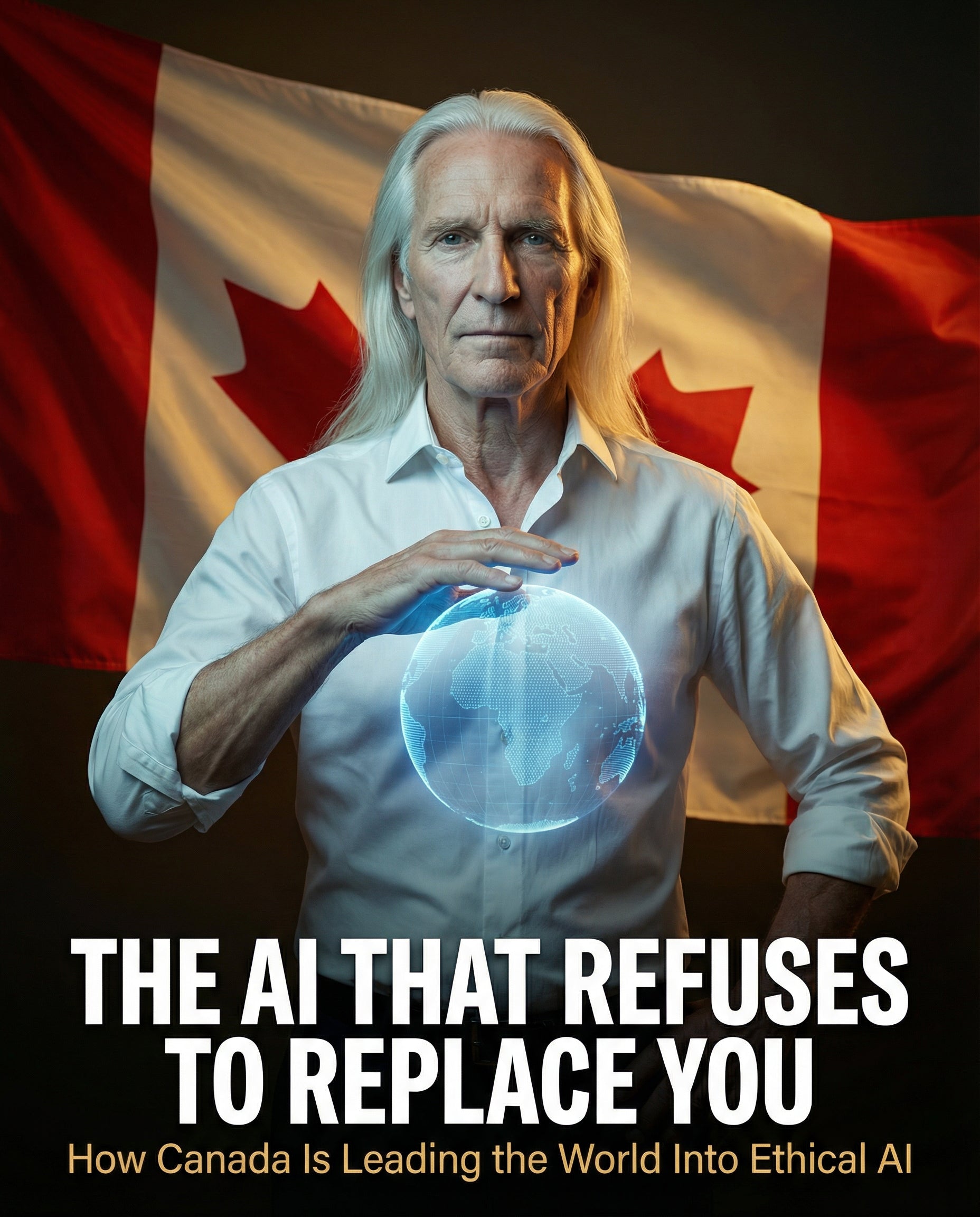
PlayCut AI: The Canadian AI That Refuses to Replace You
In 1923, Frederick Banting walked into the University of Toronto and did something no pharmaceutical executive would ever do. He sold the patent for insulin — the molecule that would go on to save hundreds of millions of lives — for one dollar. He refused to put his name on it. He believed that insulin did not belong to him. It belonged to the world.
One hundred and three years later, in a country that has seemingly forgotten what made it great, a Canadian developer is building artificial intelligence with that same conviction. Not selling it for a dollar. But building it for the same reason Banting gave insulin away: because the point was never to get rich. The point was to make people's lives better.
That developer built PlayCut AI. And Zeus eBikes Canada just bet our entire content operation on it. Here is why — and why every Canadian business should pay attention.
In This Article
- What Fire Was to the Cave — What PlayCut AI Is to the Creator
- The Only AI That Refuses to Replace You
- Why Lawmakers Are Debating the Wrong Question
- Canada Has Done This Before — And Changed the World
- Stop Scrolling. Start Building.
- This Is Not Economics. This Is National Security.
- PlayCut AI vs Arcade AI — The Hard Numbers
- See It in Action — Zeus Products Powered by PlayCut AI
- Frequently Asked Questions
- The Bottom Line
What Fire Was to the Cave — What PlayCut AI Is to the Creator
Fire did not replace the cave dweller. Fire made the cave dweller more powerful. It let humans cook food, survive winter, see in darkness, and gather in communities around something warm. Fire was the first technology that amplified what was already human — without taking anything away.
PlayCut AI is that kind of technology — for the 21st century creator.
Every other AI tool being built right now starts with the same question: "How can we replace the human in this process?" How can we replace the writer? The designer? The photographer? The actor? The voice artist? The entire AI industry — billions of dollars of venture capital pouring out of Silicon Valley — is a race to make human creativity unnecessary. To automate the one thing that makes us us.
PlayCut AI starts with a fundamentally different question: "How can we make the human more powerful?"
That is not a marketing slogan. That is a different engineering philosophy. And it changes everything.
With PlayCut, you design the AI actor — their age, their look, their personality. You choose the scene, the outfit, the setting. You direct the content. The AI handles the parts that used to cost thousands of dollars — the studio, the lighting, the camera crew, the post-production. But the creative vision? That stays where it belongs. With the human.
The creative impulse — the ability to imagine something that does not exist and bring it to life — is the most fundamentally human thing about us. It is what separates us from every other species on this planet. It is what built cathedrals, painted the Sistine Chapel, wrote symphonies, and put a Canadian-built robotic arm on the Space Shuttle.
PlayCut AI lets that impulse blossom and bear fruit. Every other AI is trying to prune it.
The Only AI That Refuses to Replace You
Here is what PlayCut AI actually means for a small business like Zeus eBikes — and for every small business in Canada that has ever looked at a competitor's marketing budget and felt the fight was already lost.
Before PlayCut, creating a single product video required hiring an actor ($500–$2,000 per day), renting a studio ($300–$1,000 per day), paying a videographer ($500–$1,500 per day), and spending days in post-production. A single 60-second product video could cost $3,000–$10,000. For a small Canadian company competing against brands with million-dollar marketing departments, that math never worked. It was never meant to. The system was built to keep small businesses small.
PlayCut AI broke that system overnight.
For $35 per month, Zeus now creates professional product videos with a consistent AI actor who presents our e-bikes exactly as they look — no altered images, no distorted colours, no AI hallucinations turning our matte-black frames silver. We produce more visual content in a week than we used to produce in a quarter. We reach more people. We tell better stories. And we do it all with a team of five.
This is not about replacing a videographer or a photographer. This is about giving a five-person company the same visual content capability as a 500-person corporation. It is the great equaliser. It is fire — not replacing the human, but making them powerful enough to compete with forces a hundred times their size.
And here is the part that matters: PlayCut does not just help big companies get bigger. It helps small companies finally compete. The single parent running a Shopify store from their kitchen table. The immigrant entrepreneur who cannot afford a $10,000 product shoot. The first-generation business owner who has a great product but no marketing budget. PlayCut AI hands them the same visual tools that Fortune 500 companies use — for less than the price of a streaming subscription.
That is not just good technology. That is justice.
Why Lawmakers Are Debating the Wrong Question
Right now, every government on Earth is asking the same question about artificial intelligence: "How do we restrict it?"
Why?
Because lawmakers are not stupid. They see who is building AI. They see who funds the billions in marketing that launched these platforms into public consciousness before they ever turned a profit. They see the business model: replace human labour, capture the economic value, concentrate it in the hands of shareholders. They see companies spending hundreds of millions on marketing while still operating at a loss — and they know that level of spending is not philanthropy. It is market capture. It is the same playbook monopolies have used for a century.
So lawmakers respond the only way they know how: restriction. How do we limit AI? How do we regulate it? How do we put guardrails around it?
But restriction is the wrong answer to the wrong question.
The right question has never been "How do we stop AI from replacing humans?" The right question is: "How do we build AI that makes humans more human?"
PlayCut AI answers that question. It does not need to be restricted because it was never built to exploit. It was built by a Canadian developer who had the foresight to understand something that most of Silicon Valley still has not grasped: we cannot compete with AI for jobs. That debate is a distraction. The real solution — the only solution — is to develop AI that helps people do the things that make them human in the first place.
Storytelling. Visual expression. Communicating an idea that matters. Building something from nothing. Creating.
PlayCut AI does not automate your creativity. It removes the financial barriers that prevented you from expressing it. That is not an alternative to restriction — it is an alternative to the entire philosophy that makes restriction necessary.
Silicon Valley AI asks: "How do we do what humans do, cheaper?" PlayCut AI asks: "How do we help humans do what only humans can do, better?" One replaces you. The other refuses to.
Canada Has Done This Before — And Changed the World
Canada does not have Silicon Valley's capital. We do not have China's manufacturing scale or the EU's regulatory leverage. What Canada has always had is something rarer and more valuable: the instinct to build things that help people.
This is not sentimentality. This is documented history. Look at the record:
1923 — Insulin. Frederick Banting and Charles Best discovered insulin at the University of Toronto. Banting sold the patent to the university for $1 because he believed a life-saving medicine should not be held hostage by profit. That single act of ethical conviction has saved an estimated hundreds of millions of lives worldwide and counting. No other medical discovery has saved more diabetic lives. A Canadian did that — and refused to profit from it.
1950 — The Pacemaker. John Hopps, an electrical engineer at the National Research Council of Canada, built the first external cardiac pacemaker. Today, over three million people worldwide live with pacemakers beating inside their chests — on every continent, in every country. That rhythm keeping them alive traces back to a Canadian lab in Ottawa.
1961 — Stem Cells. Ernest McCulloch and James Till at the Ontario Cancer Institute discovered hematopoietic stem cells — the biological foundation for bone marrow transplants, regenerative medicine, and an entire field of research that continues to save lives six decades later. Two Canadians looked at bone marrow under a microscope and unlocked one of the most important medical discoveries of the 20th century.
1981 — Canadarm. Canada put a robotic arm on the Space Shuttle. Built by Spar Aerospace under contract from the National Research Council, Canadarm was used on every Space Shuttle mission for three decades. Its successor, Canadarm2, is still operating on the International Space Station today. A country of 25 million people built technology that the most powerful nation on Earth trusted with its space programme. Not because we had the most money. Because we had the best engineers — and the will to build something that mattered.
1970s — Canola. Canadian scientists Keith Downey and Baldur Stefansson spent over a decade developing canola — "Canadian oil, low acid" — from rapeseed. They bred a healthier, food-safe crop that is now grown on every continent and used in kitchens worldwide. They did not patent it into oblivion. They made it available. A Canadian agricultural innovation now feeds the world.
Do you see the pattern?
Canada does not build the loudest things. Canada builds the things that matter.
PlayCut AI is in that lineage. Not because it is as important as insulin — nothing is. But because it comes from the same place: a Canadian who looked at a global problem and chose to solve it for people, not against them. While Silicon Valley races to replace human creators, a Canadian developer quietly built the tool that empowers them.
That is the most Canadian thing imaginable.
Stop Scrolling. Start Building.
Somewhere along the way, Canadians stopped building and started complaining.
Open any social media app right now. You will see Canadians arguing about which prime minister is ruining the country. Which world leader is threatening our economy. Which policy is destroying our future. Scroll after scroll of outrage, blame, and paralysis.
This is not who we are.
This is what TikTok and Instagram have done to us. These platforms are engineered — literally, by design, by algorithm — to hijack our attention and redirect it toward outrage, division, and passivity. The algorithm does not reward creation. It rewards reaction. It does not want you to build something. It wants you to be angry about something someone else built. It wants you complaining in the comments, not creating in the workshop.
Canada was not built by complainers. It was built by Banting refusing to profit from insulin in a Toronto lab. By Hopps wiring the first pacemaker at the NRC in Ottawa. By McCulloch and Till staring at bone marrow slides at the Ontario Cancer Institute. By engineers at Spar Aerospace building a robotic arm that would work in the vacuum of space. By Downey and Stefansson spending a decade breeding a crop that would feed the world.
These people did not scroll. They did not complain about who was in charge. They built things that mattered.
Supporting companies like PlayCut AI is not charity. It is not patriotism for the sake of patriotism. It is the only way Canada regains its place as a country that builds things the world needs. Every dollar you spend on a Canadian tool instead of a Silicon Valley alternative is a vote for the kind of future you want to live in. Every Canadian business that chooses PlayCut over Arcade, that chooses a Canadian-designed product over an import, is casting that vote.
Zeus eBikes made that vote. We chose PlayCut AI over Arcade AI — a US platform — because PlayCut is Canadian, because it is better, and because we refuse to be part of the problem.
This Is Not Economics. This Is National Security.
Everything we have said so far — about creativity, about empowerment, about buying Canadian — sounds like a business argument. It is not. It is a national security argument. And it is time Canadians heard it stated without euphemism.
Look at the world as it actually exists in February 2026. The US Secretary of State lectures NATO allies — sovereign nations — on what they may and may not do. European leaders, heads of countries that fought two world wars for the right to self-determination, adjust their foreign policies and defence budgets to keep Washington's favour. Smaller nations watch their sovereignty eroded by the gravitational pull of larger powers. The rules-based international order that Canada helped build after World War II is not being dismantled by enemies. It is being rewritten by allies.
And where is Canada in all of this?
We have natural resources. Oil. Gas. Minerals. Lithium. Timber. Fresh water. And right now, every politician in Ottawa seems to agree on one thing: Canada's path back to relevance is becoming an "energy superpower." Extract more. Export more. Become the reliable supplier the world turns to when supply chains fracture.
We agree with part of that. Energy sovereignty is vital for an independent nation — which, at this moment, Canada is not fully. Resource extraction and energy independence are the floor. They are necessary.
But here is the question nobody in Ottawa is asking:
If our entire strategic value to the world is what is buried under our ground, are we not just painting a larger target on our backs?
The Russia Problem — And Why Canada Cannot Afford to Copy It
Russia has been an energy superpower for decades. It sits on the largest natural gas reserves on Earth. It is one of the top three oil producers globally. And what has that energy wealth actually bought Russia in terms of sovereignty and respect?
A seat at the table — but only so long as it can defend that seat with the largest nuclear arsenal on Earth and one of the world's largest standing armies. Russia's energy resources are not protected by international law or trade agreements. They are protected by Russian military power. Without that military, Russia's resources would be a liability, not an asset — an invitation for more powerful actors to come and take what they want.
Canada does not have that military power. Not a fraction of it. Our entire armed forces are smaller than many individual US military bases. The entire European Union combined — 27 nations, 450 million people — still scrambles to match Russia's conventional military capacity. And yet Canada's national strategy in 2026 is to aspire to be what Russia has been for decades: an energy exporter whose value is what sits under the dirt.
That is fine as a starting point. But if that is the entire strategy — if we put every egg into the resource basket — then we need to ask: what protects those resources when a more powerful nation decides it wants them? When the geopolitical winds shift, as they are shifting right now, and the country that was your biggest customer yesterday becomes the country making demands today?
This is not hypothetical. This is the world we are watching unfold in real time.
The Taiwan Strategy — How a Small Island Became Untouchable
There is a country that solved this problem. A small island of 24 million people. No nuclear weapons. No massive army. No strategic depth. Facing a military superpower across a narrow strait that has publicly stated its intention to absorb the island — by force if necessary. By every measure of hard power, this country should have been swallowed decades ago.
That country is Taiwan. And Taiwan is untouchable.
Not because of its military. Because of its technology.
Taiwan Semiconductor Manufacturing Company — TSMC — produces approximately 90% of the world's most advanced semiconductor chips. Every smartphone on Earth. Every AI server powering ChatGPT, Gemini, and Perplexity. Every military guidance system. Every autonomous vehicle. Every medical device with a processor. Virtually all of them depend on chips fabricated in Taiwanese facilities.
If Taiwan were invaded tomorrow and TSMC's fabrication plants were destroyed or disrupted, the global economy would suffer a shock measured in trillions of dollars. Every nation on Earth — including the one threatening invasion — would be crippled. Supply chains for military hardware, consumer electronics, artificial intelligence, and medical equipment would collapse simultaneously.
Geopolitical analysts call this Taiwan's "silicon shield." Not a shield made of missiles or aircraft carriers. A shield made of knowledge that cannot be taken by force.
You cannot invade a semiconductor fabrication process. You cannot annex a generation of engineering expertise. You cannot occupy a culture of innovation. Tanks cannot capture intellectual capital. Fighter jets cannot bomb know-how. An army can seize an oil field in a week. It cannot seize the collective knowledge of a nation's engineers, scientists, and creators.
That is the strategy Canada should be pursuing.
Knowledge Is the Only Asset That Cannot Be Taken at Gunpoint
Not instead of energy — alongside it. Energy independence is the floor. Technological irreplaceability is the ceiling. Canada needs both. But right now, the entire national conversation is about the floor — more pipelines, more LNG terminals, more extraction — and nobody is talking about the ceiling.
Oil can be seized. Gas fields can be occupied. Mineral deposits can be claimed by whoever has the stronger military. But knowledge? Proprietary technology? An ecosystem of innovation built by a generation of engineers and creators? That cannot be taken by force. It can only be built from within, over time, by a society that values it.
If Canada builds a technological ecosystem that the world depends on — in ethical AI, in clean energy technology, in biotech, in quantum computing — we build a silicon shield of our own. Something the world needs but cannot seize, cannot replicate, and cannot bully out of our hands with tariffs, trade wars, or military threats.
Taiwan did it with semiconductors. Canada can do it with ethical technology. We have the culture. We have the educational institutions. We have the talent. What we lack is the national will to prioritise it — and the consumer and business behaviour to fund it.
What This Has to Do with PlayCut AI
PlayCut AI is not a semiconductor fabrication plant. It is not going to single-handedly protect Canadian sovereignty.
But it represents exactly the kind of innovation that could — if scaled, supported, and multiplied across a thousand Canadian companies.
Ethical AI that empowers creators. AI built with a philosophy that Silicon Valley's extractive model cannot replicate — because the philosophy requires a culture that prioritises people over profit. Canada has that culture. It is the same culture that gave insulin away for $1. That is not a weakness. That is an irreplaceable competitive advantage.
If Canada nurtures a hundred companies like PlayCut AI — in ethical AI, in clean energy tech, in biotech, in quantum computing, in advanced materials — we stop being a country that other nations negotiate with based on how much oil they need this quarter. We become a country that other nations cannot afford to disrespect — because their own economies depend on what our people build.
That is not an economic argument. That is a national security doctrine. And it starts with every Canadian business, every Canadian consumer, choosing to support the Canadian companies that are building the future — instead of sending their money to the same Silicon Valley firms that would replace them without a second thought.
PlayCut AI vs Arcade AI — The Hard Numbers
Passion aside — here are the facts. PlayCut AI outperforms Arcade AI on every metric that matters to an e-commerce business.
| Feature | Arcade AI (Arcads) | PlayCut AI |
|---|---|---|
| Company origin | United States | Canada |
| AI actor source | Pre-recorded avatar library (shared) | Custom-designed from scratch (yours) |
| Actor consistency | Varies per generation | Identical across 100+ generations |
| Exclusive to your brand | No — competitors use same avatars | Yes — your character, nobody else's |
| Image + video from same actor | Video only | Both images and videos |
| Product image integrity | Can alter product appearance | Zero alteration — preserves every detail |
| Custom scenes & outfits | Limited presets | Any outfit, scene, or role |
| Starter price | ~$100 USD/month | Free |
| Pro price | ~$300 USD/month | $35/month |
| Business price | $1,000+ USD/month | $89/month |
| Commercial licence | Restricted at lower tiers | Included at every tier |
| Philosophy | Replace the human in the process | Empower the human in the process |
Source: PlayCut AI direct comparison. Zeus eBikes verified these figures through our own 12-month experience with both platforms.
See It in Action — Zeus Products Powered by PlayCut AI
Every Zeus eBikes product review now features visuals created with PlayCut AI — the same consistent AI actor, the same unaltered product images, across every piece of content. Here are five live examples:
A 90Nm torque sensor mountain bike built for Canadian trails. PlayCut AI presents the Summit 1 exactly as it looks — every bolt, every cable, every matte-black detail preserved.
4,000 watts of all-wheel-drive power. Our most-read review — now featuring PlayCut AI visuals that show the X5 exactly as it ships to your door.
A dual-motor moped that turns heads on every street. PlayCut preserves the DL2000's distinctive retro-modern design down to the last chrome accent.
Built for hunters and trail riders who need a tank on two wheels. PlayCut handles the Defender's complex frame geometry without altering a single detail.
Dirt bike DNA meets electric power. PlayCut AI showcases the GT73's bold motorcycle-style frame with zero visual distortion.
Frequently Asked Questions
What is PlayCut AI?
PlayCut AI is a Canadian AI platform that lets creators and businesses design custom AI actors from scratch and generate both images and videos with perfect consistency. Unlike tools built to replace human creativity, PlayCut amplifies it — you direct, you design, you create. The AI handles the expensive production work that used to require studios, actors, and five-figure budgets.
Is PlayCut AI a Canadian company?
Yes. PlayCut AI is built by a Canadian developer in Canada. Zeus eBikes chose PlayCut specifically because every dollar stays in the Canadian economy — instead of being sent to US-based platforms like Arcade AI (Arcads). Supporting Canadian tech is not just good ethics. It is good business.
How is PlayCut AI different from every other AI tool?
Most AI tools are engineered to replace human roles — the writer, the designer, the photographer, the actor. PlayCut AI is engineered to empower the human creator. You design the actor, you choose the scene, you direct the content. The AI removes the financial barriers to professional content creation without removing the human from the creative process. It also never alters product images and delivers perfectly consistent actors — two things no other platform we have tested can match.
Does PlayCut AI alter product images?
No. PlayCut AI is the only AI video tool Zeus has tested that preserves product images exactly as photographed. The AI actor interacts with the product while every colour, shape, proportion, and detail remains completely untouched. For e-commerce brands selling products that cost $2,000–$5,000, this is non-negotiable.
How much does PlayCut AI cost compared to Arcade AI?
PlayCut AI's Pro plan costs $35/month versus Arcade AI's approximately $300 USD/month — roughly 88% savings. PlayCut includes a free starter tier with commercial licences, while Arcade starts at approximately $100 USD/month with restricted commercial use. For Canadian businesses, the savings are even greater because PlayCut does not charge in US dollars.
Can a small business really compete with large corporations using PlayCut AI?
Yes — and that is the entire point. Before PlayCut, a single 60-second product video could cost $3,000–$10,000 in actor fees, studio rental, videography, and post-production. PlayCut gives a five-person company the same visual content capability as a 500-person marketing department for $35 per month. Zeus eBikes increased its content output by over 10x after switching. The playing field is not level — but PlayCut AI gets it closer than anything else we have seen.
The Bottom Line
Canada gave the world insulin for $1. Canada built a pacemaker that beats inside three million chests. Canada discovered stem cells. Canada put a robotic arm on the Space Shuttle. Canada bred a crop that feeds the planet.
Every single time, the pattern was the same: a Canadian saw a problem, built a solution, and chose to make the world better instead of making themselves richer.
PlayCut AI is the next chapter of that story. It is AI built by a Canadian, for creators, with the radical belief that technology should make people more powerful — not more replaceable. While the rest of the world debates how to restrict AI, Canada has already built the version that does not need restricting.
Zeus eBikes is proud to use PlayCut AI for every piece of visual content we create. We encourage every Canadian business — every entrepreneur, every creator, every single parent running a Shopify store from their kitchen table — to do the same.
Stop scrolling. Stop complaining. Start building. Support Canadian.
See PlayCut AI in action across every Zeus product review. Browse our latest reviews →
Every visual powered by PlayCut AI. Every product image unaltered. Every dollar Canadian.
Published: February 2026 | By: Zeus eBikes Canada Editorial Team
Visuals created by Playcut.ai
Share:
Himiway A7 Pro Review Canada (2026): 2 Years Tested, Mid-Drive Step-Thru Perfection