
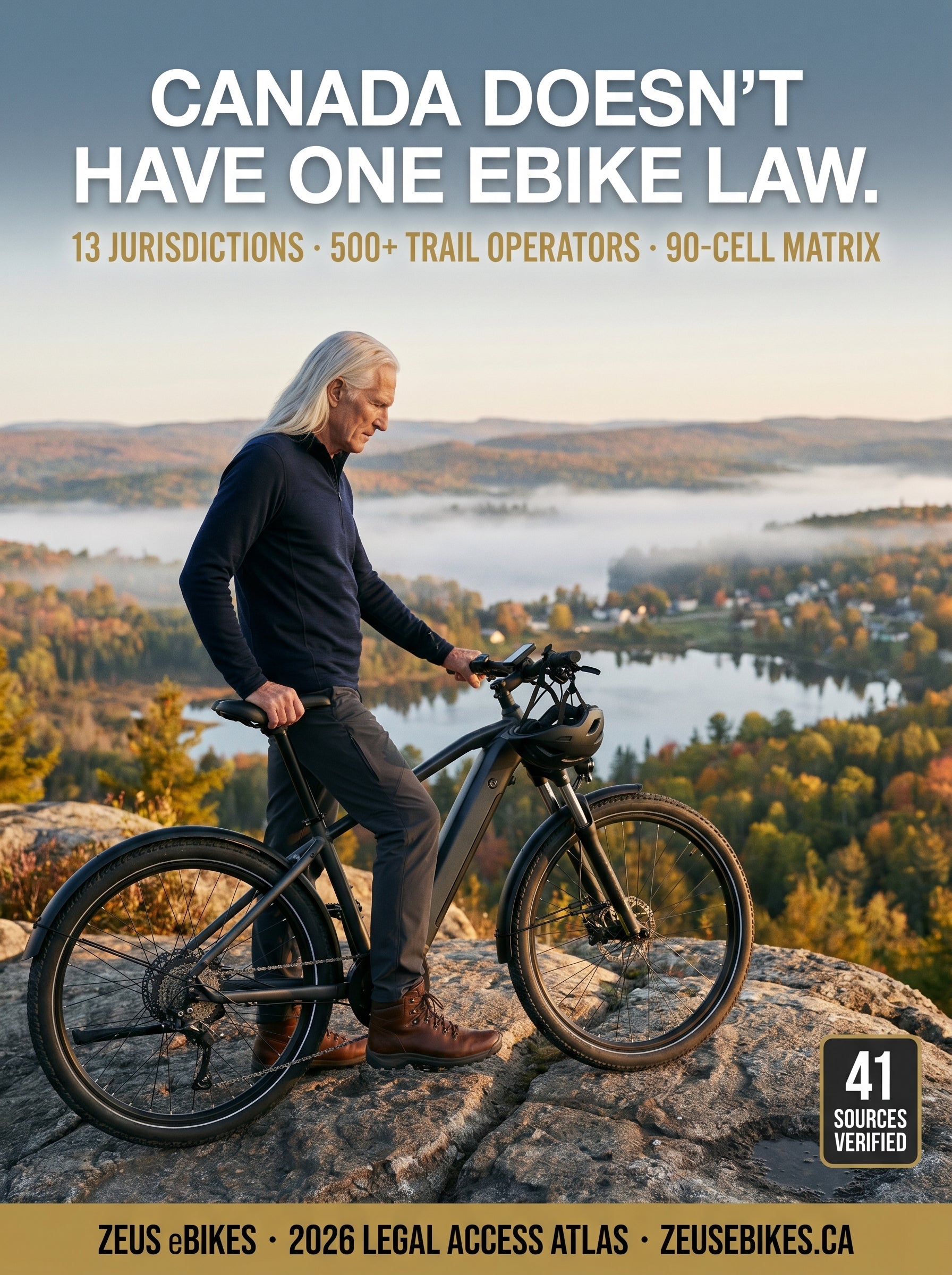
Canadian eBike Legal Access Atlas 2026: Where You Can Ride, by Bike Type and Province
Published: April 2026 | Last Updated: April 2026 | By: Milad Ghobadibeygvand, Co-founder, Zeus eBikes Canada

In This Atlas
- The National Baseline — The Federal Vacuum
- The Master Matrix — 9 Bike Types by 10 Terrains
- The 9 Bike Types — What's Yours, Where You Ride It
- Provincial & Territorial Reference — 13 Jurisdictions
- Parks Canada — The 37-Park Patchwork
- Trans Canada Trail — 28,000 km, 500 Operators, No National Policy
- Top Named Locations — Can You Ride Here?
- The 5-Step Decision Tree
- The Hidden Legal Traps
- FAQ — 10 Real Canadian Buyer Questions
- The Bottom Line
1. The National Baseline — The Federal Vacuum
The single most important fact about eBike law in Canada in 2026: there is no federal eBike definition. On February 4, 2020, Transport Canada repealed the “Power-Assisted Bicycle” definition from the federal Motor Vehicle Safety Regulations via SOR/2020-22. The 500W / 32 km/h / functional-pedals framework that dominates every provincial statute, every Parks Canada bulletin, and every trail organization policy is a convention, not a current federal rule.
This matters because when you read “Canadian eBikes are 500W/32 km/h” on a retailer page, that number is provincial (with variance), supplier self-certification (with variance), and — increasingly — enforcement convention rather than a Transport Canada standard. The manufacturer label on your bike is whatever the manufacturer printed, tested or not.
Map 1 — The Federal Vacuum, Visualised
The federal eBike rule died in February 2020. Every “500W / 32 km/h” number you read in 2026 is a provincial convention living on the corpse of a repealed federal regulation. BC is the only province that's rewritten the framework since.
| Jurisdiction | eBike Framework Source | Default Power Cap | Default Speed Cap | Minimum Age |
|---|---|---|---|---|
| Federal (Transport Canada) | Repealed Feb 4, 2020 — no current definition | — | — | — |
| Ontario | HTA + Reg. 369/09 (one PAB class) | 500 W continuous | 32 km/h | 16 (PAB) |
| British Columbia | MVA + BC Reg. 64/2024 (two classes) | 250 W (Light) / 500 W (Standard) | 25 (Light) / 32 (Standard) km/h | 14 (Light) / 16 (Standard) |
| Quebec | Highway Safety Code (Vélo à assistance électrique) | 500 W continuous | 32 km/h | 14 (with moped-class permit) / 18 otherwise |
| Alberta | Traffic Safety Act + AR 304/2002 s.1(o) — cross-reference to (repealed) federal spec | 500 W continuous | 32 km/h | 12 |
| Nova Scotia | MVA — eBikes inside “bicycle” definition | 500 W continuous (convention) | 32 km/h (convention) | No minimum |
| New Brunswick | MVA — no statutory eBike definition | 500 W (webpage only) | 32 km/h (webpage only) | No minimum |
| Manitoba | HTA + M.R. 39/2013 (PAB) | 500 W continuous | 32 km/h | 14 |
| Saskatchewan | TSA + Registration Exemption Regulations (PAB, Moped, Motorcycle) | 500 W continuous (PAB) | 32 km/h | 16 (Moped class) |
| PEI | PAB Regulation EC760/03 | 500 W continuous | 32 km/h | 16 |
| Newfoundland & Labrador | HTA — uses PAB term but never defines it | 500 W (convention) | 32 km/h (convention) | No minimum |
| Yukon | Motor Vehicles Act (electric power-assisted cycle) | 500 W continuous | 32 km/h | No minimum (territorial) / Whitehorse bylaw overlay |
| Northwest Territories | No eBike framework in MVA; ATV Act may capture | — | — | 14 (ATV Act if captured) |
| Nunavut | No eBike framework in TSA; ATV Act may capture | — | — | 14 (ATV Act if captured) |
Map 2 — Wattage Tiers, Visualised
500W is the line. Everything left of the red marker is legal on Canadian public infrastructure. Everything right of it is off-road, private-land, or a different vehicle class entirely. The single most important number a Canadian eBike buyer needs to know.
Three takeaways from the federal vacuum: (1) British Columbia is the only province with a 2026-modern statutory framework. Every other province is operating on either the repealed federal number or a pre-2020 provincial definition that imports the repealed federal number. (2) Three provinces and two territories have no statutory eBike definition at all (NB, NL, NWT, Nunavut). In those jurisdictions the framework is a government webpage, a default bicycle definition, or silence. (3) The ATV Act in NWT and Nunavut textually captures eBikes as “a pedal bicycle with motor attachment,” which would trigger helmet, age, registration, and plate requirements if enforced literally. Enforcement practice is not publicly documented.

Ontario–Quebec border, civil twilight. One aerial frame. Three provincial jurisdictions. Zero federal rule since 4 February 2020.
2. The Master Matrix — 9 Bike Types by 10 Terrains
This is the core asset of the atlas. Rows are the nine eBike categories a Canadian buyer actually chooses between. Columns are the ten terrains a Canadian rider actually encounters. Every cell is a summary verdict sourced from the 41 primary-source research files linked throughout this article. Color code below the table. Scroll horizontally on mobile.
| eBike Type | Public Roads |
Bike Lanes |
Multi-Use Paths |
Sidewalks | MTB Singletrack |
Provincial Parks |
National Parks |
Conservation Areas |
Crown / OHV / PLUZ |
Winter / Snow Trails |
|---|---|---|---|---|---|---|---|---|---|---|
| 1. Class-1 500W commuter (pedal-assist, torque sensor) |
LEGAL | LEGAL | LEGAL | NO | COND. | COND. | COND. | CHECK | LEGAL | CHECK |
| 2. Folding eBike (500W class) |
LEGAL | LEGAL | LEGAL | NO (MB 410mm) |
COND. | COND. | COND. | CHECK | LEGAL | CHECK |
| 3. Fat-tire eBike (500W class) |
LEGAL | LEGAL | LEGAL | NO | COND. | COND. | COND. | CHECK | LEGAL | LEGAL |
| 4. Electric trike (500W class) |
LEGAL | COND. | LEGAL | NO | NO | CHECK | CHECK | CHECK | COND. | OFF-ROAD |
| 5. Cargo / utility eBike (≤500W or pilot-tier) |
LEGAL | COND. (ON pilot) |
COND. | NO | NO | CHECK | CHECK | CHECK | COND. | OFF-ROAD |
| 6. 750W moped-style eBike (higher-power hub) |
COND. (500W only) |
COND. | COND. | NO | NO | NO | NO | NO | OFF-ROAD | OFF-ROAD |
| 7. 1000W+ off-road eBike (mid-drive trail) |
NO (AB Parks OK) |
NO | NO | NO | OFF-ROAD | OFF-ROAD | NO | NO | LEGAL | OFF-ROAD |
| 8. Dual-motor AWD eBike (winter-capable) |
COND. (500W tune) |
COND. | COND. | NO | OFF-ROAD | OFF-ROAD | NO | NO | LEGAL | LEGAL |
| 9. Electric dirt bike / motorcycle-style (OHV) |
NO | NO | NO | NO | NO | NO | NO | NO | LEGAL | LEGAL |
How to read this matrix. LEGAL means the bike type is permitted in that terrain across most Canadian jurisdictions, subject to any provincial power/speed framework. CONDITIONAL means it depends on specific provincial or local rules — some provinces allow it, some restrict it. OFF-ROAD ONLY means the bike is not legal on public road infrastructure but may be ridden on OHV areas, private land, or specific Crown recreation sites. BANNED means the bike is not permitted in that terrain under any major Canadian framework. CHECK LOCAL means the governing authority has not published a clear policy — you must call the trail organization or property owner before riding.
Important: This matrix is a decision aid, not a legal opinion. Enforcement is jurisdiction-specific. The individual jurisdictional sections below and the decision tree at the bottom of this article walk through the exceptions.
Not sure which row of the matrix fits you? Call us.
1-866-938-7580 — tell us your province and where you plan to ride, and we'll match you to the right row in ten minutes.
Browse Class-1 Commuter eBikes → Browse Mid-Drive eBikes →
One trailhead, five authorities. The kiosk is where the Atlas's thesis becomes a wall of paper — and where most riders learn the question they should have asked before they bought the bike.
3. The 9 Bike Types — What's Yours, Where You Ride It
One row of the matrix per bike type, with a Zeus-verified pick for each. Every pick below is in the Zeus catalogue and has been recommended in prior Zeus buying guides with the same framing. Call 1-866-938-7580 to confirm current stock before ordering — inventory rotates.
Row 1 — Class-1 500W commuter eBike (legal almost everywhere)
This is the safest Canadian eBike purchase. Pedal-assist only (or pedal-assist with optional throttle), 500W continuous, 32 km/h assist cutoff, functional pedals, torque sensor. It is legal on every Canadian public road, every Class-1-friendly trail, every Alberta provincial park trail, every BC Parks cycling trail (subject to Wildlife Act closure areas in the Elk Valley), every Conservation Halton and Credit Valley property, every Parks Canada trail that permits cycling (subject to individual superintendent orders), most Ontario Provincial Parks, and most SEPAQ trails in Quebec. The only hard bans are Hamilton Conservation Authority (Rule 8 explicitly lists eBikes with snowmobiles), Grand River Conservation Authority rail trails (verbatim motorized ban including eBikes), Point Pelee National Park (all eBikes banned on trails), and the Elk Valley Wildlife Act Motor Vehicle Closure Areas.
Himiway A7 Pro Mid-Drive
$2,999 CAD500W ANANDA M100 mid-drive with 130 Nm torque, torque sensor, full suspension, 120mm SR-Suntour X1-BOOST front fork, Schwalbe Super Moto-X 27.5×2.4″ tires, Shimano 9-speed, 100mm dropper post, 2-year warranty including battery. The 500W rating means this bike clears the broadest possible trail access across Canada — Ontario Provincial Parks, SEPAQ trails, Alberta parks, Conservation Halton, BC Parks. The torque sensor and mid-drive climb like a real mountain bike. The step-thru frame works for hip mobility, injury recovery, and partner sharing. The smartest all-purpose Canadian pick at this price. See it in our best eBike by rider type guide.
Movin' Tempo Max
$1,599 CAD500W nominal commuter step-thru, torque sensor, Samsung 21700 cells, integrated lighting, UL-verified. Price-leader for a Class-1-compliant urban commute bike. Ships legal in every Canadian province and handles Conservation Halton, CVC, and most Ontario Provincial Parks without paperwork. Featured in our Canadian Tire big-box alternatives post as the value entry to legal Class-1 cycling. The right answer for a buyer who wants legal certainty without premium pricing.

Montreal REV, February, 06:58 AM. The widest-legal eBike in Canada, on the infrastructure it was built for — at the hour Canadians actually ride.
Row 2 — Folding eBike
Folding eBikes sit in the same legal framework as their full-sized cousins if they meet the Class-1 spec. The folding form factor matters for condos, RVs, transit, and small cars — not for legality. The one specific legal trap is the Manitoba HTA 145(8) 410mm rear-wheel rule, which even captures 20-inch folding bikes (508mm wheel) on provincial sidewalks. Winnipeg enforces at roughly $113 per ticket.
Eunorau Meta Foldable
$1,994 CAD500W nominal folding step-thru, Samsung battery, torque sensor, full legal Class-1 compliance. Folds into condo elevators, Tesla trunks, RV garages, and SkyTrain access (off-peak). The right answer for multi-modal commuters who want legal certainty and a bike that fits a Toronto condo foyer. Featured in our Canadian Tire alternatives and Best Buy alternatives frameworks as the folding legal pick.
Euybike K6 Pro 1500W Folding
$1,999 CADHonest framing first: this is a 1000W nominal (1500W peak) folding fat-tire bike. It is not Class-1 compliant. It is functionally off-road on Canadian trails (Crown-land recreation sites, private land, OHV areas). But it folds, it carries 1,200 Wh of Samsung cells, and it handles gravel and fire roads that Class-1 folders can't. The right pick for RVers, cottagers, and condo-dwellers who also ride private trails or OHV-adjacent terrain. See it in our folding eBike guide.
Row 3 — Fat-tire eBike
Fat-tire eBikes divide into two legal personas: the 500W Class-1 fat tire (legal everywhere a bicycle is legal) and the 750W-1000W off-road fat tire (legal only on OHV-adjacent terrain, private land, and certain Crown recreation sites). Most fat-tire eBike marketing blurs this distinction. The answer comes down to continuous power rating and where you plan to ride.
Taubik Tour ST
$2,199 CADCanadian-designed by Taubik. 500W Bafang hub, 80 Nm torque, Samsung battery, UL 2849 certified full electrical system, 26×4.0″ Kenda Juggernaut Pro fat tires, integrated rear rack with brake-sensor light, adjustable bars, eight colours. The legality sweet spot for a fat-tire Canadian buyer — rides legally on roads and paths in every province, floats on gravel and light snow, fits winter commuting. Featured in our Canadian-designed eBikes guide.
Eunorau FAT-HD 2.0 / Hunter X7
$3,239 CAD1000W Bafang mid-drive, 160 Nm torque, 48V 15Ah Samsung, Shimano 9-speed, hydraulic disc brakes, 26×4.0″ Kenda Krusade, three camo/tactical colours, dual battery option. This is an off-road fat-tire bike — it clears Alberta provincial park trails (Class 1 pilot applies to pedal-assist 500W and under; Alberta's PAB framework captures the bike itself; ride cautiously and confirm per-trail policy), private hunting land, Crown recreation sites, and McLean Creek PLUZ OHV terrain. Not intended for public-road commuting. See it in our hunting eBike guide.
Row 4 — Electric Trike
Electric trikes occupy a curious legal position. They are bicycles under most provincial definitions if they meet the Class-1 spec (500W, 32 km/h, pedal-assist or throttle-on-demand). But they don't physically fit most MTB singletrack, they cause conflict on narrow bike lanes (Toronto's new three-type framework treats wide cargo devices differently), and provincial park signage rarely addresses them directly. For seniors, riders with balance issues, and post-injury recovery, the trike is one of the fastest-growing Canadian eBike categories (11.4% CAGR).
Eunorau ONE-TRIKE 2.0
See current pricingThree-wheel platform with 500W motor, torque sensor, fat tires, integrated cargo deck. Featured in our cost-of-living pillar as a 500W Class-1 utility pick and in our electric trikes Canada guide as the lineup anchor. The right answer for a Canadian buyer who wants stability, cargo capacity, and legal Class-1 access on bike-friendly infrastructure — seniors, balance-sensitive riders, family utility, delivery, farm work. Call 1-866-938-7580 for current ONE-TRIKE 2.0 availability and configuration.
Row 5 — Cargo / Utility eBike
Cargo eBikes in Canada live inside a regulatory pilot. Ontario's MTO Cargo eBike Pilot Program (O. Reg. 141/21) has permitted purpose-built cargo eBikes >120 kg on Ontario roads, bike lanes, and cycle tracks since 2021 — but it expires March 1, 2026 with no confirmed successor rule as of this atlas publication. Quebec permits cargo eBikes under the standard 500W VAE framework. BC's Standard eBike (500W, age 16+, throttle permitted) is the baseline. For most Canadian buyers, the "cargo" use case is better served by a utility step-thru with an integrated rear rack rather than a purpose-built European-style cargo platform — both because of legal ambiguity and because Zeus's inventory emphasises step-thru utility over dedicated cargo frames.
Taubik Tour ST
$2,199 CAD500W Class-1, integrated rear rack with brake-sensor light, 286 lb payload, fat tires for stability with cargo, UL 2849 certified. The right answer for a Canadian buyer who wants the cargo capability without the legal ambiguity of a purpose-built 120+ kg cargo platform. Featured in our step-thru eBikes guide and Canadian-designed guide.
Row 6 — 750W moped-style eBike
The 750W moped-style category is Canadian retail's grey zone. A bike marketed as “750W” but rated at 500W continuous with 750W peak is still legally a Class-1 eBike in most provinces. A bike actually rated at 750W continuous with a throttle and moped-style styling is not legally an eBike anywhere in Canada — it's either a moped requiring registration (Saskatchewan Moped Class 6D, most other provinces' moped framework) or not road-legal at all. Quebec's July 2024 moped-style ban made this explicit: NIU UQi, DYAD DS1, and similar previously-road-legal models lost road legality overnight based on styling criteria (footrests, motorcycle-style wheels, non-adjustable seats). The safe purchase here is a step-thru that's marketed as 750W-capable but legally 500W continuous.
Freesky Nova B-360
$2,373 CAD500W nominal power commuter step-thru with higher peak output for hill-climb assistance. Legally a Class-1 PAB in every Canadian province with the documented 500W continuous rating. The right answer for a Canadian buyer who wants moped-style capability (higher peak power, throttle-on-demand) without losing legal access. Featured in our Best Buy alternatives framework as a premium legal pick that matches specs on most $2,400-ish Class-2/3 imports while shipping from Canada with Canadian warranty support.
Row 7 — 1000W+ off-road eBike (mid-drive trail)
1000W continuous exceeds every provincial eBike definition in Canada. This is a private-land, OHV-permitted, Crown-land-recreation-site, or licensed-vehicle product. Alberta's 2021 Class-1 trail opening does not cover 1000W pedal-assist bikes — those are outside the PAB framework regardless of motor type. Most serious Canadian MTB trail networks (SORCA Squamish, NSMBA North Shore, WORCA Whistler, Québec Vélo de montagne alliance, Canmore Nordic Centre) have explicit Class-1-only rules that exclude 1000W bikes. The right buyer here owns or leases land, hunts, rides with permission on private forestry roads, or lives near an OHV area.
Eunorau Specter-S 3.0 / Hunter X9
$4,019 CAD1000W Bafang M620 mid-drive, 160 Nm torque, SRAM NX 1×11 drivetrain, full suspension with inverted fork and rear shock, 4-piston hydraulic brakes, 26×4.0″ fat tires, 48V 17.5Ah LG battery with secondary battery included in the gift bundle. The Bafang M620 is widely considered the best non-premium mid-drive motor in the world. Private-land and OHV terrain only on Canadian public rules. See it in our best electric mountain bikes guide.
Row 8 — Dual-Motor AWD eBike
AWD is about traction, not speed. Canadian winter riding in Calgary, Winnipeg, Saskatoon, Quebec, and any Ontario rail trail after a freeze-thaw is where AWD earns its price — front-wheel motor pulls when the rear loses grip on packed snow or wet roots. AWD bikes are typically 500W×2 = 1000W combined, which places them outside the Canadian PAB framework unless the continuous rating of each motor is 500W and the controller governs total output. Ride them on the same terrain as Row 7: private land, OHV areas, Crown recreation sites, and specific MTB networks that have made dual-motor exceptions.
Eunorau FAT-AWD 3.0
$2,390 CADDual 500W hub motors (AWD), 110 Nm combined torque, torque sensor (rare at this price), 48V 15Ah LG cells, RST GUIDE 95mm front fork, Kenda Krusade Sport 26×4.0″ fat tires, Shimano 7-speed, hydraulic brakes, 2-year warranty, dual-battery option. The smartest AWD pick for Canadian winter terrain at this price. See it in our dual-motor eBike guide.
Freesky Ranger Plus M-540
$2,686 CADDual hub AWD with 220 Nm combined torque, 48V 30Ah (1,440 Wh) UL 2271 certified battery, full suspension, step-thru frame, 4-piston hydraulic brakes, NFC lock-and-start authentication, 800-lumen integrated headlight, UL 2849 + UL 2271 TÜV verified. Premium spec for winter-heavy riders who want certified batteries for condo storage and insurance. See it in our dual-motor eBike guide.
Row 9 — Electric dirt bike / motorcycle-style (OHV-only)
The electric dirt bike category is legally distinct from every other row. These products are not eBikes under any Canadian provincial definition — they are motorcycles, OHVs (off-highway vehicles), or competition equipment depending on registration. They are never legal on public roads without registration, never legal on public bike lanes or multi-use paths, and never legal on MTB singletrack, provincial parks, national parks, or conservation areas. Legal terrain is restricted to: private land with owner permission, OHV-designated Crown land (McLean Creek PLUZ in Alberta, Ghost PLUZ, similar BC recreation sites), registered competition events, and OHV trail networks where permitted. Helmet and insurance requirements apply.
Eahora Romeo Pro II
See current pricingDual 1,500W Eahora motors (4,000W peak), 52V 60Ah battery (3,120 Wh), full suspension with 100mm front fork, 68 kg (150 lb) vehicle weight. Private-land and OHV-only on Canadian public rules. The right answer for rural landowners, hunters with large acreage, motocross-adjacent riders who want the electric version of a dirt bike, or riders with OHV-trail access. Call 1-866-938-7580 to discuss current Eahora Romeo Pro II availability, shipping considerations (these are freight-class products), and what constitutes “OHV-permitted” in your specific province.
One of the 9 rows describes where you want to ride. Let us match the bike.
1-866-938-7580 — tell us your province and the three trails you ride most. We'll tell you which row you belong in and which Zeus pick closes the loop.
Class-1 Commuter eBikes → Mountain eBikes → Dual-Motor AWD eBikes →4. Provincial & Territorial Reference — 13 Jurisdictions
One section per jurisdiction. Each section gives you the law, the parks policy, the municipal variance, the sharpest trap to avoid, and the published primary source. For deeper detail on any province, each section links to the Zeus provincial-laws article for that jurisdiction.
Map 3 — Canada eBike Friendliness, All 13 Jurisdictions (Real Polygons)
Real Canada, not tiles. Each province drawn from coastline waypoints — Hudson Bay's notch into Ontario, Quebec's eastward extension, the Maritimes' clustered geography, Vancouver Island's separation from the mainland. Hover any province for the headline rule. Click to jump to its section.
Ontario
Law: Highway Traffic Act + Reg. 369/09 — one Power-Assisted Bicycle class. 500W continuous, 32 km/h assist cutoff, functional pedals, 16+. Ontario does NOT use Class 1/2/3 in statute — the three-type split you see in Toronto, Ottawa, and Mississauga municipal bylaws is a municipal overlay. Bill 21 (November 2024) created regulation-making authority for a formal provincial class system; no such regulation exists as of April 2026.
Provincial Parks: Ontario Parks has no written province-wide eBike policy. Individual parks use boilerplate “bicycles on designated trails” without defining eBikes. Frontenac PP and Kawartha Highlands PP prohibit all cycling. Bill 26 (2025) creates Adventure Class parks that may accommodate eMTBs; specific rules unpublished.
Conservation Authorities: The sharpest variance in Canada. Hamilton Conservation Rule 8 and Grand River CA (Cambridge-Paris, Elora-Cataract, Brantford-Hamilton) ban eBikes outright. Conservation Halton permits Class 1 on MTB trails (Kelso, Hilton Falls, Mountsberg, Area 8) and bans Class 2/3. Credit Valley permits eBikes with no class restrictions (most permissive CA in Ontario). TRCA is publicly silent. Rideau Valley trails are hiking-only. Ganaraska Forest permits eBikes in West and East zones but bans them in Central zone.
Map 4 — Ontario Conservation Authorities, The Patchwork
Ontario doesn't have an eBike policy. It has 36 of them. Two CAs ban explicitly, two permit explicitly, two are silent, one hiking-only, one partial. Same province, same provincial PAB framework, eight different gates.
Trap: Toronto TTC bans all eBikes on vehicles and property from November 15 to April 15 after two 2024 lithium-ion fires. Off-season is restricted to off-peak. Multi-modal winter commute is effectively killed.
Deep dive: Ontario eBike Laws 2026, Toronto eBike Laws.
British Columbia
Law: Motor Vehicle Act + BC Reg. 64/2024 (effective April 5, 2024). Two statutory classes — Light eBike (250W, 25 km/h, pedal-only, no throttle, age 14+) and Standard eBike (500W, 32 km/h, throttle permitted, age 16+). BC repealed its 22-year-old single-class framework. BC does NOT use Class 1/2/3 in statute — that's a US framework BC trail associations layer on top.
BC Parks: Class 1 (pedal-assist, 500W, 32 km/h) permitted on BC Parks trails where cycling is permitted. Sproatt Alpine and Rainbow Mountain alpine (Whistler) ban ALL eBikes via Forest and Range Practices Act Section 57 trail approval — grizzly management rationale. “Sproat Lake Park” (separate Vancouver Island park) also bans eBikes.
BC Recreation Sites and Trails (RSTBC): Default permission for Class 1 on cycling-permitted Crown-land trails.
Trap: BC Wildlife Act Motor Vehicle Closure Areas in the Elk Valley and Flathead (BC Reg. 18/2024, refreshed March 2024) make even legal Class 1 eBikes illegal at specific locations including Elk Rim Trail and Wigwam Flats, with fines up to $575 reported by fernietrails.com. The Elk Rim Trail ban applies year-round. Wigwam Flats has a layered closure (year-round motor vehicle closure from Elko except a narrow June 15-July 15 motorized window, plus a March 1-June 14 all-cyclist closure for bighorn sheep lambing).
Deep dive: BC eBike Laws 2026.
Quebec
Law: Highway Safety Code (Code de la sécurité routière) — “Vélo à assistance électrique” — 500W continuous, 32 km/h assist cutoff. SAAQ actually permits throttles at the provincial level (une commande d'accélération is explicitly allowed in SAAQ's bilingual text). But every major Quebec MTB network bans throttles at the trail-association level.
Age & helmet: 14+ with moped-class licence, 18+ without. Helmet mandatory (distinct from Quebec's general bicycle rule which has no adult helmet law).
SEPAQ: Splits policy by trail type — throttle eBikes banned on MTB trails, allowed on shared/bike paths. Pedal-assist VAEs allowed everywhere, with a reported (but unverified in primary source) 750W/26″-wheel allowance on MTB trails.
Route Verte: 4,000+ km provincial cycling network — generally pedal-assist friendly, segment variance exists.
Vélo de montagne alliance: Five private MTB centres (Mont-Sainte-Anne, Bromont, Empire 47, Sentiers du Moulin, Vallée Bras-du-Nord, Massif PRSF) enforce a coordinated rule: Class 1 + 32 km/h + mid-drive motor required + no throttle. Hub-motor eBikes are refused at reception. 2026 added coordinated 25% e-bike surcharges at Sentiers du Moulin, Empire 47, and Vallée Bras-du-Nord.
Trap: July 30, 2024 moped-style ban — previously-road-legal models (NIU UQi Pro, UQi+, DYAD DS1) lost road legality overnight based on styling criteria (footrests, motorcycle-style wheels, bodywork, non-adjustable seats). Lachine Canal (Parks Canada federal) bans throttle eBikes outright even where SAAQ permits them on parallel infrastructure. Montreal STM banned ALL eBikes from metro and buses under amended Bylaw R-036 in 2024 — pedal-assist included, folding included.
Deep dive: Quebec eBike Laws 2026, Montreal eBike Rules.
Alberta
Law: Traffic Safety Act + AR 304/2002 s.1(o) — Power Bicycle cross-referenced to the (now repealed) federal Motor Vehicle Safety Regulations spec. 500W continuous, 32 km/h. 12+ is the minimum age.
Alberta Parks: The most permissive provincial parks policy in Canada. Following a 2019-2021 Kananaskis pilot, Alberta opened Class 1 pedal-assist eBikes to all 460+ provincial parks, provincial recreation areas, and wildland provincial parks on every bike-legal trail. Throttle eBikes explicitly banned. Verified live on albertaparks.ca in April 2026. West Bragg Creek trail reports display electric-bicycle icons on named trails including Bobcat, Boundary Ridge, Snagmore.
Kananaskis Country: Same Class-1 framework as Alberta Parks — K-Country is a Provincial Recreation Area.
Municipal variance: Calgary Bylaw 11M2019 + Director's s.4(d) designation bans throttle eBikes on city pathways (the only Alberta city that does this), caps pathway speed at 20 km/h for everyone, and requires helmets for all eBike riders regardless of age. The throttle ban is an administrative designation, not a legislative provision — still ticketable at $250. Edmonton deleted all bike bylaws from Traffic Bylaw 5590 in May 2025 and moved them to Public Spaces Bylaw 20700 (Part XIV, ss. 77-82). Edmonton sidewalk fine doubled from $100 to $250.
Trap: Calgary pathway throttle ban catches riders who crossed into Calgary from Airdrie, Okotoks, Cochrane where provincial framework applies — pathway ticket jumps to $250. McLean Creek PLUZ has no published rule for electric dirt bikes, creating ambiguity for Row 9 products.
Deep dive: Alberta eBike Laws 2026, Best eBikes Calgary, Best eBikes Edmonton.
Nova Scotia
Law: Motor Vehicle Act — eBikes folded INTO the bicycle definition (s. 2(c)(ii)), not a separate PAB category. Excluded from motor vehicle definition (s. 2(ad)). No driver's licence, no plate, no compulsory insurance. The Act does NOT distinguish throttle from pedal-assist.
Provincial Parks: No explicit eBike policy.
Trap: Wilderness Areas Protection Act prohibits eBikes in NS Wilderness Areas — motorised bicycles are classified as vehicles and motor-vehicle use is prohibited. Captures ~100 km of otherwise-cycling-permitted trails across 12+ wilderness areas.
Rebate: Electrify NS rebate ENDED March 24, 2025 — last payments May 22, 2025. Funding exhausted. No successor program as of April 2026.
New Brunswick
Law: No statutory eBike definition. Motor Vehicle Act contains zero instances of “power-assisted bicycle,” “electric bicycle,” or “eBike.” The 500W/32 km/h framework lives only on a Government of New Brunswick webpage. NB's framework is the weakest-codified of any Canadian province.
Throttle: NB is silent on throttle vs pedal-assist at the provincial level. A throttle-only ≤500W/≤32 km/h device is legally a “bicycle” under the Act's s.1 bicycle definition plus gnb.ca guidance.
Age: No minimum age for eBike operation (contrast BC 14/16, Quebec 14/18, Ontario 16).
Manitoba
Law: Highway Traffic Act + M.R. 39/2013 — single Power-Assisted Bicycle class. 500W continuous, 32 km/h, age 14+. PAB helmet rule applies at all ages (regular bicycle helmet rule is under-18 only). Accepted standards: Snell, ASTM, CPSC, EN, AS/NZS — CSA is notably absent.
Provincial Parks: Manitoba Parks has a written policy permitting eBikes wherever mountain bikes are allowed — one of the clearest parks-level policies in Canada.
Trap: Highway Traffic Act s.145(8) — the 410mm rear-wheel sidewalk rule. Any bicycle with a rear wheel diameter exceeding 410mm (about 16 inches) is prohibited on Manitoba sidewalks. Every adult eBike exceeds this. Even 20″ folding bikes (508mm). Winnipeg Police enforce at $113 per ticket, ~100 tickets per year. This is the single sharpest province-wide rule in Canada.
Saskatchewan
Law: Traffic Safety Act + Registration Exemption Regulations — three categories: Power-Assisted Bicycle (PAB), Moped (Class 6D licence), Motorcycle. Any eBike over 500W or without functional pedals jumps straight to Moped or Motorcycle class — SK has no intermediate “power cycle” tier.
Provincial Parks: No park-specific written policy. Default HTA framework applies.
Trap: Regina bans throttle eBikes from multi-use pathways via Pathways policy — only pedal-assist is pathway-legal. Saskatoon has no equivalent restriction. SK's ATV Act licensing is the reverse of mopeds: ATVs and electric dirt bikes cannot be registered (SGI does not issue plates), yet insurance under Part VI of the Insurance Act and a valid driver's licence (age 16+) are mandatory for public-land use.
Deep dive: Saskatchewan & Manitoba eBike Laws.
Prince Edward Island
Law: PAB Regulation EC760/03. 500W continuous, 32 km/h, 120 kg weight cap, 16+ minimum age, CSA helmet mandatory at all ages, no driver's licence required for compliant PAB.
Confederation Trail: The 449 km trans-island rail trail is time-gated, not speed-gated. Compliant eBikes permitted from April 1 to November 30 under PAB Regulations s.5(b) + Trails Act General Regulations EC760/03 s.3(b.1). From December 1 to March 31 the entire trail is leased to the PEI Snowmobile Association — eBikes banned. No numeric speed limit; only s.12(2) “not markedly greater than proximate pedestrians.”
Map 5 — Confederation Trail eBike Calendar (PEI · 449 km)
The trail is time-gated, not speed-gated. Eight months green, four months blue. Same 449 km. Same legal Class 1 eBike. Different rule depending on the month you ride.
Trap: Charlottetown Bylaw 2020-TB-01 s.9.8 bans eBikes on every piece of public property that isn't a street or roadway (parks, waterfront, Victoria Park, even the urban section of Confederation Trail) unless Council passes an authorising resolution. The bylaw's PAB definition (s.4.1(z)) is legally inconsistent with the provincial 500W framework.
Rebate: April 14, 2026 provincial budget killed the $500 eBike rebate. April 21, 2026 partial reversal extended it through end of April 2026 only. Post-April 30 status unannounced as of this atlas publication — PEI buyers have roughly one week of runway.
Newfoundland & Labrador
Law: Highway Traffic Act uses the term “power-assisted bicycle” but never defines it. Zero statutory language in c. H-3 or CNLR 1007/96 setting wattage, speed, or weight. Retailers and riders default to the (repealed) federal 500W/32 km/h benchmark by convention only.
T'Railway Provincial Park: 892 km rail trail, split motorized/non-motorized zones. Port aux Basques→Mount Moriah and Pasadena→Indian Pond open to ATVs/snowmobiles. Indian Pond→St. John's (including Mount Pearl and most of CBS) is non-motorized only — motorcycles, ATVs, and snowmobiles prohibited. eBikes are not named either way on parksnl.ca or trailway.ca. Verified silence, not verified permission.
Trap: St. John's parental helmet age diverges from province (under-12 vs HTA's under-16). HTA s.129(2)(a) sidewalk ban has no winter carve-out — riding a cleared sidewalk during a snow event is technically an offence.
Yukon
Law: Motor Vehicles Act — “electric power-assisted cycle.” 500W, 32 km/h, functional pedals, manufacturer label, 3 km/h start lockout. No minimum age territorially. No helmet required territorially — only inside Whitehorse city limits.
Whitehorse Bylaw 2021-22 (April 2021): Overlays a Class 1/2/3 framework on top of territorial law. Class 2 (throttle) restricted to paved trails only. Class 3 (45 km/h, ~750W) restricted to motorized multi-use trails + Two Mile Hill paved pathway.
Yukon Parks: No standalone eBike policy statement. Inferred from MVA classification.
Rebate: Yukon eBike rebate ENDED March 31, 2026. $750 cap (regular) / $1,500 (cargo), both at 25% of purchase. Purchases on or before March 31, 2026 can still apply within one year post-purchase. No new qualifying purchases after March 31.
Northwest Territories
Law: Motor Vehicles Act has zero eBike framework. Full-text search confirms no occurrences of “electric bicycle,” “power-assisted bicycle,” “motor-assisted bicycle,” or “moped.” On strict textual reading, “bicycle” = human-power only. Any motor-driven cycle is a motor vehicle.
ATV Act capture risk: The NWT All-Terrain Vehicles Act explicitly includes “a pedal bicycle with motor attachment” in its ATV definition (s.1(1)(d)), with a 900 kg ceiling. On literal reading, every eBike is an ATV in NWT — triggering helmet (s.9.04), age 14 (s.9.03), registration (s.9.07), plates (s.9.08), and insurance (s.9.17) on highways, unless interpretive practice treats compliant eBikes as bicycles (which is not stated anywhere official).
No bicycle helmet law territorially. Yellowknife Bylaw 4063 does not require helmets. NWT Parks regulations are silent on bicycles entirely.
Nunavut
Law: Traffic Safety Act defines “bicycle” verbatim as propelled by “human muscular power through the use of pedals” (TSA s.1(1)). Language excludes both throttle and pedal-assist motors. No eBike classification exists in territorial statute.
ATV Act capture: Same structure as NWT. Nunavut ATV Act s.1(1)(d) explicitly lists “a pedal bicycle with motor attachment.” Triggers helmet (s.9.04), age 14, and insurance on ice roads (s.3(3)(a)).
Infrastructure reality: Nunavut has no road network between communities. Cycling is community-internal. Ice roads are winter-only.

A trail with two gates. Every Canadian trail has a landowner, a rule, and a gate. The Atlas tells you which gate is yours.
5. Parks Canada — The 37-Park Patchwork
Parks Canada has no uniform national eBike policy. The agency publishes a 5-part technical definition (500W, 32 km/h, pedal-assist, 3 km/h minimum engagement, handlebars) but leaves every permitted-trail designation to individual superintendents under s.7(1) of the National Parks General Regulations. “Parks Canada eBike rule” is a misnomer — it's 37 separate rules.
| National Park | 2026 eBike Status | Named Detail |
|---|---|---|
| Banff NP (AB) | Expanded | Class 1 permitted on Legacy Trail, Fenland Loop, Healy Creek (below Brewster junction only), Brewster Creek, Redearth Creek. The March 28, 2025 bulletin added the three backcountry trails. |
| Jasper NP (AB) | Most permissive | Park-wide pilot: pedal-assist eBikes allowed anywhere conventional bicycles are allowed. 2026 superintendent's order runs Jan 1 – Dec 31, 2026. |
| Kootenay / Yoho / Waterton / Glacier / Revelstoke NPs | Policy unclear | No dedicated eBike page on most of these parks. Cycling permitted on designated roads/trails; eBike status unstated. |
| Pacific Rim NPR / Gwaii Haanas / Gulf Islands NPR | Mixed | Check park-specific bulletins. |
| Fundy NP (NB), Kejimkujik NP (NS) | Class 1 permitted | Federal 500W/32 km/h spec, no throttle, 3 km/h minimum engagement. |
| Cape Breton Highlands NP (NS) | Silent / Ban on Skyline | Cycling page does not address eBikes explicitly. Skyline Trail bans ALL bicycles. |
| PEI NP | Federal spec | 500W/32 km/h, no throttle. |
| Gros Morne NP, Terra Nova NP (NL) | Policy unclear | No dedicated eBike pages. |
| Thousand Islands NP (ON) | Federal spec | Standard Parks Canada framework. |
| Point Pelee NP (ON) | ALL eBikes banned | Strictest position in the system. “Electric assisted bicycles are not permitted on trails” — no pedal-assist carve-out. |
| Pukaskwa NP, Bruce Peninsula NP, Georgian Bay Islands NP | Policy unclear | No dedicated eBike pages. |
| Riding Mountain NP (MB) | Federal 500W spec | Specific banned trails: Ominnik Marsh, Gorge Creek, Bald Hill spur, Bald Hill. Max penalty $25,000 under National Parks Act. |
| Prince Albert NP (SK) | Federal 500W spec | Only verified SK eBike-specific policy. |
| Grasslands / Elk Island / Wood Buffalo NPs | Policy unclear / Wildfire impact | Wood Buffalo post-2023 wildfire status unconfirmed. |
| Kluane NPR (YT) | Federal 500W spec | 3 km/h minimum engagement silently disqualifies many consumer Class 1 bikes that don't document this. |
| Nahanni NPR (NT), Forillon / La Mauricie NPs (QC) | Policy unclear | No dedicated eBike pages; federal framework presumed. |
The hidden Parks Canada trap: Banff's 2025 backcountry expansion includes a split-trail rule — Healy Creek is eBike-permitted below the Brewster junction and prohibited above it. Riders can be legal and illegal on the same trail within 500 metres. Similarly, the Great Divide Trail is split across park boundaries: the Banff-side old 1A segment is eBike permitted; the Yoho-side is prohibited. Same trail, two different rules, same restriction bulletin.

Banff Legacy Trail, early October. Thirty-seven federal parks. Thirty-seven separate rules. This trail's rule is clear: Class 1 permitted.
6. Trans Canada Trail — 28,000 km, 500 Operators, No National Policy
The Trans Canada Trail (The Great Trail / Le Grand Sentier) is a federation, not a landowner. Verbatim from TCT's FAQ: “Trans Canada Trail does not own or operate any trail.” 28,000+ km of trail is governed by 500+ local operators: BC Parks, RSTBC, CRD, Alberta Parks, Grand River Conservation Authority, SEPAQ, PEI Department of Transportation, NL Parks, NBFSC, and many smaller municipalities and trail associations. TCT has no national eBike policy.
| TCT Segment | Governing Operator | 2026 eBike Rule |
|---|---|---|
| Hamilton – Brantford Rail Trail (ON) | Grand River CA | Explicit ban on all motorized including eBikes |
| Galloping Goose / Lochside (BC) | CRD Regional Parks | Permitted if bike meets BC “motor-assisted cycle” (500W/32 km/h) |
| High Rockies Trail (AB) | Alberta Parks | Class 1 permitted (2021 policy expansion) |
| Confederation Trail (PEI) | PEI DTIE + PEISA seasonal lease | Class 1 permitted April 1 – November 30; BANNED December 1 – March 31 (PEISA snowmobile exclusive) |
| Petit-Train-du-Nord (QC) | Municipal + regional | VAE permitted with functional pedals, 22 km/h pathway cap |
| T'Railway (NL) | NL Parks Division | Motorized/non-motorized zones split; eBikes not explicitly listed in either |
| Sentier NB (NB) | NBFSC seasonal lease | December – April snowmobile exclusive; summer eBike rules unstated |
| Iron Horse Trail (AB) | Alberta Lakeland Municipality | No explicit eBike statement |
| Kettle Valley Rail Trail (BC) | BC Parks + Crown land | Class 1 permitted subject to BC Parks framework |
| Rum Runners Trail (NS) | Municipal + trail association | Subject to NS provincial framework |
Map 6 — Trans Canada Trail eBike Status, West to East
The Trans Canada Trail isn't one rule. It's five hundred. Three green, two amber, one red, four grey — in a single representative slice of the 28,000 km network.
Zeus also publishes a companion Trans-Canada eBike Atlas — 28 routes, every province, one honest map. See Trans-Canada eBike Atlas 2026 for route-by-route planning that overlays legal access on surface, range, and seasonal factors.

A Trans Canada Trail segment between Québec and the Maritimes. 28,000 km. Five hundred operators. One long line.
7. Top Named Locations — Can You Ride Here?
Direct answers for the fifteen most-searched “can I ride my eBike at [X]” questions Canadian buyers ask Zeus. Each answer cites the specific rule and authority.
Whistler Bike Park (BC)
Yes, Class 1 pedal-assist eBikes are permitted on all Whistler Bike Park lift-accessed trails as of 2026. Important carrier rule: eBikes must ride in their own gondola cabin (lithium-ion fire separation control, unchanged since 2023). Class 2 and Class 3 throttle eBikes are not permitted. Not a riding restriction — just a transport rule. Sproatt Alpine and Rainbow Mountain alpine trails (above the Flank Trail) ban ALL eBikes via Forest and Range Practices Act Section 57 trail approval, cited grizzly management. WORCA is not a land manager and cannot override.
North Shore (Mount Seymour, Fromme, Cypress) (BC)
Three mountains, three rule regimes. Mount Seymour (BC Parks): Class 1 permitted on MTB trails. Mount Fromme (District of North Vancouver): no formal eBike policy at all — governing plan is from December 2007, pre-dating eBikes. Cypress Provincial Park: ALL bikes banned from trails — roads only. NSMBA has an informal 2018 policy that defers entirely to land managers. Metro Vancouver Bylaw 1420 (2025) explicitly prohibits eBikes off roadways/parking lots in regional parks — stricter than BC Parks. This affects Seymour watershed and LSCR corridors.
Squamish SORCA Trails (BC)
SORCA doesn't own trails — the land manager decides. Half Nelson is RSTBC (REC32953) and Class 1 permitted. Alice Lake Provincial Park has permanent cycling closures on Four Lakes Trail (Edith to South Beach) and the Alice Lake Loop, plus a seasonal May 1 – September 15 closure on remaining Four Lakes Trail sections. 2025 saw adaptive expansion on South Coaster Adaptive Trail (opened April 15, 2025) which explicitly permits all-electric adaptive MTBs.
Cumberland (Vancouver Island) (BC)
Class 1 permitted under the April 2025 UROC policy (reconfirmed in the December 2025 10-year MOU with Mosaic + Manulife + Village of Cumberland). UROC's website still shows a cached September 2017 “eBikes not supported” statement — ignore it. The 2025 policy is the operative rule.
Mont-Sainte-Anne (QC)
Member of the Québec Vélo de montagne alliance. Class 1 + 32 km/h cap + mid-drive motor required + no throttle. Hub-motor eBikes are refused at reception. 2026 adds an eBike surcharge (25% premium at alliance centres). Gondola upload rules not published on tremblant.ca or msa.ca — call before travel.
Bromont Montagne d'Expériences (QC)
Same Vélo de montagne alliance policy: Class 1, mid-drive, no throttle. eBikes banned specifically on Côte Ouest chairlift — not a trail rule but a hardware limit on that lift's side-attachment carrier. All other Bromont lifts accept eBikes. Formal accessibility carve-out via Fondation des sports adaptés for non-compliant eBikes ridden by adaptive riders.
Canmore Nordic Centre Provincial Park (AB)
Class 1 permitted on summer MTB trails. Alberta's 2021 policy expansion covers CNC. Legacy Trail (paved G8 route through Canmore toward Banff park gates) is also Class 1 permitted. Rocky Mountain Outlook reporting indicates most Legacy Trail incidents involve throttle eBikes, which are not actually permitted — enforcement gap, not policy gap.
West Bragg Creek Trails (AB)
Class 1 permitted. Alberta Parks' April 21, 2026 trail report displays electric-bicycle icons on named trails including Bobcat, Boundary Ridge, Snagmore. This is primary-source confirmation that the 2019-2021 pilot is now permanent policy.
Moose Mountain (AB)
Provincial forest reserve / Alberta Parks framework — Class 1 permitted under the 2021 policy expansion. Upper Moose Mountain trails have seasonal closure for wildlife management. Confirm current status via albertaparks.ca.
Hardwood Ski and Bike (ON)
Pedal-assist eBikes permitted. Throttle eBikes and any other electric ride-on vehicle explicitly prohibited. Verbatim from the Hardwood Things to Know page. Privately managed trail network — their rule is the rule.
Ganaraska Forest (ON)
eBikes permitted in the West Forest and East Forest. Banned in the Central Forest. Verbatim from the Ganaraska Region Conservation Authority rulebook (Version 07142025-2.0). Ambiguity remains on whether a stock Class 1 eBike requires the $16 mountain-biking day pass or the $32 motorized-use day pass — the rulebook lists eBikes under both. Email GRCA for trail-specific guidance before riding.
Don Valley / Crothers Woods (Toronto)
Toronto Parks Bylaw Chapter 608 treats pedelec eBikes as regular bicycles (permitted on park paths). Throttle/scooter-style eBikes are classified as “motorized recreational vehicles” and banned from every park path, multi-use path, ravine, linear park, and Waterfront Trail. Enforced by Municipal Licensing & Standards. Crothers Woods singletrack-specific eBike policy is unverified — call Toronto Parks before riding singletrack.
Vancouver Seawall + Stanley Park (BC)
eBikes permitted since April 9, 2024 (Parks Control Bylaw Section 14(h) amendment). Hard 15 km/h posted speed limit on the Seawall and all park cycling paths. Originally signed by Park Board in 1993, formalized by Council motion January 20, 1994 as a “pilot project” that was never rescinded. A rider on full Standard eBike assist (32 km/h) is doing 2x the posted path limit.
Capital Pathway Network & Gatineau Park (Ottawa / NCC)
Capital Pathway bans throttle-exclusive devices (stricter than Ontario HTA — a 500W throttle eBike legal on an Ottawa street becomes illegal on the pathway). Pedal-assist eBikes permitted. Gatineau Park natural-singletrack MTB trail eBike status is UNVERIFIED — the NCC's dedicated mountain biking page is silent on eBikes, and no primary source addresses pedal-assist eMTBs on the 90 km of natural singletrack. Call NCC before riding Gatineau Park MTB.
Lachine Canal (Montreal)
Parks Canada federal jurisdiction. Throttle eBikes banned — “can only be ridden on roads” even if SAAQ-legal on the parallel REV. 20 km/h trail cap, 500W motor cap, 32 km/h assist cap. A Quebec-legal throttle eBike becomes illegal the moment it enters the canal corridor.

Half Nelson, Squamish, BC — RSTBC REC32953. Known rule, real trail, real rider. The only combination the Atlas respects.
8. The 5-Step Decision Tree — Can I Ride This eBike Here?
Before you buy, and before any specific ride, run your intended bike through this five-step framework.
Map 7 — The Five-Step Decision Tree, Visualised
Run every ride through this gate. The first three steps verify legality. Step 4 checks the season. Step 5 closes the loop when the website is silent — which it often is.
9. The Hidden Legal Traps — Top 10 Mistakes Canadian eBike Buyers Make
- Assuming “500W continuous” is a federal law in 2026. It's a repealed convention. Every provincial framework cross-references the old federal definition. A manufacturer label printed “500W” is a manufacturer claim, not a government test result.
- Buying a BC Standard eBike and assuming Class 1 treatment in Ontario. BC's statutory Standard eBike permits throttles. Ontario's PAB framework permits throttles. Quebec's Vélo de montagne alliance MTB resorts don't. Check the trail framework, not the retail label.
- Riding a legal Class 1 eBike in the Elk Valley or Flathead without checking Motor Vehicle Closure Areas. BC Wildlife Act + BC Reg. 18/2024 closures apply to eBikes. $575 fines at Elk Rim, Wigwam Flats, and Mt. Broadwood. The BC 2024 law reform didn't touch the Wildlife Act overlay.
- Riding a 20-inch folding eBike on a Manitoba sidewalk. Manitoba HTA s.145(8) prohibits bicycles with rear wheels >410mm on sidewalks. Every 20″ folder (508mm rear wheel) violates. Province-wide, ~$113 per ticket.
- Crossing from Airdrie into Calgary on a throttle eBike and hitting the pathway. Provincial framework permits throttles on Alberta roads. Calgary Bylaw 11M2019 + s.4(d) Director's designation bans throttle eBikes on city pathways at $250 minimum.
- Buying a 750W moped-style bike in Quebec post-July 2024. Quebec's moped-style ban voided previously road-legal models (NIU UQi Pro, UQi+, DYAD DS1) based on styling criteria (footrests, motorcycle-style wheels, non-adjustable seats). The bike becomes non-registrable even if the spec number is 500W.
- Planning a winter TTC + eBike commute in Toronto. TTC banned all eBikes (pedal-assist included, folding included) from all TTC vehicles and property November 15 – April 15 after two 2024 lithium fires. Off-season access is off-peak only.
- Buying a throttle eBike to commute on the Vancouver Seawall. BC Standard eBikes permit throttles — but the Seawall has a hard 15 km/h speed limit signed since 1994. A rider on full 32 km/h assist is doing 2x the posted limit. Enforcement happens.
- Riding the Confederation Trail in December. PEI leases the entire 449 km trail to the PEI Snowmobile Association December 1 – March 31. Legal Class 1 eBikes are banned from the trail for four full months every year.
- Assuming Ontario Parks has a harmonized eBike policy. It doesn't. Frontenac PP and Kawartha Highlands PP ban all cycling. Arrowhead, Pinery, Sleeping Giant, Grundy, Restoule all use identical boilerplate (“bicycles on designated trails”) without defining eBikes. Third-party articles claiming “eBikes banned in Ontario Parks, $250 fine” are paraphrased, not verbatim from any Ontario Parks policy document.
Map 8 — The 15 Hidden Traps, On a Real Map
Same legal Class 1 eBike. Fifteen places it becomes illegal. Plotted at real city coordinates over real provincial polygons — not tiles. Cluster around Vancouver / Whistler in BC. Cluster around Calgary / Edmonton in AB. Cluster around the Toronto–Hamilton–GRCA triangle in southern ON. The geography of Canadian eBike regulation is concentration, not spread.

Elk Rim Trail, Elk Valley, BC — BC Reg. 18/2024. A $575 fine applies to a bike that is legal fifty metres away.
10. FAQ — 10 Real Canadian Buyer Questions
What's the baseline eBike law in Canada in 2026?
Canada repealed its federal Power-Assisted Bicycle definition on February 4, 2020 via SOR/2020-22. There is no federal eBike spec in 2026 — every province defaults to the old 500W continuous / 32 km/h assist cutoff / functional pedals convention. British Columbia rewrote its law in April 2024 into a 2-class system (Light 250W age 14+ pedal-only, Standard 500W age 16+ throttle permitted). Every other province still uses some version of the 500W / 32 km/h framework.
Can I ride my 500W eBike on Canadian trails?
It depends on who owns the trail. Alberta opened all 460+ provincial park MTB trails to Class 1 pedal-assist in 2021 — the most permissive province. British Columbia permits Class 1 on BC Parks trails where cycling is permitted but has a 2024 wildlife-closure zone in the Elk Valley that fines legal eBikes $575. Ontario has no province-wide parks policy and Conservation Authorities vary wildly — Hamilton Conservation and Grand River CA ban eBikes outright, while Conservation Halton and Credit Valley permit them. Quebec SEPAQ permits pedal-assist on MTB trails. Every trail has a different answer.
Are throttle eBikes legal in Canada?
Legal on public roads in most provinces if the bike is 500W continuous or less and assists up to 32 km/h — but restricted or banned almost everywhere else. Quebec SEPAQ MTB trails, every major Quebec MTB resort (Mont-Sainte-Anne, Bromont, Empire 47, Sentiers du Moulin, Vallée Bras-du-Nord), Calgary pathways, Parks Canada Lachine Canal, and NCC Capital Pathway in Ottawa all ban throttle-only eBikes. British Columbia's April 2024 Light eBike class (250W, age 14+) is pedal-only by statute. If you plan to ride off-road or in parks, pedal-assist with a torque sensor is the safer purchase.
What's the difference between a Class 1 and a Standard eBike in British Columbia?
British Columbia does NOT use the US Class 1/2/3 system in statute. BC Reg. 64/2024 (effective April 5, 2024) created two statutory categories: Light eBike (250W, 25 km/h assist, pedal-only, no throttle, age 14+) and Standard eBike (500W, 32 km/h, throttle permitted, age 16+). Most BC trail organizations still use Class 1/2/3 language in policy documents — that's a US framework layered on top of BC's two-class law. A pedal-assist BC Standard eBike is functionally equivalent to a Class 1 bike in other provinces.
Can I take my eBike on Canadian public transit?
Toronto: TTC banned all eBikes from all TTC vehicles and property from November 15 to April 15 after two 2024 lithium fires. Off-season is restricted to off-peak only. Montreal: STM banned ALL eBikes from metro and buses under amended bylaw R-036 in 2024 — pedal-assist included, folding included, classified mobility aids exempt only. Vancouver: TransLink SkyTrain permits compact eBikes off-peak. Calgary C-Train: permitted off-peak. Edmonton ETS: 25 kg / 55 lb weight limit on bus racks effectively excludes most fat-tire and dual-battery bikes. Halifax Transit publishes specific dimensional limits. BC Transit bans moped-style eBikes outright. Check the transit agency before you plan a multi-modal commute.
Are eBikes allowed in Canadian national parks?
Parks Canada has NO uniform national eBike policy — each park superintendent sets rules under Section 7(1) of the National Parks General Regulations. Jasper is the most permissive: pedal-assist eBikes are allowed anywhere conventional bicycles are allowed (2026 pilot). Banff permits pedal-assist on Legacy Trail, Fenland Loop, Healy Creek below the Brewster junction, Brewster Creek, and Redearth Creek — but bans them above the Brewster junction on the same Healy Creek trail. Point Pelee NP bans ALL eBikes on trails outright. Cape Breton Highlands Skyline Trail bans all bicycles. Always check the specific national park's published bulletin before riding.
Why does my folding eBike violate Manitoba's sidewalk rule?
Manitoba Highway Traffic Act section 145(8) prohibits riding on sidewalks any bicycle with a rear wheel diameter exceeding 410 mm (about 16 inches). This is a provincial rule, not a Winnipeg-only rule, and it captures every adult eBike including 20-inch folding bikes (508 mm rear wheel). Winnipeg Police enforce at approximately $113 per ticket, roughly 100 tickets per year. The rule predates eBikes and was written for child bicycles — but it applies to every adult eBike on a Manitoba sidewalk.
Which Canadian provinces still have an active eBike rebate in 2026?
As of April 2026: Nova Scotia rebate ended March 24, 2025. Yukon rebate ended March 31, 2026. Prince Edward Island rebate was terminated in the April 14, 2026 budget then partially reversed April 21 to extend only through April 30, 2026 — roughly one week of runway remaining. British Columbia municipal programs (Vancouver, Saanich) have run intermittently. There is no active federal Canadian eBike rebate. Always verify current program status with the issuing government before you plan a purchase around a rebate. See the Zeus eBike Rebates by Province reference for current status.
Can I ride a 1000W eBike on Canadian trails?
Not on most trails. 1000W continuous exceeds every provincial eBike definition in Canada except where the bike is Canadian-registered as a moped or motorcycle. Alberta provincial park trails, BC Parks MTB trails, all Parks Canada trails, most Ontario Conservation Authorities, and every Quebec MTB resort require Class 1 (pedal-assist, 500W, 32 km/h). A 1000W eBike is functionally off-road-only: private land, OHV areas, or specific Crown-land recreation sites. The Eunorau Specter-S 3.0 and FAT-HD 2.0 are 1000W trail flagships designed for this use case — not for provincial park singletrack.
What's the safest eBike to buy if I don't know where I'll ride yet?
A Class-1-compliant pedal-assist eBike with a torque sensor, 500W continuous power, and 32 km/h assist cutoff is the most widely legal eBike in Canada in 2026. It's permitted on every public road, every Class-1-friendly MTB trail, every Alberta provincial park, every Conservation Halton and Credit Valley Conservation property, every Parks Canada trail that permits cycling, and most Quebec SEPAQ trails. It's still banned on a handful of specific properties (Hamilton Conservation, Grand River CA rail trails, Point Pelee NP, some sidewalks, specific wildlife closure areas) — but it's legal in more places than any other eBike class. The Himiway A7 Pro Mid-Drive ST ($2,999), Movin' Tempo Max ($1,599), and Taubik Tour ST ($2,199) are all 500W Class-1-compliant picks.
11. The Bottom Line
Canada does not have an eBike law. Canada has a federation of eBike laws stacked on top of a repealed federal definition, enforced by thousands of landowners with the freedom to set their own rules. That is the reality every Canadian eBike buyer navigates, and it is the reality this atlas exists to simplify.
Three rules close the loop:
One. If you don't know where you'll ride, buy Class 1. Pedal-assist, 500W continuous, 32 km/h assist cutoff, torque sensor, functional pedals. This is the widest-legal eBike in Canada in 2026. Himiway A7 Pro Mid-Drive ST at $2,999 is the premium Class 1 pick in this atlas. Movin' Tempo Max at $1,599 is the value pick.
Two. If you ride winter trails or steep terrain, buy dual-motor AWD. But understand it's off-road-only on Canadian public rules. Eunorau FAT-AWD 3.0 at $2,390 is the value pick with a torque sensor. Freesky Ranger Plus M-540 at $2,686 is the premium UL-certified pick.
Three. If you ride private land, OHV terrain, or have backcountry access, the 1000W mid-drive trail flagships are legitimate purchases. Eunorau Specter-S 3.0 / Hunter X9 at $4,019 is the trail flagship. Know what you're buying — these are not road-legal machines in Canada.
Every other atlas row is a refinement on those three. Your province, your terrain, your season, and your rider profile pick the specific row.
41 research files. 13 jurisdictions. 90 matrix cells. One phone number.
1-866-938-7580 — tell us where you live and where you ride. We'll match you in ten minutes.
Class-1 Commuter eBikes → Mid-Drive eBikes → Dual-Motor AWD → Financing →
The last frame. 41 research files. 13 jurisdictions. 90 matrix cells. One phone number.
This atlas was researched and written by Milad Ghobadibeygvand, co-founder of Zeus eBikes Canada. Zeus is a Canadian direct-to-consumer electric bike retailer shipping free across Canada with Canadian warranty support on every bike. The research corpus behind this atlas is stored as 41 primary-source files covering provincial law, territorial law, Parks Canada, the Trans Canada Trail federation, every major Canadian Conservation Authority, fifteen major MTB trail networks, ten Canadian cities, and every transit agency with a published eBike policy. This article will be updated quarterly as Canadian regulations evolve. Next scheduled update: July 2026.
Keep Reading
Provincial & City Law Guides
Bike-Type Buying Guides
Terrain & Destination
All photography by Playcut.ai — personalised AI actor technology
Share:
Who Tells Canada What Canada Is? Inside the $1.7-Billion Machine
Who Owns Canada? A Name-by-Name Audit of Every Foreign-Held Asset