
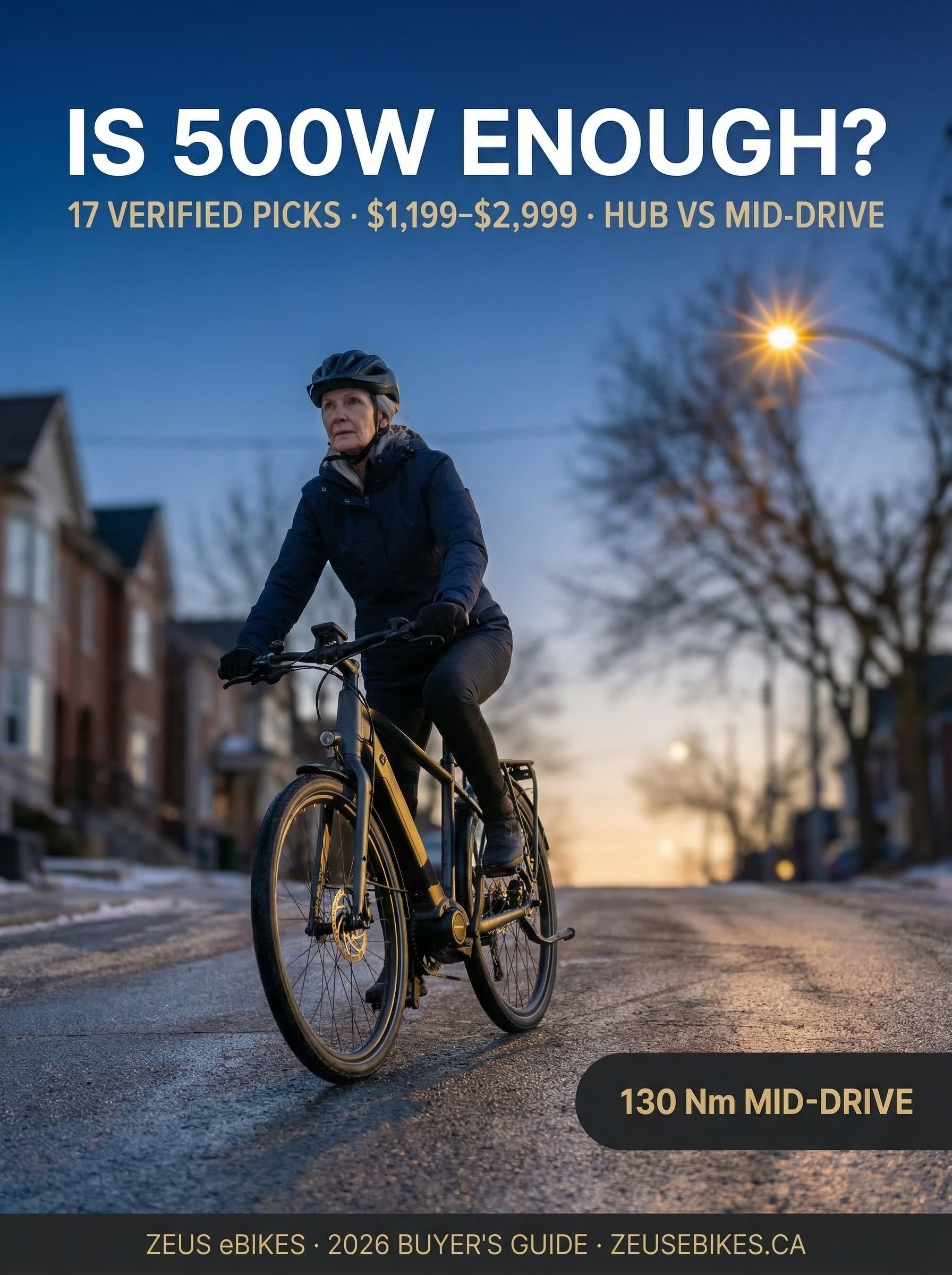
Best 500W Electric Bikes in Canada (2026): 17 Picks, Honest Limits & the Decision Explained

Is 500W enough? For flat commutes and moderate hills under 90 kg — yes, comfortably. For steep daily hills — only if you choose a mid-drive. Our top picks: Himiway A7 Pro ($2,999) for hills, Samebike XD26-II ($1,199) for budget, Freesky Nova B-360 ($2,373) for range. We started with 26 models and cut 9 that could not justify their price, had weak specs, or duplicated a better bike in the lineup.
Zeus stocks 26 bikes with 500W nominal motors. We tested spec claims against manufacturer data sheets, eliminated two sold-out models, cut three budget bikes whose only distinction was a low price paired with mechanical brakes and no compensating feature, removed four that were outclassed by a better bike at the same price. The 17 remaining bikes each win their category or offer something no other model in the lineup does. Torque, battery capacity, and weight are sourced from Zeus product pages. Winter range estimates use the 20–30% loss at 0°C benchmark from Bosch eBike Systems and Battery University data.
In This Guide
- Is 500W Actually Enough? (Honest Answer)
- Find Your 500W eBike in 30 Seconds
- Best Budget 500W eBikes ($1,199–$1,599)
- Best 500W Commuter eBikes
- Best 500W Folding & Compact eBikes
- Best 500W Fat Tire & Winter eBikes
- Best 500W Hardtail Mountain eBike
- Best 500W Mid-Drive eBikes (The Hill Slayers)
- Specialty: Delivery & Trike
- When 500W Falls Short — And What to Buy Instead
- Frequently Asked Questions
Is 500W Actually Enough? The Honest Answer
This is the question that brings most people to this page. And the answer is not a simple yes.
500W is enough for most Canadian riders in most conditions. A 500W hub motor producing 55–86 Nm of torque will carry a sub-90 kg rider at 32 km/h on flat ground, handle hills up to about 8% grade without losing meaningful speed, and deliver 60–128 km of range depending on battery size. That covers the vast majority of urban commutes, recreational rides, and errands in this country.
But here is where it gets interesting. Not all 500W motors are equal. A 500W hub motor and a 500W mid-drive motor are fundamentally different machines despite sharing a wattage number.
| 500W Hub Motor | 500W Mid-Drive Motor | |
|---|---|---|
| Torque | 55–86 Nm | 130 Nm |
| Hill Performance | Moderate hills (up to 8%) | Steep hills (12%+ grade) |
| Rider Weight Comfort Zone | Under 90 kg (200 lbs) | Up to 115 kg (250 lbs) |
| Price Range (this guide) | $1,199–$2,599 | $2,699–$2,999 |
| Maintenance | Low — motor is sealed | Higher — chain and gears wear faster |
| Pedal Feel | Motor pushes from rear | Motor amplifies your legs |
The takeaway: a 500W mid-drive with 130 Nm torque outclimbs most 750W hub motors on steep grades, because it uses your gears to multiply force at low speeds. If hills are your concern, the answer is not “buy more watts.” It is “buy a mid-drive.” Read our mid-drive vs hub motor deep dive for the full engineering comparison.
500W is enough for 80% of Canadian riders. Flat terrain? Any 500W hub motor works. Hills? Buy a 500W mid-drive ($2,699+), not a bigger hub motor. Over 115 kg on steep daily hills? Consider stepping up to 750W.
Find Your 500W eBike in 30 Seconds
Match your riding to a pick. No scrolling required.
| Your Situation | Best Pick | Price |
|---|---|---|
| Tightest budget possible | Samebike XD26-II | $1,199 |
| Flat commute, just works | Movin’ Tempo Max | $1,599 |
| Long commute (50+ km) | Eunorau Meta275 | $1,979 |
| Condo / apartment / transit | Eunorau Meta Foldable | $1,994 |
| Folding + hills (most torque) | Taubik Escape | $2,199 |
| Winter / snow / gravel | Eunorau FAT-AWD 3.0 | $2,390 |
| Maximum range, no anxiety | Freesky Nova B-360 | $2,373 |
| Trail riding / mountain bike | Taubik Westridge 29T | $2,899 |
| Hills in your commute | Himiway Zebra D5 Pro | $2,999 |
| Best overall, money is flexible | Himiway A7 Pro | $2,999 |
| Delivery / gig work | Movin’ Pulse | $1,999+ |
| Need three-wheel stability | Eunorau ONE-TRIKE 2.0 | $2,429 |
Not sure 500W is the right wattage for you?
Best Budget 500W eBikes ($1,199–$1,599)
You are spending your own money. You want to know: what is the least I can spend and still get a bike that does not embarrass me in six months? These three bikes answer that question. We cut five other budget models that had mechanical brakes, undersized batteries, or specs that a better bike at the same price already beat.
| XD26-II | RS-A02 Pro | Tempo Max | |
|---|---|---|---|
| Price | $1,199 | $1,299 | $1,599 |
| Battery | 720 Wh | 720 Wh | 960 Wh |
| Weight | 25.5 kg | 33 kg | 27.2 kg |
| Suspension | Full | Front (lockout) | Front (Suntour) |
| Brakes | Hydraulic 160mm | Mechanical disc | Hydraulic (Tektro) |
| Torque | 70 Nm | 80 Nm | — |
| Winter Range* | ~44–77 km | ~38–77 km | ~56–63 km |
*Winter range estimated at 0°C using 30% reduction from rated maximum (Bosch eBike Systems).
Samebike XD26-II
$1,199Full suspension and hydraulic disc brakes at $1,199. The XD26-II weighs 25.5 kg — lighter than folding eBikes costing $800 more — and delivers 70 Nm of torque through 26” wheels. Shimano 7-speed, colour display, 720 Wh battery handles a 30 km round-trip commute with room to spare. The lowest price point at which we can honestly say 500W justifies itself.
Honest limit: Cadence sensor. 160mm rotors are smaller than the 180mm standard — fine for city riding, less confidence on steep descents with cargo.
 Samebike XD26-II — Best Budget 500W
Samebike RS-A02 Pro
$1,299A folding 500W fat-tyre bike for $1,299. 20”×4.0” Kenda all-terrain fat tyres, 80 Nm torque (strongest in the budget tier), Shimano 7-speed, front suspension fork with lockout, colour LCD with USB charging, fenders, rear rack. Folds for condo storage or car trunks. Payload rated to 150 kg (330 lbs).
Honest limit: Mechanical disc brakes, not hydraulic. Cadence sensor. At 33 kg, “folding” helps storage but carrying up stairs is still a workout.
 Samebike RS-A02 Pro — Best Budget Fat Folder
Movin’ Tempo Max
$1,599The bike to hand a friend who says “I just want something that works.” Tektro hydraulic brakes, 26”×2.1” CST puncture-resistant tyres, Suntour adjustable fork, 30-lux LED headlight, USB charging port, rear rack. At 27.2 kg with battery, it is 6 kg lighter than the RS-A02 Pro with 33% more battery capacity (960 Wh vs 720 Wh). The 960 Wh battery matters most in Canadian winter — at 0°C you still have an estimated 56–63 km to work with.
Honest limit: Cadence sensor. The assist feels like an on/off switch rather than a tailwind. Adequate for flat terrain; riders coming from a torque-sensor bike will notice the difference.
 Movin’ Tempo Max — Best Value Daily Driver
Cheapest and lightest: XD26-II ($1,199, 25.5 kg). Best folding fat-tyre value: RS-A02 Pro ($1,299, 80 Nm, folds for storage). Best daily driver: Tempo Max ($1,599, lightest package with 960 Wh). If you plan to ride through Canadian winter, the 960 Wh battery on the Tempo Max gives you a meaningful cushion against cold-weather range loss.
Best 500W Commuter eBikes
A commuter eBike replaces your car. That means it needs to work every single day — in rain, on potholed roads, and over distances that make battery anxiety real. These two models earn the commuter label because they solve the two problems that kill daily ridership: range fear and ride quality.
Eunorau Meta275
$1,979Ships with a free secondary battery — 1,296 Wh total for under $2,000. At 0°C in Canadian winter, that still delivers an estimated 70–90 km. A torque sensor for natural pedal feel, 27.5”×2.6” tyres for rough roads, Shimano 9-speed drivetrain, and hydraulic brakes. If your daily commute is 30–50 km round-trip and you ride year-round, this is the rational choice.
Honest limit: 65 Nm torque is modest — hills above 8% grade will slow you. 31 kg — you will feel it lifting the bike.
 Eunorau Meta275 — Best Range Per Dollar
Soho 50
$2,199Designed in Canada with UL-certified Samsung 21700 cells — the same cell chemistry used in Tesla vehicles. At 29 kg it is the lightest commuter in this section. Classic 26”×2.2” proportions, Shimano 7-speed Altus, Zoom hydraulic brakes, rear rack and mudguards included. For riders who value simplicity and Canadian design, it delivers.
Honest limit: Cadence sensor. 720 Wh is tight in winter — budget 50–70 km at 0°C.
 Soho 50 — Canadian-Designed Urban
Long commute? Meta275 — the free second battery makes it the range king under $2,000. Want the lightest, cleanest ride? Soho 50 — 29 kg, Canadian-designed, UL-certified. If your commute includes hills, skip both and go to the mid-drive section.
Best 500W Folding & Compact eBikes
If you cannot park a full-size bike — condo rules, apartment stairs, transit, or RV storage — you need something that folds or fits where a standard frame will not. These two take different approaches: one folds flat with a torque sensor, the other uses compact 20″ wheels for small-space storage without a folding mechanism.
Eunorau Meta Foldable
$1,994The only folding 500W eBike in this guide with a torque sensor. That alone separates it from every budget folder — power adjusts based on how hard you pedal, delivering 10–20% better range and smoother acceleration than cadence-based systems (read our pedal assist vs throttle guide). 20”×3.0” Kenda tyres, hydraulic brakes, Shimano 7-speed. Add an optional second battery for 160 km total range.
Honest limit: 55 Nm is the lowest torque in this section. Steep hills will test your patience. At 28.8 kg, folding does not mean light enough to carry up stairs comfortably.
 Eunorau Meta Foldable — Best Torque-Sensor Folder
Taubik Monaco
$2,099Designed in Canada. UL-certified Samsung 21700 cells. 20”×3.0” Kenda Street tyres on compact wheels that handle tight urban storage — hallways, elevator corners, condo bike rooms. Zoom hydraulic dual-piston brakes with 180mm rotors, Shimano 8-speed, colour LCD display. Four colour options including Robin’s Egg. At $2,099, it undercuts the Meta Foldable by $100 while adding an extra gear and larger brake rotors.
Honest limit: 55 Nm. Cadence sensor. Does not fold — compact wheels make it storable but not packable for transit.
 Taubik Monaco — Compact Canadian Urban
Taubik Escape
$2,199Designed in Canada. 85 Nm torque — 30 Nm more than every other folder in this section. If you live on a hill and need a bike that folds, this is it. 20”×4.0” Kenda Krusade fat tyres handle snow, gravel, and broken pavement that 3.0” tyres struggle on. Zoom hydraulic brakes 180mm, Shimano Altus 7-speed, UL-certified Samsung cells, thumb throttle. The Bafang peaks at 1,000W — strong enough for steep residential hills.
Honest limit: Cadence sensor. At 30.3 kg, carrying up stairs is still a workout. 720 Wh is tight in winter.
 Taubik Escape — Folding Fat Tire Hill Slayer
Torque sensor + true folding: Meta Foldable ($1,994). Canadian design + compact 20″ wheels: Taubik Monaco ($2,099). Hills + fat tyres + folding: Taubik Escape ($2,199) — 85 Nm torque makes it the strongest folder here by a wide margin. None are light enough to carry easily — that is the trade-off of a 500W compact eBike with a real battery.
Best 500W Fat Tire & Winter eBikes
Canadian winters do not care about your warranty. They care about tyre width, battery insulation, and whether your brakes work when the temperature drops to −15°C. These four bikes earn the winter label because they combine fat tyres (3.0″–4.0″) with batteries large enough to absorb cold-weather range loss and still complete a useful ride.
Eunorau Defender
$2,169Full suspension: Zoom 100mm front fork + EXA rear shock (165mm travel) — rear travel unusual at this price. 27.5”×3.0” Chaoyang tyres, app connectivity, 40-lux LED headlight, hydraulic brakes. The optional 17Ah Samsung second battery pushes total capacity to 1,536 Wh. Read the Eunorau Defender long-term review for 2-year reliability data.
Honest limit: 60 Nm — trail cruiser, not trail climber. Fine on rolling terrain. Underpowered on sustained steep grades.
 Eunorau Defender — Full Suspension Trail Cruiser
Riding year-round in Canada? Winter range is what separates good eBikes from great ones.
The picks below carry 1,296–1,536 Wh — enough to handle -10°C mornings without anxiety. See our best winter eBikes guide for the full cold-weather breakdown.
Shop All-Season eBikes →Eunorau FAT-AWD 3.0
$2,390Two 500W hub motors. Front and rear drive. Genuine all-wheel traction for snow, sand, mud, and loose gravel — terrain single-motor bikes slip on. Torque sensor, 26”×4.0” Kenda Krusade fat tyres, hydraulic 180mm brakes, Shimano 7-speed, step-thru frame. Add the optional second 15Ah LG battery for 1,440 Wh total — enough for a full Canadian winter day without mid-ride charging.
Honest limit: 36 kg. AWD draws battery 30–40% faster than rear-only mode. Budget for the second battery to unlock real potential.
 Eunorau FAT-AWD 3.0 — Dual Motor All-Wheel Drive
Freesky Nova B-360
$2,3731,440 Wh. More battery than most 1,000W dual-motor eBikes carry. If battery anxiety is the single thing preventing you from buying an eBike, this removes it. Torque sensor, step-thru frame, 27.5”×2.2” tyres, hydraulic brakes, 400 lb payload. At 0°C in January, an estimated 84–135 km means most riders are not worrying about charging mid-day.
Honest limit: 55 Nm is the weakest torque in the fat-tyre section. Hills will humble this bike. 27.5”×2.2” are not true fat tyres — handles light gravel but will not float on deep snow like 4.0” Kenda. This is a range machine, not a terrain machine.
 Freesky Nova B-360 — Maximum Range
Taubik Westridge 4T
$2,599Designed in Canada. RST air forks — tuneable to your weight and terrain, a genuine upgrade over the coil forks on every other hub-motor pick in this guide. Torque sensor, 26”×4.0” Kenda Juggernaut Pro fat tyres, Shimano 8-speed, UL-certified Samsung cells. For riders who want the closest thing to a trail bike that a 500W hub motor can deliver. Also a strong option for hunting and backcountry access.
Honest limit: 720 Wh is tight for winter trail rides longer than 50 km. No second-battery option. At $2,599, you are $400 from the Himiway Zebra D5 Pro mid-drive — which has 130 Nm torque and 960 Wh. If hills are your primary concern, that extra $400 buys a fundamentally different class of motor.
 Taubik Westridge 4T — Canadian Off-Road Pick
Winter range matters. The Freesky Nova B-360 (1,440 Wh) survives Canadian cold better than any single-motor bike here. The Eunorau FAT-AWD 3.0 with dual battery (1,440 Wh, AWD traction) is the best all-conditions winter workhorse. The Taubik Westridge 4T is the fat-tyre trail pick. For actual trail riding with 29″ wheels and a torque sensor, see the Westridge 29T in the next section.
All 17 bikes ship across Canada — financing available
7 ways to finance an eBike in Canada → | Browse the full Zeus collection →
Best 500W Hardtail Mountain eBike
Every other 500W bike in this guide uses 20″–27.5″ wheels. If you ride actual trails — packed dirt, gravel fire roads, cross-country single-track — you need 29″ wheels rolling over roots and rocks instead of bouncing off them. One bike in the Canadian 500W market does this properly.
Taubik Westridge 29T
$2,899Designed in Canada. A proper 29er hardtail: Mozo coil suspension fork, Shimano Acera 8-speed drivetrain, Zoom hydraulic dual-piston brakes with 180mm rotors, 29”×2.4” Kenda Booster Pro trail tyres. Torque sensor reads how hard you push and delivers proportional assist — making technical climbs feel natural. At 29.7 kg, the lightest pick above the budget tier. Class 1/2/3 modes, colour LCD, UL-certified Samsung cells. 90 Nm on 29” wheels rolls over trail obstacles that 26” fat tyres catch on.
Honest limit: Hardtail only — no rear suspension for big drops. 720 Wh with no dual-battery option: budget 50–70 km in cold weather.
 Taubik Westridge 29T — Best 500W Hardtail
If you ride trails, not roads, the Westridge 29T is the pick. It is the only 500W hardtail 29er in the Zeus catalogue — torque sensor, proper mountain geometry, Kenda trail tyres, and the lightest weight in its price range. For riders who want a mountain bike that happens to be electric, not an eBike that happens to have knobbly tyres.
Best 500W Mid-Drive eBikes (The Hill Slayers)
If you have read this far wondering “but will 500W handle my hills?” — this is the section that answers it. A mid-drive motor sits at the cranks and uses your gears to multiply torque. At 130 Nm, these two bikes produce more climbing force than a 750W hub motor at 80 Nm. That is not marketing. That is physics.
Himiway Zebra D5 Pro
$2,999130 Nm + 960 Wh for $2,999. The D5 Pro pairs a mid-drive with 26”×4.0” Kenda fat tyres — the combination that makes 500W outclimb most 750W hub motors. TRAMA FAT34-PLS front fork with 100mm travel and 15×135mm thru-axle, Tektro 180mm hydraulic brakes, Shimano 7-speed, KD718-P LCD with USB-C charging, 400 lb payload. Excellent for senior riders on gravel, snow, or unpaved paths.
Honest limit: Mid-drives wear chains and cassettes faster than hub motors — budget $50–80/year in drivetrain maintenance. Hardtail only. At 35.8 kg with fat tyres, not a nimble city bike.
 Himiway Zebra D5 Pro — Mid-Drive Fat Terrain King
Himiway A7 Pro
$2,999This is where the money goes. Full suspension: SR Suntour 120mm front fork, DNM rear shock, 100mm dropper seatpost. ANANDA M100 mid-drive with 130 Nm torque. Four sensors (torque, shifting, speed, brake) creating the most seamless assist of any 500W bike we have tested. Schwalbe Super Moto-X 27.5”×2.4” tyres, Shimano 9-speed, electronic rear wheel lock, anti-theft alarm, U-lock included. Zeus rates it 9.2/10. Read the Himiway A7 Pro 2-year review.
Honest limit: 720 Wh — the smallest battery in the mid-drive section. Winter range ~39–56 km limits all-day cold-weather adventures. If you need 80+ km in winter, the D5 Pro’s 960 Wh is the better choice.
 Himiway A7 Pro — Best Overall 500W eBike
Choose the Zebra D5 Pro ($2,999) if: you ride on gravel, snow, or unpaved surfaces. Fat 26″ × 4.0″ tyres, 960 Wh battery, 400 lb payload, and thru-axle fork make it the all-terrain mid-drive.
Choose the A7 Pro ($2,999) if: you want the best ride quality (full suspension, 9-speed, 4 sensors), ride year-round on paved and mixed surfaces, and can charge daily.
Same price. Same 130 Nm torque. Same Samsung/LG cells. The D5 Pro buys terrain capability (fat tyres + bigger battery). The A7 Pro buys ride refinement (full suspension + 4 sensors + 9-speed).
A 500W mid-drive is the best-kept secret in Canadian eBiking. It outclimbs 750W hub motors at a lower price, and you do not need to step outside the 500W class to solve your hill problem. Zebra D5 Pro for fat-tyre terrain and maximum range. A7 Pro for the best ride quality money can buy at 500W.
Specialty: Delivery & Trike
Two picks for riders whose problem a standard eBike cannot solve. The Movin’ Pulse exists because gig couriers cannot stop to charge mid-shift — so it carries three battery slots and a 50 kg rack. The ONE-TRIKE exists because balance anxiety is a real barrier that costs real people their independence — and a rear differential solves it where a two-wheel bike cannot.
Movin’ Pulse
From $1,999Three battery slots. That is the pitch. Built for gig couriers who cannot stop and charge mid-shift. Tektro 180mm hydraulic brakes stop under load, RST Guide fork with lockout, 20” fat tyres handle urban potholes and rain gutters. Price varies by battery configuration. Full coverage in our best delivery eBikes guide.
Honest limit: No torque spec available. Cadence sensor. Purpose-built cargo tool, not a performance bike.
 Movin’ Pulse — Built for Delivery Work
Eunorau ONE-TRIKE 2.0
$2,429Built for riders who need balance support — seniors, those recovering from injury, or anyone who does not feel safe on two wheels. Key feature: rear differential lets the two rear wheels spin at different speeds during turns, dramatically improving cornering stability over fixed-axle trikes. Hydraulic 180mm brakes, comfort saddle with backrest, front and rear cargo baskets, folding stem. 5-level pedal assist with half-twist throttle. 440 lb payload — the highest in this guide. More trike options: electric trikes Canada guide.
Honest limit: Single-speed only — no gears for steep hills. Cadence sensor. 39 kg is heavy. 20”×2.6” tyres are not fat tyres — adequate for pavement, not deep snow.
 Eunorau ONE-TRIKE 2.0 — Three-Wheel Stability
Delivery riders: Movin’ Pulse — three battery slots (up to 3,120 Wh), 50 kg rear rack, RST fork, 180mm hydraulic brakes. Built to run a full courier shift without a charging break. Balance-challenged riders: ONE-TRIKE 2.0 — rear differential, 440 lb payload, front and rear baskets. The only 500W pick in this guide engineered from the ground up for stability over speed. If your problem is storage or cargo, the Pulse. If your problem is confidence on two wheels, the trike.
When 500W Falls Short — And What to Buy Instead
We would be dishonest if we told you 500W is always enough. It is not. Here is when to step up:
- You weigh 115+ kg and face steep daily hills (10%+ grade). Even a 500W mid-drive with 130 Nm will labour. A 750W mid-drive at 160 Nm handles this with margin.
- You carry heavy cargo regularly (50+ kg on top of your body weight). The combined load pushes a 500W hub motor past its comfortable operating range on anything but flat ground.
- You ride serious off-road trails — roots, rocks, steep single-track. The Taubik Westridge 29T (90 Nm, torque sensor, 29″ wheels) handles moderate cross-country trails well at 500W. But aggressive single-track with big drops and sustained steep climbing demands burst power that a 1,000W mid-drive (160 Nm) delivers more confidently.
- You want consistent 40+ km/h speeds. 500W motors are capped at 32 km/h assisted. Higher speeds require higher wattage and are off-road only.
What to read next:
- 500W vs 750W vs 1000W — the complete wattage comparison
- Best eBikes for heavy riders in Canada
- Best eBikes for hills in Canada
500W covers 80% of Canadian riders. The other 20% know who they are. If you read the list above and thought “that is me,” check our wattage comparison guide before buying. Spending $200 more on the right wattage is cheaper than regretting the wrong one.
- 500W vs 750W vs 1000W eBike Canada — the wattage decision explained
- Best 1000W eBikes Canada (2026): 11 Verified Picks — if 500W isn’t enough, here’s what to look at
- Mid-Drive vs Hub Motor — the engineering comparison
- Long Range eBikes Canada — 10 best by battery size
- Best Folding eBikes Canada — every foldable in the lineup
- Best eBikes Under $2,000 — 12 picks across all wattages
- Best eBike Deals Canada (2026) — current savings
Frequently Asked Questions
Is a 500W electric bike enough for hills?
It depends on the motor type. A 500W hub motor (55–86 Nm) handles moderate hills up to 8% grade for riders under 90 kg. A 500W mid-drive motor (130 Nm) is fundamentally different — it uses your gears to multiply torque and climbs grades that make 750W hub motors struggle. If hills are in your daily commute, buy a mid-drive, not more watts.
How fast does a 500W eBike go?
Most 500W eBikes are capped at 32 km/h in pedal assist. Both hub and mid-drive reach this on flat ground. The gap appears on hills: a 500W hub slows to 15–20 km/h on a 10% grade, while a 500W mid-drive with 130 Nm maintains 25+ km/h on the same incline.
Is 500W enough for a heavy rider over 200 lbs?
On flat terrain, 500W works for riders up to 115 kg (250 lbs). On hilly terrain above 90 kg, choose a 500W mid-drive (130 Nm) — the gear multiplication outperforms a 750W hub motor. Several models in this guide support 170–200 kg (375–440 lb) payloads: the Eunorau FAT-AWD 3.0 (375 lbs), Himiway Zebra D5 Pro (400 lbs), and Eunorau ONE-TRIKE 2.0 (440 lbs). If you weigh over 115 kg and face steep daily hills, our heavy riders guide covers 750W+ options.
How far can a 500W eBike go in Canadian winter?
Lithium-ion batteries lose 20–30% capacity at 0°C and up to 50% at −18°C (Bosch eBike Systems, Battery University). A 720 Wh battery rated for 100 km in summer delivers roughly 50–70 km at 0°C. Dual-battery models like the Freesky Nova B-360 (1,440 Wh) and Eunorau Meta275 (1,296 Wh) deliver 84–130+ km even in winter. Store the battery indoors overnight and install it just before riding to minimise cold-start losses.
500W hub motor vs 500W mid-drive — which should I buy?
Hub motor: simpler, quieter, cheaper ($1,199–$2,599), less maintenance. Best for flat terrain and budget-conscious riders. Mid-drive: uses gears to multiply torque, far stronger on hills (130 Nm vs 55–86 Nm), more natural pedal feel, but costs $2,999 in this guide and wears drivetrain components faster. Flat commute = hub. Hills = mid-drive. The full comparison: mid-drive vs hub motor guide.
What is the difference between 500W nominal and peak watts?
Nominal watts is continuous power during normal riding. Peak watts is a short burst under heavy load (hill starts, acceleration). A 500W nominal motor may peak at 750W to 1,000W. For real-world capability, torque (Nm) matters more than either wattage number — a 500W mid-drive with 130 Nm outclimbs a 750W hub motor with 80 Nm.
Do I need a torque sensor on a 500W eBike?
A torque sensor adjusts power based on how hard you pedal — it feels like a tailwind. A cadence sensor detects that you are pedalling and applies fixed power — it feels like an on/off switch. Torque sensors deliver 10–20% better range and smoother acceleration. Budget models under $1,500 use cadence sensors. From $1,979+, torque sensors become available. If you have ridden a regular bicycle and want that same natural feel with electric assist, a torque sensor is worth the premium.
The Bottom Line
500W is not a compromise. It is the wattage tier where you get the widest selection, the lowest prices, and — if you choose a mid-drive — more hill-climbing torque than most 750W bikes deliver. The trick is knowing which 500W bike fits your riding.
Three picks that summarise the whole guide:
- Tight budget, flat commute: Movin’ Tempo Max ($1,599) — 960 Wh, 27.2 kg, does exactly what you need
- Hills in the picture: Himiway Zebra D5 Pro ($2,999) — 130 Nm mid-drive, 960 Wh battery, fat-tyre terrain capability
- Money is flexible, want the best: Himiway A7 Pro ($2,999) — full suspension, 4 sensors, 130 Nm, 9.2/10 rating
Every bike in this guide is in stock and ships across Canada
Financing available — 7 ways to finance an eBike in Canada
Browse All 500W eBikes → Mid-Drive Collection →📸 All photography by Playcut.ai — personalised AI actor technology
Share:
eBike Insurance Canada (2026): Do You Need It? Real Costs & 3 Options
eBike vs Regular Bike Canada (2026): 4 Non-Fat-Tire Picks, Real Exercise Data & Honest Math